
If a firm produces two or more products jointly, then the pricing of these different products is the joint product pricing. Under the joint pricing, it is difficult to find the cost of the individual product because they are produced jointly and share the cost.
So, we consider the total cost when determining the price, since different products have different demand and marginal revenue.
So, we find the firm’s total marginal revenue as the vertical sum of the MRs of each product. It is assumed that the firm is a profit maximizer and tries to maximize the profit from these multiple products jointly.
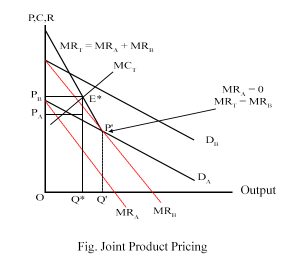
In order to explain the joint product pricing, assume that the firm produces two products, A and B, jointly in equal proportion.
i.e. A: B = 1:1
MRt = MRa + MRb
- At Q’ = MAa = 0, then MRt = MRb
- At less than Q’ = MRa > 0, MRb >0 MRt = MRa + MRb
- At more than Q’, MRa <0 and the firm does not supply A more than Q’ then MRt = MRb.
Here, DB and MRA are the demand and marginal revenue of product A, respectively. Similarly, DB nd MRB are the demand and MR of product B.
- MRT is the total/aggregate MR of the firm derived by vertical summation of MRA and MRB.
- MCT is the aggregate MC of producing A and B together.
- If the firm produces Q’ amount, then MRA = 0, and if it produces more than Q’, MRA <0 (-ve), but the rational firm does not supply the product if its MR is (-ve) MR < 0 (-ve).
So, in this case, the firm does not supply any quantity of A more than Q’. Then, for the output more than Q’, the firm receives MR from B only. But for the output less than Q’, the firm receives MR from A and B both.
So, MRT is kinked outward at Q’ level of output.
Both conditions of profit maximization are satisfied at E*, and so the firm produces OQ* quantity of each A and B. Then the firm charges PA price for A and PB price for B for the profit-maximizing output OQ* of each product.
Other posts