Consumption decisions in the short run are more or less rigid or less elastic because, in the short run, the factors affecting consumption are given and do not change immediately.
For example, in the short run, the taste and preference of the consumer remain the same.
The income of the consumer is also more or less similar. The other products competing with the given product are also the same. It means the innovation and arrival of the product takes time.
Since all such determinants of consumption remain rigid, the short-run consumption is less elastic or less flexible. This makes the short-run consumption less elastic or less flexible. This makes the short-run demand curve relatively inelastic or steeper.
But in the long run, the taste and preference of the consumer change. The other determinants of consumption, such as income of the consumer, availability of substitutes, and government policy, among many other things, change over the period.
This makes long-run consumption more flexible or elastic. So, the long-run demand curve is flatter or more elastic than the short-run.
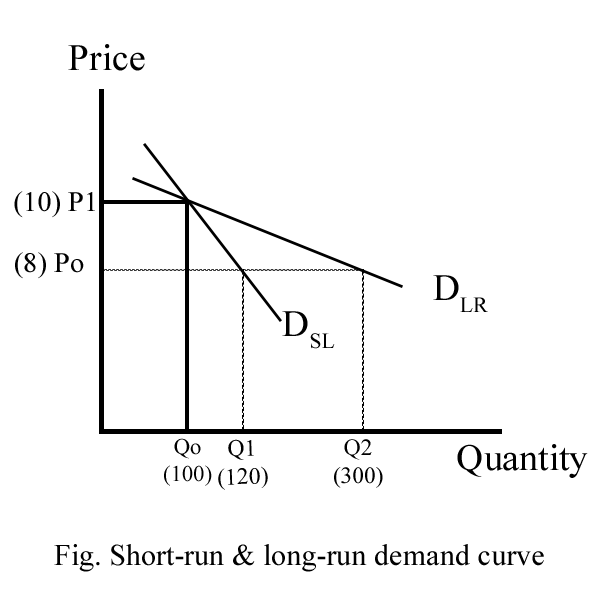
Here, DSL is the short-run demand curve, which is steeper than the long-run curve DLR.
This shows that in the short run, when the price falls from Po to p1, the quantity demanded increases from Q0 to Q1, but in the long run, the quantity demanded increases from Qo to Q2 at the same fall in price.
This implies that in the short run, though the price of the products declines, other determinants of consumption are more or less the same, but in the long run, the other factors affecting consumption are also changing, which increases demand in the long run.