
| Fixed Exchange Rate | Flexible Exchange Rate | |
|---|---|---|
| Monetary Policy | Less effective | More Effective |
| Fiscal Policy | More Effective | Less effective |
The effectiveness of fiscal and monetary policy depends upon the exchange rate system of the economy. If the exchange rate system is fixed, then monetary policy is ineffective; however, for a flexible exchange rate system, monetary policy is more effective than fiscal policy.
i) Fixed Exchange Rate System and Monetary Policy
If the country has adopted a fixed exchange rate system, the monetary policy has less space to promote employment and growth. In such a system, the central bank is given the authority to maintain the fixed rate, which is the primary issue of the central bank. Therefore, if the central bank changes the money supply, it also changes the exchange rate, which is not permitted in a fixed exchange rate system.
 Here,
Here,
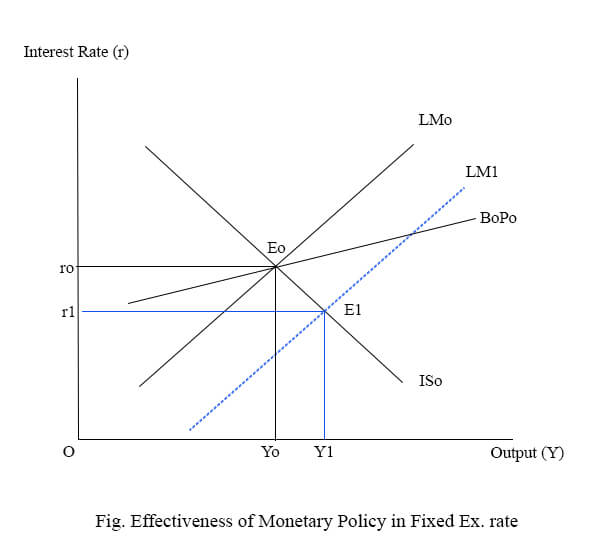
- Initially, both the domestic and external sectors of the economy are in equilibrium at E0 with r0 interest rate and OY0 output.
- Assume that the central bank uses an expansionary monetary policy which shifts the LM curve rightward from LMo to LM1, and the economy attains internal equilibrium at E1 with a lower interest rate r1 and higher output OY1.
- Since this internal equilibrium E1 is below the BoP curve, it represents the BoP deficit. This deficit of BoP depreciates the value of domestic currency, but it is the fixed exchange rate system, and so the central bank has to supply forex to the market by absorbing the domestic currency in such a way that the LM curve shifts leftward from LM1 to LM0. Then, both the internal and external sectors are in equilibrium at E0, which keeps the exchange rate fixed. Therefore, in the Fixed Exchange Rate system, the independent monetary policy is not effective in promoting growth and employment due to the obligation of maintaining the fixed exchange rate.
ii) Fixed Exchange Rate System and Fiscal Policy
Under the fixed exchange rate system, fiscal policy is more effective in promoting growth and employment. When the government uses expansionary monetary fiscal policy, the central bank also adjusts the monetary policy to maintain the fixed exchange rate. This helps to promote growth and employment in the economy.
Here,
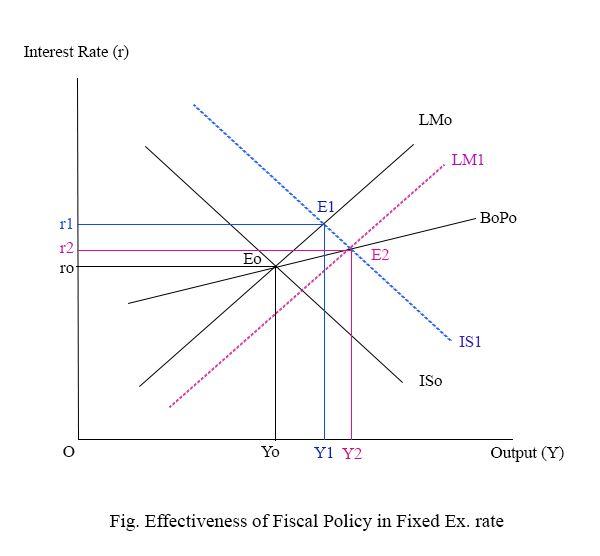
- Initially, both the internal and external sectors are in equilibrium at E0 with r0 interest rate and OY0 output. Now, assume that the government uses an expansionary fiscal policy, which shifts the IS curve rightward from ISo to IS1, and the internal equilibrium of the economy is at E1 with r1 interest rate and OY1 output. This internal equilibrium E1 is above the BoP curve representing the BoP surplus. Such surplus is BoP appreciation, but it is the fixed exchange rate system.
- So, the central bank absorbs the excess forex from the market by supplying domestic currency in such a way that the LM curve shifts rightward from LM0 to LM1.
- Then both the internal and external sectors are in equilibrium at E2 with r2 interest rate and OY2 output.
- This shows that the expansionary fiscal policy is more effective in promoting growth and employment, which is supported by monetary policy to maintain the fixed exchange rate.
iii) Flexible Exchange Rate System and Monetary Policy
The monetary policy is relatively more effective under the flexible exchange rate system. In such a system, the market itself adjusts the exchange rate and supports growth and employment.
 Here,
Here,
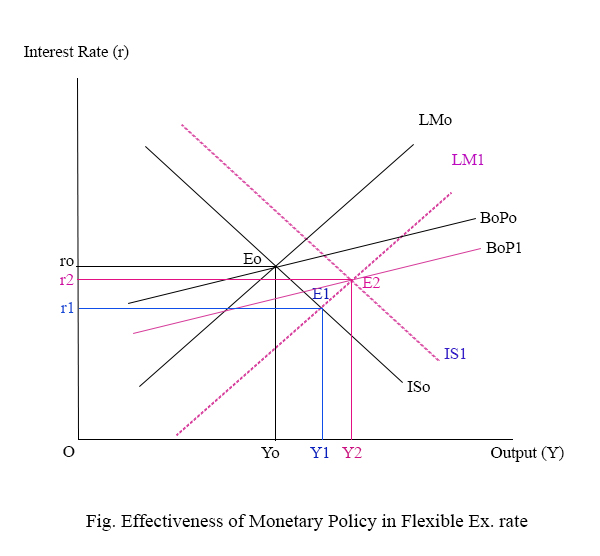
- The economy is initially in equilibrium in both the internal and external sectors at E0 with r0 interest rate and OY0 output.
- Now, assume that the central bank increases the money supply, which shifts the LM curve rightward from LMo to LM1, and the economy attains internal equilibrium at E1 with r1 interest rate and OY1 output.
- Since this internal equilibrium point E1 is belowthe BoP curve, it represents a BoP deficit, and such a deficit in BoP depreciates the value of the domestic currency. So, net export increases due to imports being relatively expensive and export are relatively cheaper.
- Such an increase in net exports shifts the IS curve and BoP curve rightward gradually until they meet in E2 equilibrium with r2 interest rate and OY2 output.
- This shows that the expansionary Monetary Policy is effective in promoting growth and employment under the flexible exchange rate system.
iv) Flexible Exchange Rate System and Fiscal Policy
Under the flexible exchange rate system, fiscal policy is relatively less effective in promoting growth and employment.

Here,
- The economy is initially in equilibrium at Eo with r0 interest rate and OY0 output, at which both the internal and external sectors are in equilibrium.
- Assume that the government increases expenditure and so the IS curve shifts rightward from IS0 to IS1, and the economy attains internal equilibrium at E1 with a higher interest rate r1 and OY1 output.
- This internal equilibrium point E1 is above the BoP curve, implying a BoP surplus. This surplus is a BoP appreciates the value of the domestic currency and reduces net export. So, both IS and BoP curves shift inward gradually until they shift to IS` and BoP’ such that they intersect with the LM curve at E’ with a lower interest rate r’ and OY’ output.
- This shows that in the flexible exchange rate system, fiscal policy is less effective because the output, once increased due to expansionary fiscal policy, declines again because of the exchange rate adjustment.