- Proposed by or based on George Stigler (in 1939)
The traditional theory of cost was criticized both theoretically and empirically by the modern theory, which argues that the average cost, both in the short run and the long run, does not have a U shape. According to the modern theory, the short-run average variable cost (SAVC) has a saucer-type shape, and LAC has roughly an L shape.
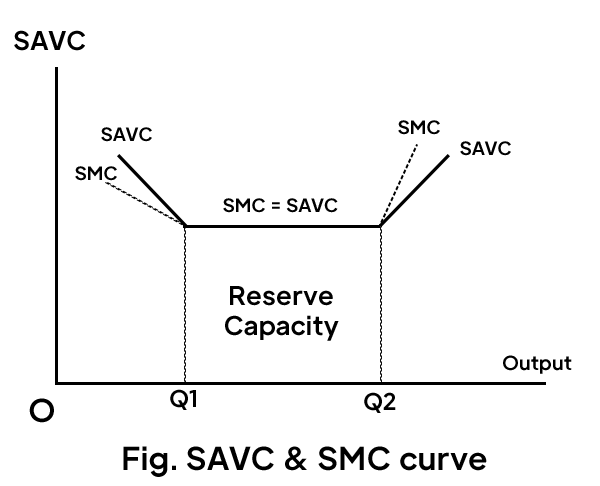
The SAVC curve has a saucer-type shape because the firm has intentionally maintained the reserve capacity. It means, in the normal period, the firm does not operate at its full capacity; there is some reserve capacity of the firm, which is maintained due to the following reasons.
- To maintain a smooth supply of the product, if some part of the machinery breaks down.
- To meet the seasonal growth of demand, consider whether there is a seasonal pattern in demand.
- To meet the expected growth of demand in the near future.
- Some technology is reserved by its nature.
- Some human resource generally at the top management in reserve to deal with any new issues if occurs.
- Land and buildings are generally in reserve capacity because of unavailability at any time.
- Due to these reasons, the modern firm has maintained the reserve capacity, and so long as the firm is in reserve capacity, the SAVC remains the same. So, initially, the SAVC curve declines due to better utilization of the resources, within the reserve capacity, it is constant, and once the reserve capacity is over, the SAVC increases. This makes the SAVC curve a saucer-type shape.

Here,
Initially, SAVC declines up to the Q1 level of output. Within Q1 to Q2, SAVC is constant due to the reserve capacity, then after Q2, SAVC increases. It means that due to the reserve capacity of the firm, the SAVC curve has a flat stretch over the range of output representing output capacity.
Similarly, the SMC curve also has also saucer type shape where SMC is below SAVC before the reserve capacity, within the reserve capacity, SAVC and SMC are equal, and after the reserve capacity, SMC is increasing and higher than SAVC.
LAC and LMC curve
The modern theory argues that, in the long run, production and managerial costs are cost-efficient because per-unit production costs continuously decline due to technological advances. The per unit managerial cost initially declines due to improved management efficiency, but at large production scales, the per unit managerial cost may increase; however, the increasing rate of the managerial cost cannot exceed the falling rate of production cost. So, the LAC curve in the long run is continuously declining and has a roughly L shape. Similarly, in extreme cases, the falling rate of per unit production cost and rising rate of the managerial cost may be equal at a large scale of production, then the LAC remains constant at such a large scale.
When the LAC curve is falling continuously, the LMC curve is also declining and below the LAC curve. If LAC is constant at a large scale of production, the LAC and LMC are equal.

Here, in fig 1, LAC is falling throughout, and LMC is also falling and below LAC. It implies that though per unit managerial cost increases, it is below the falling rate of production cost.
In fig 2, when LAC is falling, LMC is also falling and below the LAC curve. After Q* level of output, LAC is constant, and LMC is also constant and equal to LAC.
i.e. LAC = LMC
Implications/Uses of Cost Curve
- To know the relationship between the specific output and its corresponding cost, as well as to assess how the cost changes due to a change in the level of output.
- To decide the production level and supply capacity of the firm,
- To determine the appropriate pricing and output strategy for the firm.
- To make an appropriate cost-cutting strategy for the firm through the adoption of appropriate technology.
- To formulate an appropriate government policy of taxation or subsidy.