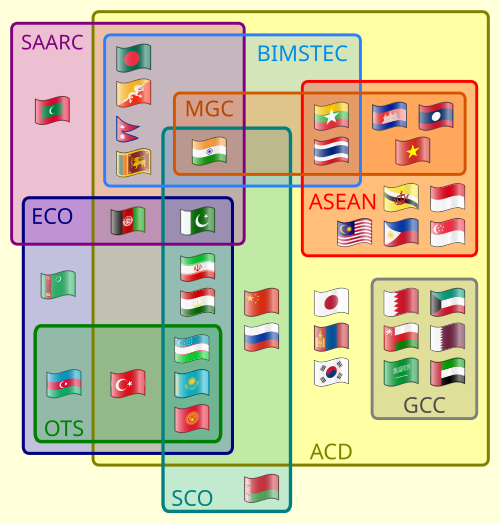
South Asian Association for Regional Cooperation (SAARC) was established on December 8, 1885, with seven founding members: Bangladesh, Bhutan, India, Maldives, Nepal, Pakistan, and Sri Lanka. Afghanistan joined SAARC in 2007, and there are 8 members of SAARC at present.
As per the SAARC charter, it was established to promote peace, stability & progress in the region following the principle of the UN Charter & with the principle of Non-alignment, including national sovereignty, territorial integrity & peaceful dispute settlement.
The objectives of SAARC:
(i) To promote the welfare of the people in this region.
(ii) To accelerate the economic growth, social progress, and cultural development in the region.
(iii) To promote & strengthen collective self-reliance among the countries.
(iv) To contribute to mutual trust, understanding, and appreciation of one another’s problems.
(v) To promote active collaboration & mutual assistance in the economic, social, cultural, technical & scientific fields.
(vi) To strengthen cooperation with other developing countries.
(vii) To strengthen cooperation among themselves in the international forums in the matter of common interest.
(viii) To cooperate with international and regional organizations with the similar aims & purposes.
Structure & Working of SAARC
SAARC works under three basic principles such as:
(a) Principle of sovereign equality, territorial integrity, political independence, non-interference in the internal affairs of others.
(b) Not be a substitute for bilateral & multilateral cooperation but complement them.
(c) Not be inconsistent with bilateral and multilateral obligation.
Structure of SAARC
Based on these basic principles, SAARC has specific structure and working modality such as:
(i) Heads of the State or Government – which is the highest body of SAARC comprising all the heads of the country or government of the member states. It provides overall direction to the SAARC and meets once in a year or more if needed.
(ii) Council of Ministers – It consists of all the ministers related to foreign affairs which formulates the policy of the SAARC. It reviews progress in cooperation and also decides on new area of cooperation. It means twice a year and more if necessary.
(iii) Standing Committee: It comprises the foreign secretaries. It monitors and co-ordinates the cooperation programs. It approves the projects, programs and financing modalities as well as determines the inter sectoral priorities. It meets as necessary and reports to the council of ministers.
(iv) Technical Committee: It comprises sectoral representatives from each member countries. It prepares sectoral projects, implement & coordinate and monitors them. It can use experts, meeting, agency consultation and research center. Its chairmanship rotates alphabetically every two years and it meets as necessary and report to the standing committee.
(v) Action Committee: These committees are set up by standing committee and handle the projects involving more than two member countries.
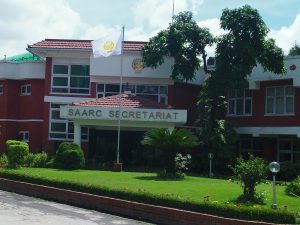
(vi) Secretariat: Its secretariat is in Kathmandu established in 1987 which provides administrative and coordination support to SAARC.
(vii) Financial Arrangement: Member countries contribute voluntarily. The technical committee recommends cost sharing for specific programs & projects. If internal resources are insufficient, then external financing can be used with the approval from the standing committee.
(viii) Decision Making: All decisions are taken by unanimity (consensus) & the bilateral issues are excluded deliberately.