
Price descrimination as the different price charged by the seller (firm) to different buyers. It is an activity by a firm with at least some monopoly power to charge different prices to different buyers in terms of the individual unit, bulk purchase, or in different markets. So, price discrimination refers to the different price to the different buyers, different volumes of purchase, and different markets.
A.C. Pigou classified price discrimination into
- First Degree of Price Discrimination
- Second Degree of Price Discrimination
- Third Degree of Price Discrimination
1. First degree of price discrimination
In this type of price discrimination, each unit of the product is charged a different price by the firm (sellers), where the price is determined by bargaining between the buyer and seller. The bargaining goes to the level of take it or leave it in order to extract the whole consumer surplus.
This bargaining helps assess the buyer’s willingness to pay, and the firm (sellers) charges a price equal to the buyer’s maximum willingness to pay, so there is no consumer surplus in this type of price discrimination.
Bargaining depends on
- Product type
- Scenario
- Urgency
- Individual bargaining power
- Information
- Place
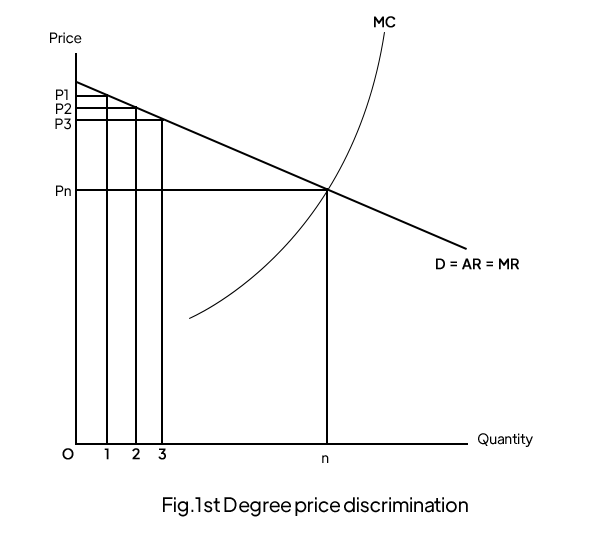
Here, each unit of the product has a different price, and so the marginal and average revenue are the same. The price of 1st, 2nd, and 3rd….. nth unit are respectively P1, P2, P3 …..Pn, which are determined through bargaining. The minimum possible price equals the product’s marginal cost.
Since the price of each unit is equal to the maximum willingness to pay of the buyers, there is no consumer surplus.
2. Second degree of price discrimination
In this type of price discrimination, different prices are charged for different volumes of the product. The price is set based on the bank or the volume of the purchases. Since the price is not for the individual unit but for the specific bulk or volume, there is some consumer surplus in second-degree price discrimination.
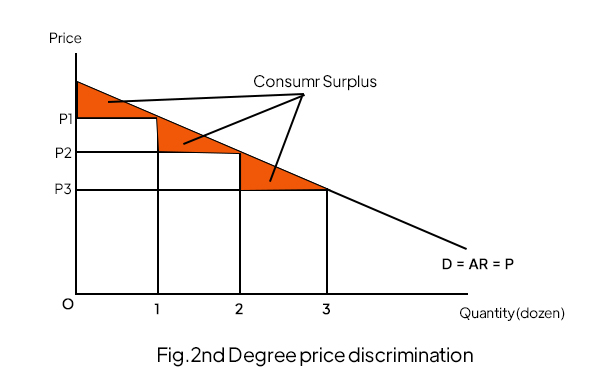
Here, the price is set by the seller for each dozen of the product, where the prices for the first, second, and third dozen are P1, P2, and P3, respectively. Since the price is set for 12 units, there is some consumer surplus. Which is shown in the shaded (Orange Colour) in the figure.
3. Third degree of price discrimination
In this type of price discrimination, the firm or seller charges a different price in different markets for the same product. The cost of the product may not be slightly different in different markets, but not as different as in price. This type of discrimination can be applied if the firm has some degree of monopoly power and the market can be differentiated in terms of the price elasticity of demand, where no reselling is economically viable, buying from the cheaper market and selling it to the higher price market.
In this price discrimination, the firm is assumed to have information about demand in each market, and then by horizontal summation of the demand of each market, the firm estimates its total demand. Similarly, the total MR of the firm is estimated through horizontal summation of MR from each market. The firm has the information about its own cost. Then, using the marginalistic principle, profit maximisation, it determines the profit-maximising output and allocates this output into the different markets in such a way that the MR of each market equals the MC and the MR of the firm at equilibrium.
In order to explain this, assume that the firm is monopolistic, which sells its product in two different markets, A and B.
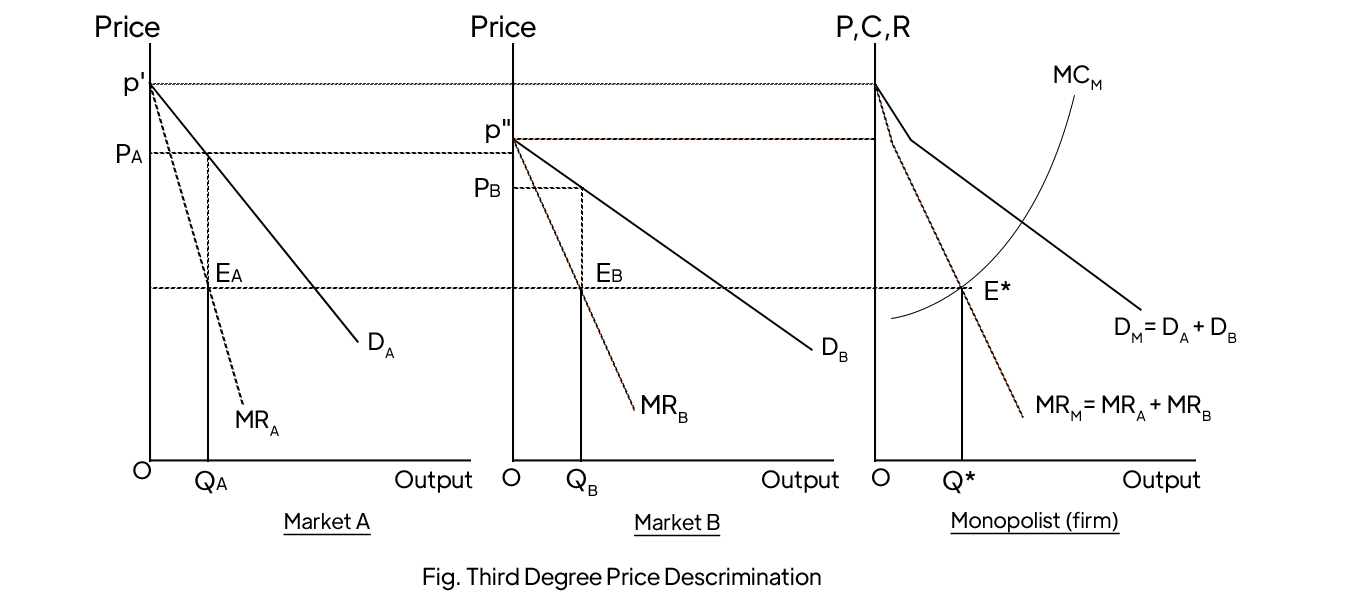
Here, both conditions of profit maximisation of the monopolist (firm) are satisfied at E*, and so OQ* is the profit-maximising quantity. This profit-maximising quantity is distributed in market A and B as PQA and OQB, respectively, such that OQA + OQB = OQ* and MRA = MRB = MRM = MCM.
In market A, the monopolist charges PA price for OQA quantity, and in market B, it charges PB price for OQB quantity. Since the market demand of A is steeper or less elastic, the price charged in market A is higher than in B. i.e., PA > PB.
Therefore, in third-degree price discrimination, the firm segregated the market in terms of the differences in price elasticity. Then, by using the marginalistic principle of profit maximisation, it determines the profit-maximizing output and allocates this output to each market in such a way that the marginal revenue from each market is equal.
Then charges a higher price in the market with lower price elasticity.
Other posts