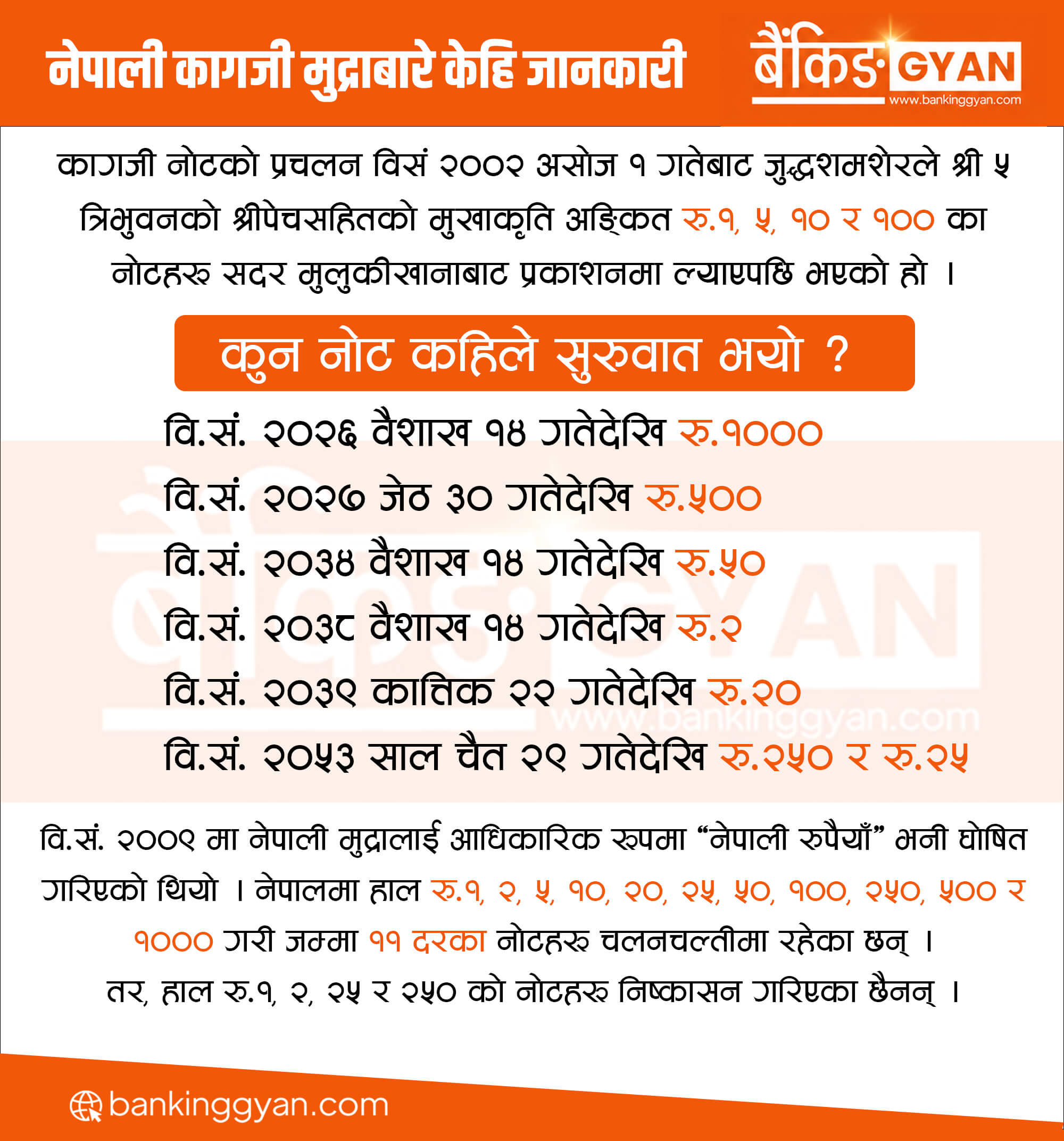
Coins had served Nepal for centuries, but paper currency is a much younger invention in the country. The first banknotes entered circulation on 1 Ashoj 2002 B.S. (around September 1945), under the authority of then Prime Minister Juddha Shumsher. The notes were issued through the Sadar Mulukikhana, the government’s central treasury office at the time, and they featured the portrait of King Tribhuvan wearing his royal crown. Four denominations launched together in that very first batch: Rs. 1, Rs. 5, Rs. 10, and Rs. 100.
It would be a few more years before the currency had an official name to call its own. In 2009 B.S. (around 1952), it was formally declared the “Nepali Rupee” (Nepali Rupaiya), giving Nepal’s money a distinct national identity.
Building Out the Family of Notes
Over the following decades, new denominations joined the lineup one at a time, each arriving to meet the country’s changing economic needs:
| Denomination | Introduced (BS) | Introduced (AD) |
| Rs.1, Rs.5, Rs.10, Rs.100 | 2002 Asoj 1 | around 1946 |
| Rs. 1000 | 2026 B.S., Baisakh | around 1969 |
| Rs. 500 | 2027 B.S., Jestha 30 | around 1970 |
| Rs. 50 | 2034 B.S., Baisakh 14 | around 1977 |
| Rs. 2 | 2038 B.S., Baisakh 14 | around 1981 |
| Rs. 20 | 2039 B.S., Kartik 22 | around 1982 |
| Rs. 250 and Rs. 25 | 2053 B.S., Chaitra 29 | around 1997 |
That last entry is a story in itself. The Rs. 250 and Rs. 25 notes weren’t part of the regular currency lineup — they were special commemorative issues, released to mark the Silver Jubilee of King Birendra’s twenty-five years on the throne, and circulated only in limited quantities.
Eleven Denominations, Four of Them Retired
Today, Nepal’s currency system recognizes eleven note denominations in total: Rs. 1, 2, 5, 10, 20, 25, 50, 100, 250, 500, and 1000. But not all of them are still being actively issued. The Rs. 1, Rs. 2, Rs. 25, and Rs. 250 notes have fallen out of active circulation — the smaller two were eventually replaced by coins for everyday small change, while the Rs. 25 and Rs. 250 notes remain collector’s items from their one-time commemorative run rather than working currency.
Quiet Kind of History
It’s easy to overlook a banknote as just a number with a portrait on it, but Nepal’s currency tells a layered story — of a monarchy issuing its first paper money through a treasury office, of an economy growing enough to need a thousand-rupee note, and of a king’s anniversary commemorated in everyone’s pocket for one printing run. The next time a Rs. 250 or Rs. 25 note turns up in an old drawer, it’s worth remembering it isn’t spare change — it’s a small piece of 1997 in cotton-paper form.