Deadweight loss is defined as the loss in social welfare due to inefficiencies of the market. The market is inefficient due to government intervention and market imperfections. It is a loss in social welfare due to the imperfect nature of the market and government intervention. It is assessed in terms of the loss of consumer and producer surplus due to any reason.
1. Dead-weight loss due to market imperfection:
If the market is perfectly competitive, there is no deadweight loss because in perfect competition, price and marginal cost are equal.
i.e., P = MC, but in the case of an imperfect market. P ≠MC, and there is deadweight loss. In order to explain this, consider the case of monopolistic which aims to maximize profit under the given condition.

Here,
The monopolist is in equilibrium at EM with PM price and OQM quantity, which satisfy both conditions of profit maximisation. Then the consumer and producer surplus are:
- CS = ΔABPM
- PS= □ CEMBPM
Social welfare = CS + PS
= ΔABPM +CEMBPM
If the market is perfectly competitive, then the equilibrium will be EPC with PPC Price and OQPC output, then
- CS = ΔAEPCPPC
- PS = Δ CEPCPPC
Social welfare = CS + PS
= ΔAEPCPPC + Δ CEPCPPC
Now, the deadweight loss is the loss in social welfare due to a monopoly market. This is calculated as the difference between the social welfare under perfect competition and monopoly.
i.e. Deadweight loss = Δ CEPCA – □ ABEMC
= Δ BEPCEM
2. Tax and deadweight loss:
If the government imposes a tax, it creates deadweight loss in society, which is the loss in consumer and producer surplus due to the tax. In order to explain this, assume that the market is initially in equilibrium and the government imposes a tax on the supplier.
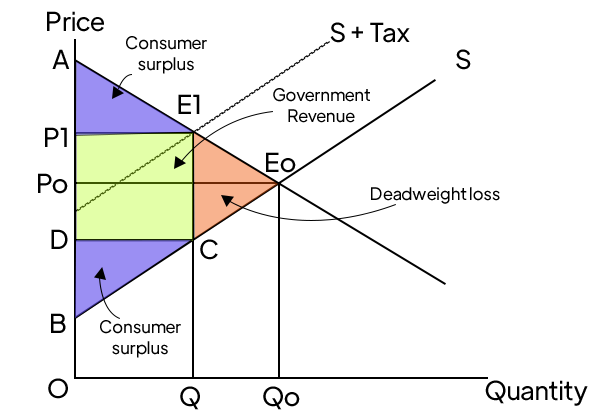
Here,
- The market is initially in equilibrium at Eo with Po price and OQo quantity. Now, the consumer and producer surplus are CS = ΔAEoPo, PS = ΔBEoPo
- Social welfare = CS + PS, = CS + PS, =ΔAEoB
- Now, assume that the government imposes a tax on the seller or producer, and so the supply shifts left to ‘S + Tax’.
- Then, the market attains a new equilibrium at E1 with P1 price and OQ1 quantity. After tax CS = ΔEE1P1, PS = ΔDCB, Tax Rev = □ P1E1EoC
This means if the government imposes a tax, there is a loss in social welfare, which is the deadweight loss. Such a loss occurs due to discouragement or disincentive to the higher price for lower quantity, and producers receive a lower price for lower quantity.
Other posts