The BoP Theory of Exchange Rate Determination is a modern theory for exchange rate determination.
- BoP Deficit = appreciation of forex, i.e., exchange rate of forex↑
- BoP surplus = depreciation of forex, i.e., exchange rate of forex↓
- BoP Equilibrium = no change in exchange rate, i.e., equilibrium exchange rate
This theory shows that the BoP position of the economy determines the exchange rate. If there is a BoP deficit, then the foreign currency appreciates against the domestic currency. Similarly, if there is a BoP surplus, the foreign currency depreciates its value, and if the BoP is in equilibrium, then the exchange rate is in equilibrium.
If there is a BoP deficit, there is a shortage of forex, which appreciates its value or increases its exchange rate. When the BoP is in surplus, there is an excess supply of forex, which reduces its exchange rate, and at the BoP equilibrium, both market demand and supply of forex are equal, and forex market attains equilibrium.
This means the interaction between the demand and supply of the forex determines the exchange rate under this theory.
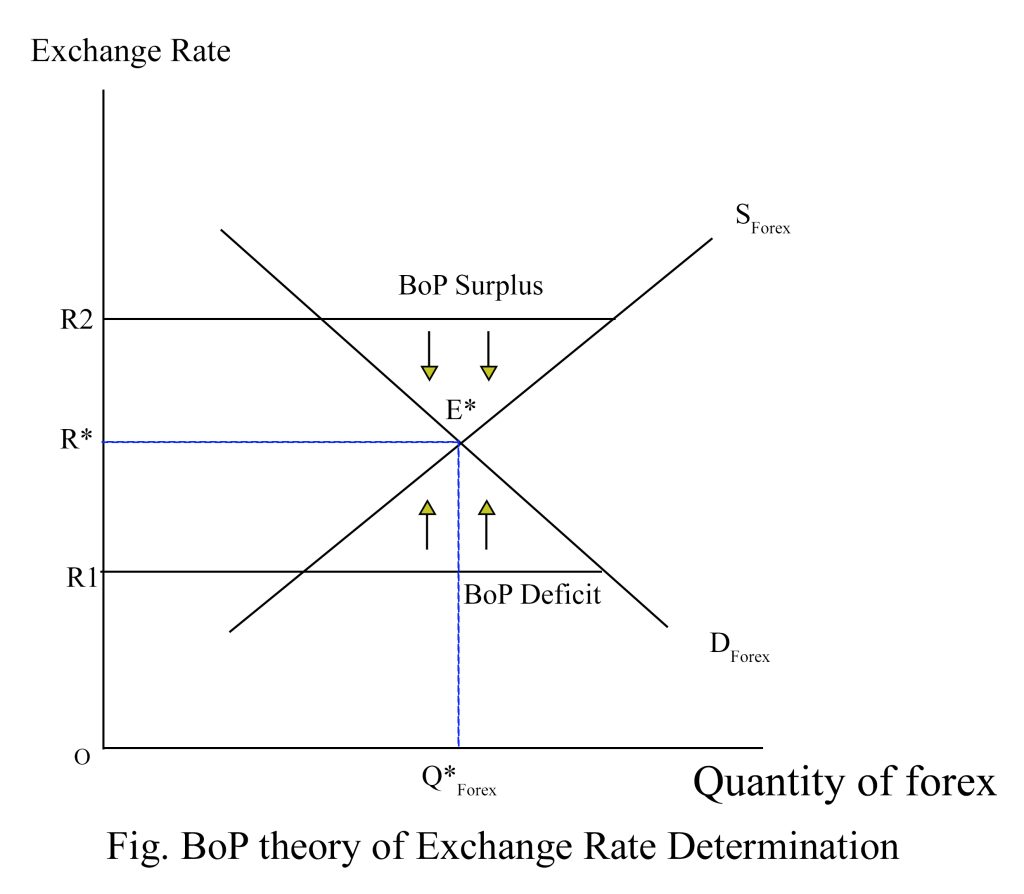
Here, at R1 exchange rate of forex, there is excess demand of forex implying that BoP deficit which gradually increases the exchange rate. Similarly, at the higher exchange rate R2, there is excess supply of forex in the market implying that BoP is in surplus. Such excess supply of forex gradually reduces its exchange rate and ultimately it reaches to equilibrium at E* with R* exchange rate at which both market demand and supply of forex are equal indicating BoP equilibrium.