What is Balance of Payment (BoP)
A balance of Payments is a systematic record of a country’s economic transactions with the rest of the world during a specific period. It records the inflow (receipts) and outflow (payments) of foreign exchange reserves during the given period in the economy.
- If the inflow of the forex is more than the outflow, the BoP is said to be in surplus.
- If the inflow of the forex is less than the outflow, the BoP is said to be in deficit.
- If the inflow of the forex is equal to the outflow, the BoP is said to be in equilibrium.
| Reciepts (Cr) | Payment (Dr) | |
|---|---|---|
| Export | ☑️ | |
| Import | ☑️ | |
| FDI | ☑️ | |
| External Int. Paid | ☑️ |
Every century has maintained the BoP account to assess the external sector of the economy. This helps to examine the changes in foreign exchange reserves in the economy, which is a common indicator of external sector stability.
The BoP account is maintained under the double-entry bookkeeping system, where receipts are recorded as credits and payments are recorded as debits.
So BoP account is always balanced.
The BoP account has three major sub-accounts, such as:
- Current Account
- Capital Account
- Financial Account
- Official reserve account
1. Current Account: It records the current flow of goods and services, current transfer of income factors such as remittance, interest payment, interest received, pension, and grants.
2. Capital Account: It records the transactions of capital, such as foreign loans, investments, etc.
3. Financial Account:
Records transactions that change ownership of foreign financial assets and liabilities.
-
Direct Investment – investment in a business to gain control. e.g Indian company buying shares in a Nepali hydropower project.
-
Portfolio Investment – buying stocks/bonds without control. e.g Foreign investor buying Nepal Stock Exchange shares.
-
Other Investments – loans, deposits, trade credit. e.g Foreign bank giving a loan to a Nepalese company.
-
Reserve Assets – changes in NRB’s foreign exchange reserves
4. Official Reserve Account: It records changes in the reserve position of foreign exchange, gold, Special Drawing Right, etc.
Example of Current Account Transaction in Nepal’s BoP
-
Merchandise Exports (Goods)
- Export of ready-made garments from Nepal to the USA is worth USD 5 million.
- This earns foreign currency for Nepal and is recorded as a credit in the current account.
-
Merchandise Imports (Goods)
- Import of petroleum products from India is worth USD 20 million.
- This involves paying foreign currency to India and is recorded as a debit in the current account.
-
Services
- Foreign tourists visiting Nepal and spending USD 3 million on hotels, trekking, and transportation. (Credit)
- Nepalese students are paying USD 2 million in tuition fees to universities in Australia. (Debit)
-
Primary Income
- Interest earned by Nepal Rastra Bank on foreign reserves deposited in overseas banks. (Credit)
- Dividends paid by Nepalese companies to foreign investors. (Debit)
-
Secondary Income (Current Transfers)
- Remittances sent by Nepalese migrant workers in Qatar to their families in Nepal are worth USD 8 billion annually. (Credit)
- Donations made by Nepalese NGOs to foreign charities. (Debit)
In short:
- Current Account → Goods, services, income, transfers (day-to-day transactions).
- Capital Account → Capital transfers & non-produced assets.
- Financial Account → Investments, loans, reserves.
BoP Curve
BoP curve represents the various combinations of interest rate and income required to keep the BoP equilibrium. So, every point on the BoP curve represents the equilibrium of the BoP of the economy.
To derive the BoP curve, we define BoP position as the gap between net export and net capital output.
i.e. BoP = (X -M) – H
Where,
- H = It is a payment for Forex. It is the Net of Capital account.
- (X -M) = Receipt of the forex by Net export. It is the net of the current account.
If (X-M) > H, then BoP > 0 (meaning BoP Surplus)
If (X-M) < H, then BoP > 0 (meaning BoP Deficit)
If (X-M) = H then BoP = 0 (meaning BoP equilibrium)
Here, export is assumed to be determined exogenously (externally), which depends on the foreign country’s policy and its income. So, export is given
i.e. X = Xo
Similarly, import is assumed to be a positive function of domestic income.
i.e. M= f (Y), f` < 0 (rate of change is positive)
The net capital outflow is assumed to be the inverse function of the domestic interest rate.
i.e. H = f (r), f1 <0 (rate of change is negative)
Based on these assumptions, we derive the BoP curve.
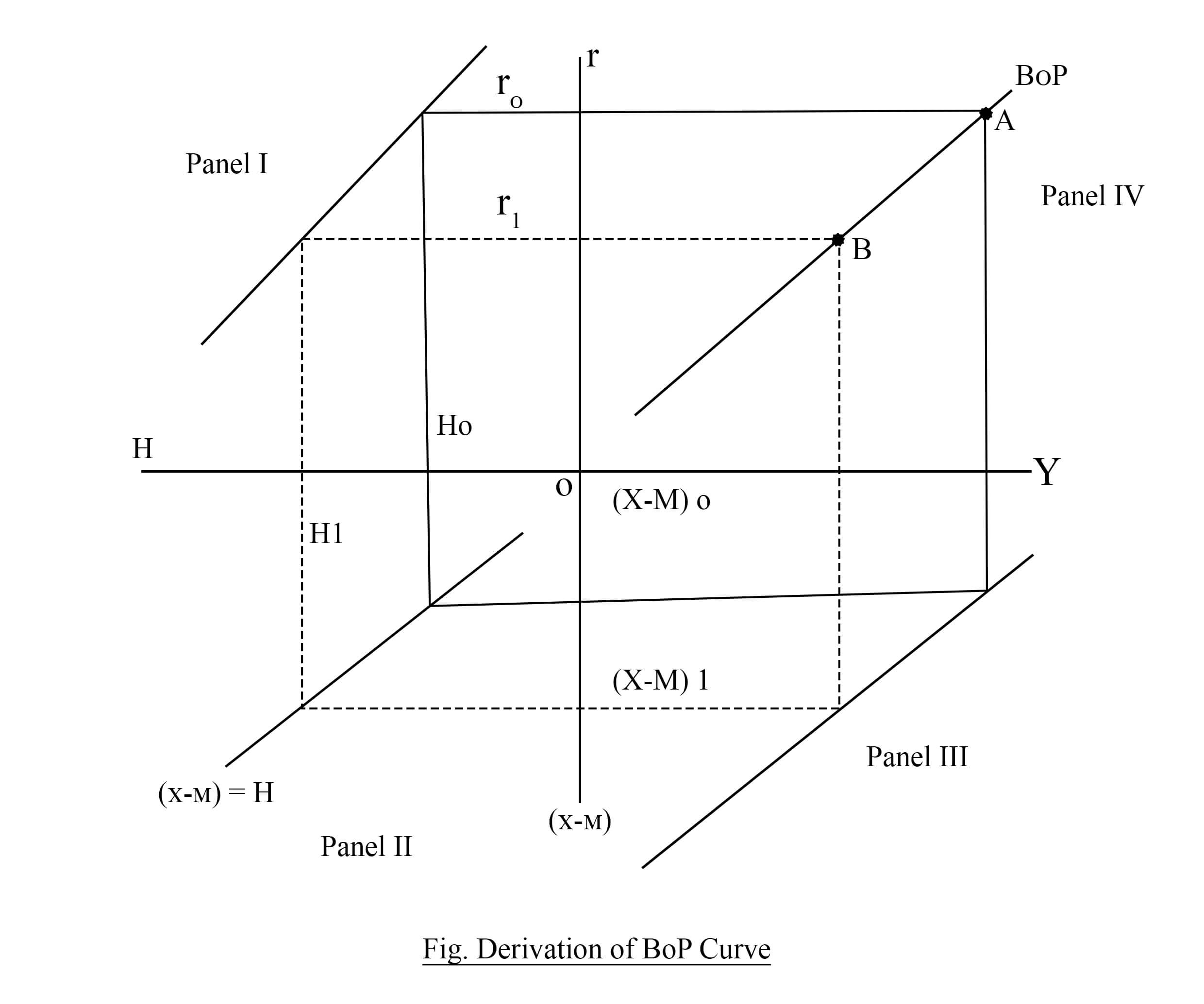
Here, Panel I shows the net capital outflow function, Panel II shows the BoP equilibrium i.e. (X-M) = H, Panel III shows the net export function, & panel IV derives the BoP curve with the help of other panels. As in panel I, the interest rate is ro the net capital outflow is Ho. For the BoP equilibrium, net export should be (X-M)o such that (X-M)o=Ho as shown in panel II. For (X-M)o net export, output should be Yo, which is shown in panel III. It means if the interest rate is ro and output is oyo, BoP is in equilibrium and this specific combination of interest rate (y) and income (y) is represented by point A in panel IV.
Similarly, the point B panel IV shows that BoP is in equilibrium if the interest rate r1, and output is y1. If we join the points A and B in panel IV we get BoP curve which is upward sloping.
Shift in BoP Curve
1) Change in (X-M)
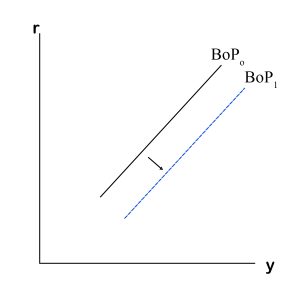
If (X-M) (↑) BoP shifts rightward.
ii) Change is exchange rate
if the domestic currency becomes weak, export increases & input declines. So, not export increases.
iii) Change in the domestic price level (p)
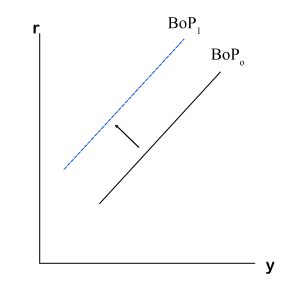
if P (↑) then (X-M)↓, BoP curve shifts leftward.
Other posts
- Price and Output Determination Under a Perfect Market
- Decision Under Certainty and Uncertainty
- Economics of Organisation – Expansion of Enterprises
- Economies of Scope and Economies of Scale