
Nepal’s foreign exchange rate system has evolved, reflecting the country’s trade needs and economic structure. Initially, Nepal followed a fixed exchange rate system, pegging the Nepalese rupee to foreign currencies, particularly the Indian rupee, to maintain stability in cross-border trade. Later, with globalization, Nepal adopted elements of the flexible or floating exchange rate system, where the value of the currency is influenced by market forces of demand and supply. However, instead of a completely free float, Nepal practices a managed exchange rate system, where the Nepal Rastra Bank (NRB) intervenes in the foreign exchange market to reduce volatility and ensure stability. At present, Nepal maintains a fixed peg of the Nepalese rupee to the Indian rupee, while exchange rates with other foreign currencies fluctuate based on international market conditions but are regulated by the NRB.
Exchange Rate Systems in Nepal
- Flexible & Floating Exchange Rate System
- Fixed Exchange Rate System
- Managed Flexible and Floating Exchange Rate System
1) Flexible & Floating Exchange Rate System
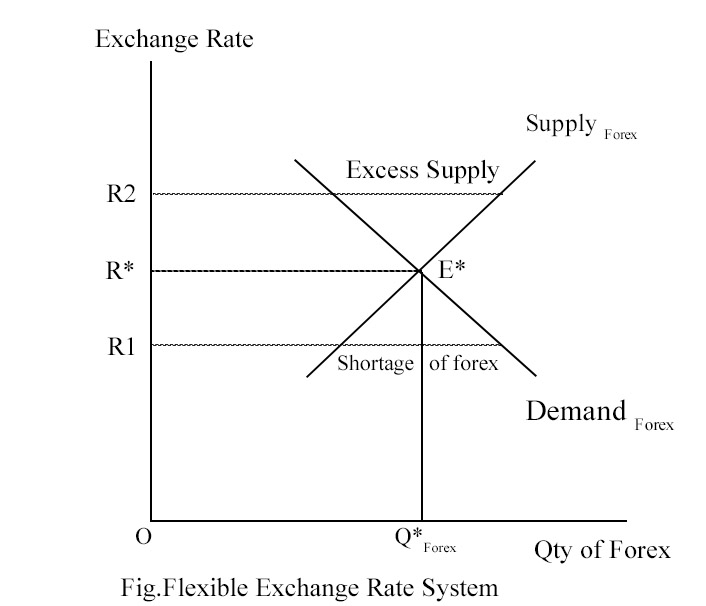
Under the flexible exchange rate system, the forex market is free to determine the exchange rate without any intervention from the government or any other authority. In such a system, the exchange rate between currencies is determined by the interaction between market demand and supply of the forex. If there is a shortage of forex, it increases the exchange rate, and if there is an excess supply of forex in the market. It reduces the exchange rate of forex against the domestic currency. It means, in the flexible exchange rate system, the exchange rate is adjusted by the market forces.
Here,
- The forex market is in equilibrium at E* with R* exchange rate and OQ* forex quantity.
- This means, at the R* exchange rate, both demand and supply of the forex are equal.
- If the existing exchange rate is below the equilibrium rate, i.e., R1, then there is excess demand or a shortage of forex, which gradually increases the exchange rate and ultimately reaches the equilibrium point.
- Similarly, if the exchange rate is above the equilibrium point, i.e., R2, then there is excess supply or low demand for the forex, which reduces its exchange rate and brings it to the equilibrium point.
- Therefore, in the flexible exchange rate system, the market demand and supply of the forex adjust its exchange rate and lead to the equilibrium point. So, there is no need for any intervention in the forex market.
Advantages of a Flexible Exchange Rate System
- Adjust the exchange rate itself, and there is no burden on the government and the central bank.
- Provides opportunities for private sector investment and innovation in the forex market.
- Able to realize the benefits to the economy coming through the changes in the exchange rate in the global market.
- Independent monetary policy can be implemented by the central bank itself if the exchange rate system is flexible.
- Automatic adjustment of the BoP through adjustment in the exchange rate by the market.
Disadvantages of the Flexible Exchange Rate System
- Exchange rate uncertainty and volatility.
- External shocks to the economy due to changes in the exchange rate globally.
- Discourages foreign investment and trade due to the unpredictable exchange rate.
- Causes inflation if the exchange rate of the domestic currency declines.
- Encourages speculative hoarding and threat for exchange rate crisis.
- Unfavorable to the small economy, hugely dependent on a large economy.
- Encourages unhealthy market practices. Such as artificial shortage, trading through an illegal system like Hundi, etc.
2) Fixed Exchange Rate System
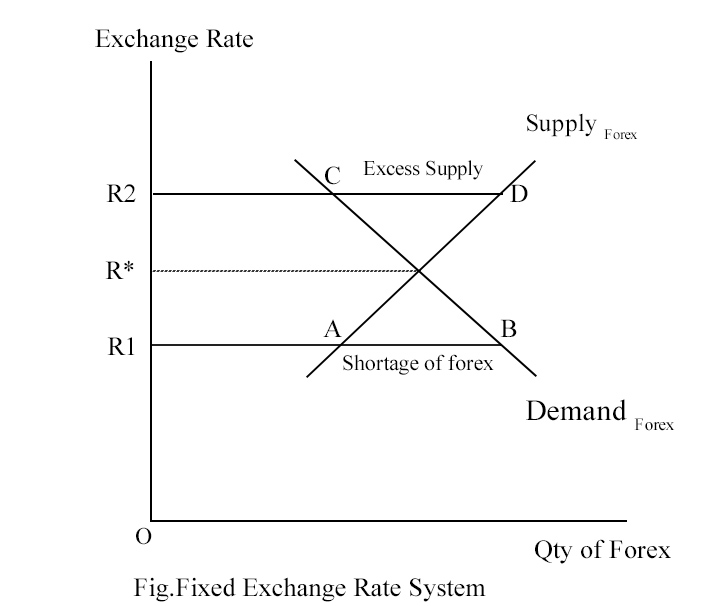
In this system, the government determines the exchange rate between domestic and foreign currency based on the size of the economy and its growth rate, nature and pattern of external trade, foreign exchange reserve, inflation, and interest rate, among others. Once the government determines the exchange rate, then the central bank is given authority to maintain the fixed rate. So, the central bank closely observes the forex market and intervenes if necessary.
For example, if there is a shortage of forex in the market, which can appreciate the value of forex, and to keep the fixed exchange rate central bank supplies forex in the market to meet the demand and is able to maintain the fixed exchange rate.
Here,
- If the government has fixed the exchange rate of the forex R1, there is excess demand for forex AB. If the central bank does not intervene in the market, then the exchange rate gradually increases and reaches the market equilibrium rate R*.
- However, this is the fixed exchange rate system, and so the central bank supplies an AB amount of forex in the market, which keeps the exchange rate fixed at R1.
- Similarly, if the exchange rate is fixed at R2, then there excess supply of forex, which depreciates its exchange rate. So, to maintain the fixed exchange rate, the central bank absorbs CD amount of forex from the market to maintain the fixed exchange rate at R2.
- Therefore, in the fixed exchange rate system, the central bank is actively involved in maintaining the fixed exchange rate.
Advantages of the Fixed Exchange Rate System
- Predictable or certain exchange rate.
- No external shocks from changing the exchange rate in the global market.
- Encourages foreign trade and investment due to certainty in the exchange rate.
- No speculative hoarding of forex.
- Control of inflation by keeping a fixed rate with the major import partners.
Disadvantages of the Fixed Exchange Rate System
- Increase the burden on the central bank
- Unable toe execute independent monetary policy (नेपालमा मौद्रिक नीति निर्माण गर्दा भारतको मौद्रिक नीतिलाई आधार बनाएर नेपालको नीति बनाउनु परेको छ किनकि भारतीय रुपैयाँ संग नेपालि रुपैयाँ पेग गरिएकोले भारतको आर्थिक सूचकहरुले नेपालमा प्रत्यक्ष असर गर्छ।)
- Unable to realize the benefits of the economy coming through the changes in the exchange rate globally.
- Requires sufficiently large forex reserve all the time to maintain the fixed exchange rate.
- Vulnerable to external sector crisis if the economy is unable to maintain a forex reserve.
3) Managed Flexible & Floating Exchange Rate System
- There are relative merits and demerits of both fixed and flexible exchange rate systems in order to minimize the harms of both systems. Most of the countries have adopted the managed flexible exchange rate system.
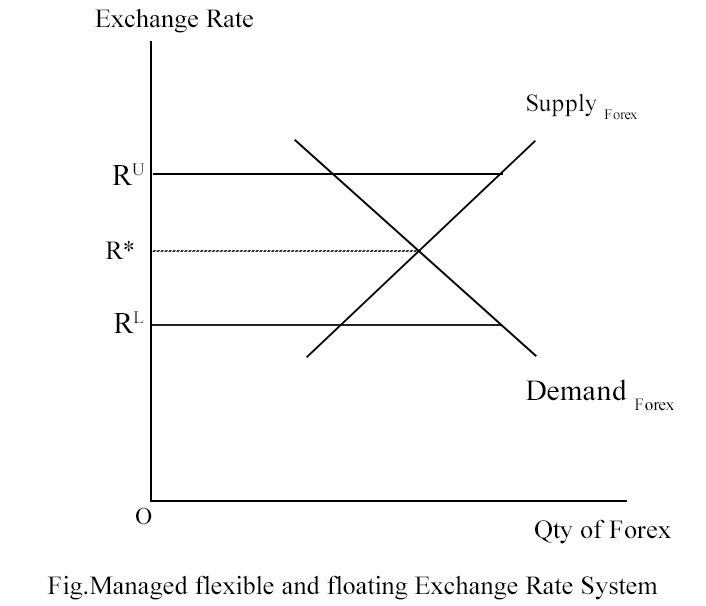
- Under this system of exchange rate, it can change or vary within a limit that is defined by the central bank. If the exchange rate tries to cross the limit, then the central bank intervenes in the forex market through buying and selling of forex. It means the central bank decides to keep the exchange rate between the lower and upper limits during the period in order to avoid exchange rate uncertainty.
- So, the exchange rate can freely move within the defined range, and the central bank intervene the market to keep the exchange rate within the limit.
Here,
- RL & RU are the lower and upper limits of the exchange rate defined by the central bank. So, the exchange rate is flexible within this range, but if the exchange rate tries to cross the lower and upper limits, then the central bank intervenes in the forex market to maintain the exchange rate within the limits.
- For example, if the exchange rate tries to fall below the lower limit RL due to excess forex in the market, then the central bank buys forex from the market to prevent its depreciation from RL.
- Similarly, the central bank supplies forex in the market to prevent the appreciation of forex from RU.
- So, in the managed flexible exchange rate system, the exchange rate is maintained within a range in order to make the exchange rate more predictable and also enjoy the benefits of such a flexible rate.
Must Real – Effects of Fixed Exchange Rate Between the Indian Rupee and Nepali Rupee
- Theories of the Exchange Rate System