Elasticity Approach to BoP (Price Effect or Micro Effect)
- Devaluation & Revaluation – by policy adjustment by the government
- Depreciation & Appreciation – by market adjustment
हामी संग १०० भारु = १६० नेरु छ।
यदि भारु १०० = १७६ नेरु भयो भने, मूल्यमा परिवर्तन अर्थात् (ΔP – १०%) ले बढ्यो।
यदि ΔP = १०% भयो र ΔQd पनि १० % ले घट्यो भने Import Payment मा परिवर्तन आउदैन किनभने जुन प्रतिशतले मूल्य बढेको हो त्यति नै प्रतिशतले आयात घटेको छ ।
यदि ΔP = १०% भयो र ΔQd (मागमा आएको परिवर्तन) पनि ५ % ले घट्यो भने Import Payment बढछ किनभने जुन प्रतिशतले मूल्य बढेको हो आयात 50% ले मात्र घटेको छ ।
यदि ΔP = १०% भयो र ΔQd पनि १५ % ले घट्यो भने Import Payment घट्छ किनभने जुन प्रतिशतले मूल्य बढेको हो आयात १५० % ले घटेको छ ।
This elasticity to BoP shows that devaluation of domestic currency helps to correct the BoP deficit but it depends on the elasticity of export and import for the success of devaluation in correcting BoP deficit.
If we devalue the domestic currency, it makes exports relatively cheaper and imports relatively expensive. So, export increases and import declines. However, it depends on the elasticity of exports and imports to determine whether the devaluation is able to solve the BoP deficit.
If exports and imports are highly elastic, devaluation helps correct the BoP deficit; if they are less elastic, devaluation may further increase the BoP deficit.
According to the Marshall-Lerner condition, devaluation is effective in reducing the BoP deficit if the sum of export and import elasticities of demand exceeds 1.
i.e
|Eex | + |Eim| > 1 then devaluation corrects BoP deficit.
|Eex | + |Eim| = 1 no change in BoP deficit.
|Eex | + |Eim| < 1 then devaluation further increases BoP deficit.
This means devaluation can be used as a policy instrument for solving the BoP deficit, but it may not always be successful in solving the problem. So, before devaluing the domestic currency to correct the BoP deficit problem, it requires a comprehensive and reliable study on the export and import elasticity of demand.
To explain this, assume that there are two countries, A and B, where country A exports X to country B and imports Y from country B. Country A is having a problem of a BoP deficit and devalues its currency.
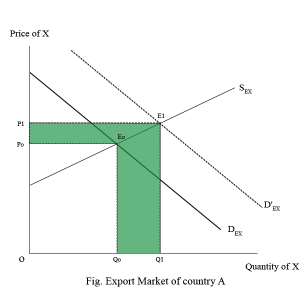
Here,
- Initially, the export market of country A is in equilibrium at Eo with Po price and OQo quantity of export. The export earnings are OQoEoPo.
- Assume that country A devaluates its domestic currency, which makes exports relatively cheaper and export demand increases from Dex to D’ex. Then the export market attains a new equilibrium at E1 with a higher price P1 and more exports OQ1.
- Now, the export earnings after devaluation are OQ1E1P1, which is higher than the initial export earnings.
- This means devaluation helps to promote export earnings by increasing export price and quantity. So, devaluation is beneficial for the country to increase its exports.

Here,
- Initially, the import market of country A is in equilibrium at Eo with Po price and Q0 export quantity. So, the initial import payment is OQ0E0Po.
- Assume that country A devaluates its domestic currency, which reduces the import supply from Sim to S’im, then the import market attains a new equilibrium at E1 with a higher import price P1 and lower import quantity OQ1.
- The import payment after devaluation is OQ1E1P1, which may be higher, lower, or equal to the initial import payment because on the one hand, import quantity has declined, but on the other hand, price has increased. So, it depends on the price elasticity of import demand that determines whether import payment has reduced or not after devaluation.
- Therefore, the elasticity approach shows that devaluation can be a useful policy instrument for correcting the BoP deficit, but it may not always be successful given the elasticity of exports and imports.
- In case of lower export and import elasticity of demand, devaluation can not solve the BoP deficit, but if the export-import is highly elastic to price, then devaluation is able to solve the BoP deficit problem.
Effect in Perfectly Elastic and Inelastic Markets
Case I: Export & Import elasticity of demand are perfectly inelastic (i.e.Eex = Eim = 0)
If both export and import demand are perfectly inelastic, then devaluation increases the BoP deficit.

Here, there is no change in the export market due to the devaluation because export demand is perfectly inelastic, which means there is no effect of the changes in the price due to devaluation on the export quantity.
But in the import market, the import payment has increased by 🔲 PoEoE1P1 due to a fall in import supply, but import demand is perfectly inelastic. So, in the case of perfectly inelastic export and import demand, the devaluation increases the BoP deficit.
Case II: Export & Import elasticity of demand is perfectly elastic (i.e. |Eex | = | Eim |= ∞)

- Here, in the export market, devaluation helps to increase export earnings by increasing the export price and quantity. In the import market, the import price remains the same, but import quantity has declined. So, import payment is lower after devaluation.
- This means that if the export and import demand are perfectly elastic, devaluation of the domestic currency corrects the BoP deficit problem. It implies that the chances of devaluation in solving the BoP deficit are higher if the export and import demand elasticity are higher, and such a change is lower if the export and import demand elasticity is lower.