It is also called Factor Proportions Theory, or Heckscher–Ohlin Theory. It was developed by Swedish economists Eli Heckscher and Bertil Ohlin in the early 20th century.
It is a modern theory that argues the basis of trade between countries should be based on the availability of resources or factors required to produce the particular product. According to this theory, the trade between the countries benefits both of them in their trade is based on the relative factor endowment.
The country should specialize and export those products if the resources required to produce them are relatively more available domestically, and import those products if the resources required to produce them are relatively scarce.
The trade is based on this principle, making the trade competitive, sustainable, and providing a win-win effect.
For example, if a country has relatively more capital than labor, the country should specialize more in capital-intensive products and import labor-intensive products.
Basic Assumptions
- There are two countries A and B, Two goods X and Y, Two factors, labor and capital. (classic model: 2×2×2)
- There are two products X and Y with different production technologies. (Labor-intensive and capital-intensive).
- There are two factors, capital (K) and Labor (L), available in different quantities, and their quantities are given. Factors are movable only within the country.
- Both product and factor markets are perfectly competitive.
- There is free trade between the countries.
- There is no transportation and other transaction cost associated with trade.
- Products are perfectly mobile between the countries, but factors are mobile with the countries only.
- There is no discrimination between domestic and foreign products in the market.
- Resources are fully utilized/employed.
Based on these assumptions, this theory shows that the country with relatively more capital than labor should specialize in capital-intensive products and export them and import the labor-intensive products.
The country A is said to have relatively more capital than labor.
- (K/L)A > (K/L)B , Factor quantity ratio
- (PK/PL)A< (PK/PL)B , Factor price ratio
- PK = Price of capital
- PL = Price of labor
To explain this theory, assume that country A has relatively more capital than labor in comparison to country B and product X is capital-intensive, whereas Y is labor-intensive. In such a situation, if there is free trade between A and B, it makes both of them better off and also equalizes the product price ratio in both countries when the trade between them reaches equilibrium.
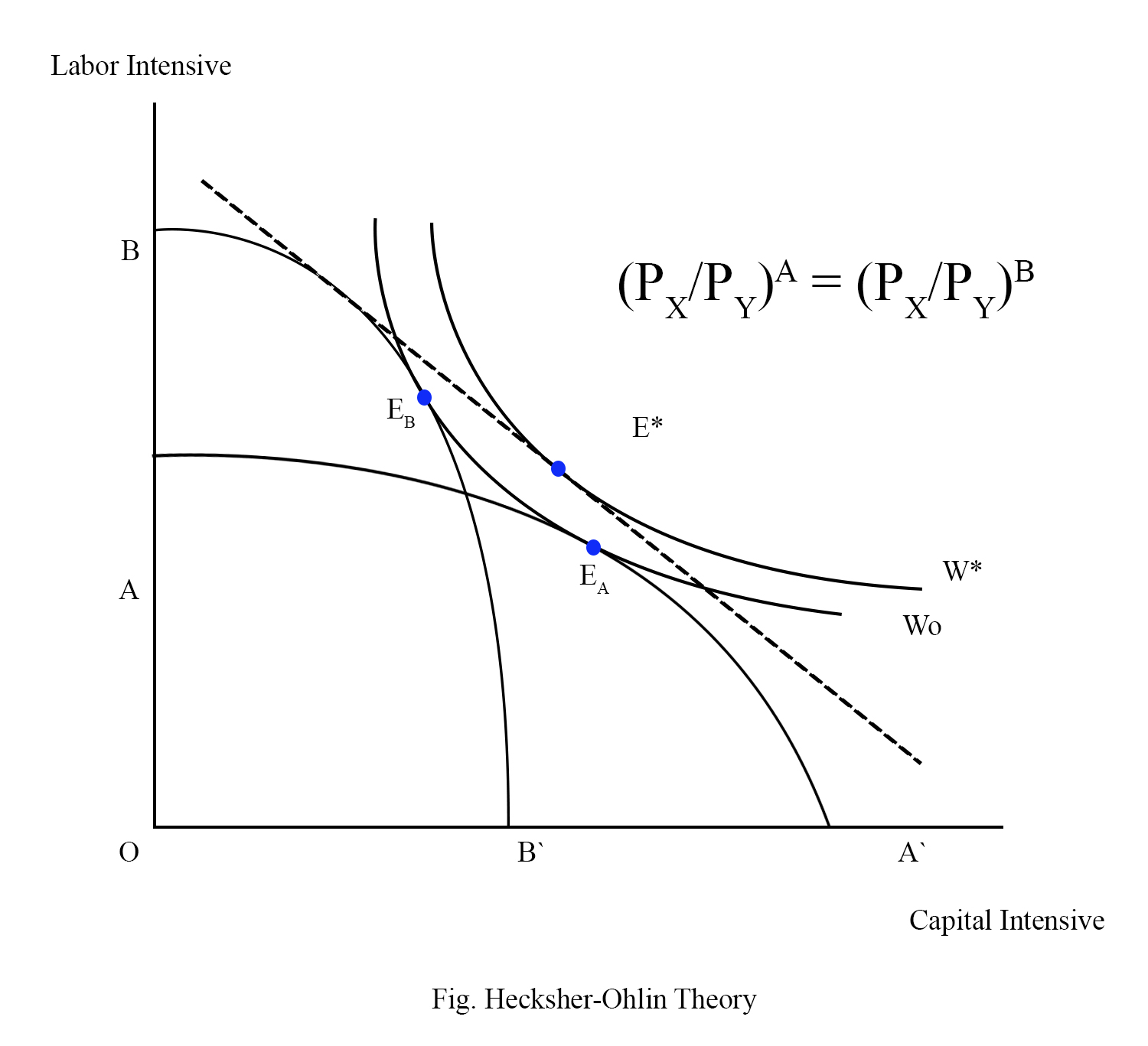
Here, AA` represents the PPF (Production Possibility Frontier) of country A, which shows the maximum quantity of X and Y that country A can produce from full utilization of given resources. Similarly, BB` is the PPF of country B, where the PPF represents the supply capacity of the economy.
If there is no trade between them, they have to produce both X and Y together to meet the domestic demand. Since country A has relatively more capital than labor, the capital-intensive X is relatively cheaper and Y is relatively expensive in country A than in B, It means the domestic price ratio of X and Y in country A is lower than that in B.
i.e. (PX/PY)A< (PX/PY)B
This means the slope of the budget line of country A is smaller than that of country B. This implies that the budget line of country A is flatter than the budget line of country B, and so country A is in equilibrium at a relatively flatter part of the PPF.
i.e., EA and country B are in equilibrium at EB, which is at the relatively steeper part. So, countries A and B are having W0 level of social welfare when there is trade between them.
If they agree to have free trade between countries, country A exports X to country B because X is relatively expensive in country B and the producer of country A can earn more by selling X in country B.
This increase in the price of X in country A, while the price of X in country B declines. Country A increases the export of X to country B until price of X in both countries is equal.
Similarly, after free trade, country A imports labor-intensive product Y from country B, which reduces its price in A and increases the price of Y in country B. Once the price of X and Y in both countries are equal, the trade between them reaches equilibrium. So, at equilibrium of the trade between the countries, the domestic price ratio in both countries are equal.
i.e. (PX/PY)A = (PX/PY)B
Such free trade between the countries leads to the equilibrium with equal product price ratio in both countries and they attain new equilibrium ar E* with higher social welfare W*. This shows that free trade improves the welfare of both countries implying that free trade is better than no trade.
उदाहरण
-
अमेरिका जस्तो देशमा मेसिनरी, प्रविधि, उद्योग, लगानी पूँजी धेरै छ तर श्रमिक (कामदार) अन्य विकासोन्मुख देशको तुलनामा कम छन्।
त्यसैले, अमेरिका Capital Abundant देश हो। -
नेपालमा श्रमिक धेरै छ तर ठूलो उद्योग–पुँजी, मेसिनरी कम छ।
त्यसैले नेपाललाई प्रायः Labor Abundant देश भनिन्छ। - नेपालले श्रमिकमा आधारित सामान अमेरिका पठाउने र अमेरिकाले पूँजीमा आधारित सामान नेपाल पठाउने यसो गर्दा दुवै देशलाई फाइदा हुन्छ।
Criticisms / Limitations of Heckscher -Ohlin Theory
- Leontief Paradox (1953):
U.S. (a capital-abundant country) was found to export labor-intensive goods and import capital-intensive goods—contradicting H–O. - Ignores the technological differences between nations.
- Ignores economies of scale and imperfect competition.
- Assumes identical tastes and preferences, which is unrealistic.
- Neglects transport costs, tariffs, and trade barriers.