
What is Factor Pricing?
Factor Pricing refers to the determination of the reward or payment given to the factors of production (land, labor, capital, and entrepreneurship) for their contribution to the production process.
Suppose a shoe factory produces shoes.
- The landlord is paid rent for the land.
- The workers are paid wages.
- The investor who provided machines or money receives interest.
- The entrepreneur who manages everything earns profit.
Marginal Productivity Theory Neoclassical Theory of Distribution
- This is the neoclassical theory of distribution, which argues that the price of any input depends on its marginal productivity.
- The marginal productivity refers to the additional product produced by the factor from its additional unit.
- If the marginal product of the factor is higher, it gets higher price.
- When a firm decides to employ or use the factor, it compares the price to be paid to the factor and the value of the product produced by the factor.
- If the price of the factor is less than the additional value it generates for the firm then the firm demands more of other factor.
- For example, consider labor as a factor and the wage rate per hour is Rs. 500 and the value of the product produced by the labor in an hour is Rs. 800, then it is profitable to hire more labors.
- But if the value of the product produced by the labor is less than the wage rate, then the firm does not demand or employ the labor.
- It means higher the value of product produced by the labor, the firm increases its demand and as the demand increases the labor gets higher wages rate.
- So, the theory of marginal productivity is related to the demand and price of the factor which argues that higher the marginal productivity of the factor, higher the price it receives.
- So, the market determines the price of any factor based on its marginal productivity.
Factor Pricing in Perfectly Competitive Market
- In the perfectly competitive market, we are assuming both the factor and product market are perfectly competitive. So, the price of the factor and the product are given to the firm and the firm is profit maximizer.
- In such case, the price of the factor is determined by the interaction between market demand and supply of the factor.
- The market demand of the factor is the summation of the factor demand by individual firm and market supply of the factor is also the summation of the supply of individual factor.
- However, the demand of the factor is the derived demand which depends on the demand of the goods and services produced by it. Similarly supply of the factor is also different from the product supply.
- In order to explain factor pricing in perfectly competitive market, assume that labor is such factor. Then the market demand of the labor is the summation of labor demand by the individual firm which demand labor based on the value of marginal product of the labor (VMPl) and the wage rate.
If VMPL > W, it is profitable to employee more labor and so the firm demands more labor.
If VMPL<W, then firm reduces labor. So, the firm attains equilibrium when VMPL = W.
VMPL = MPPL. Px [ MPPL is extra additional output from an additional unit of labor]
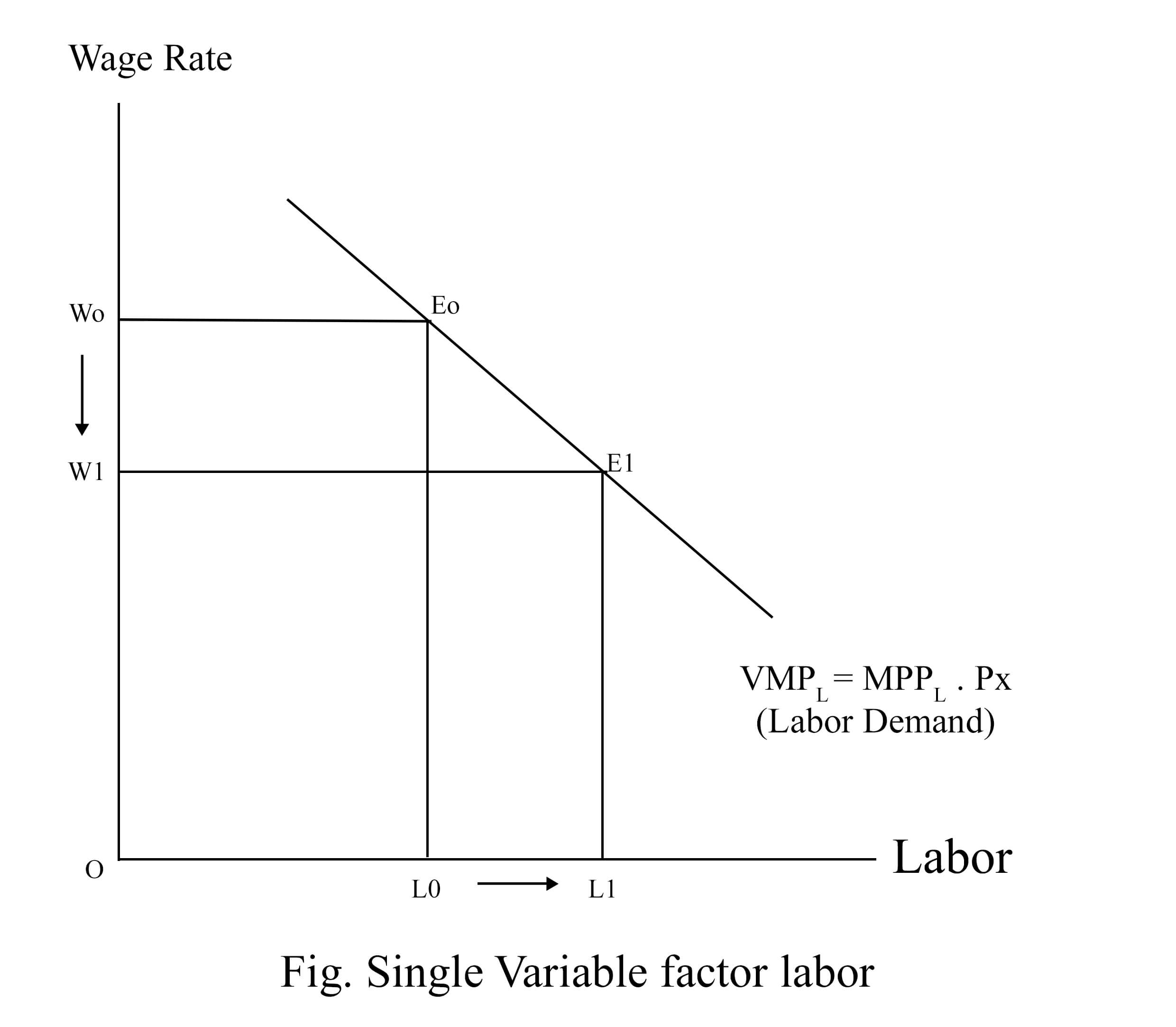
Here,
- If the wage ware it Wo then the firm employ OL0 units of labor at which VMPL = W.
- If the ware rate declines to W1 then the firm is in equilibrium at E1 with OL1 units of labor.
- This shows that if wage rate declines the firm employs more labor.
- Such inverse relationship between ware rate and quantity of labor is represented by the VMPL curve so the VMPL curve itself represents the labor demand curve by the firm if labor is single variable factor.
- If there is multiple variable factor where labor is one of them then when the wage rate changes it shifts the
- VMPL curve due to substitution effect, output effect and profit maximization effect.
- Then the labor demand by individual firm is derived by joining the point of intersection between the wage rate and corresponding VMPL curve.