In the previous post, we explained the causes of the BoP Deficit in Nepal. Now, we talk about how to adjust the BoP Disequilibrium.
BoP disequilibrium refers to the situation of either a deficit or a surplus, and the adjustment of such disequilibrium depends on the exchange rate system adopted by the country. If there is a flexible exchange rate system, then the BoP disequilibrium is adjusted through the market mechanism. If there is a fixed exchange rate system, then the disequilibrium is adjusted through the intervention of the central bank or monetary authority in the fixed market.
1) Flexible exchange rate system & adjustment of BoP disequilibrium
BoP deficit = shortage of FOREX, then depreciation of domestic currency, then export↑, import↓ = (X-M)↑ = BoP deficit ↓ = BoP equilibrium
BoP Surplus = Appreciation of currency = export↓, import↑ = (X-M)↓ = BoP surplus ↑ = BoP equilibrium
In the case of a flexible exchange rate system, BoP disequilibrium is adjusted by the forex market itself. If there is a BoP deficit, it depreciates the value of domestic currency which encourages export and discourages import. So, the net export increases which gradually reduces the BoP deficit and ultimately reaches to the equilibrium.
Similarly, if there is BoP surplus it appreciates the domestic currency. Then net export declines and import rises which gradually reduces the BoP surplus and reaches to equilibrium.
In order to explain, the adjustment of BoP disequilibrium under the flexible exchange rate system, assume that the country is having BoP deficit.
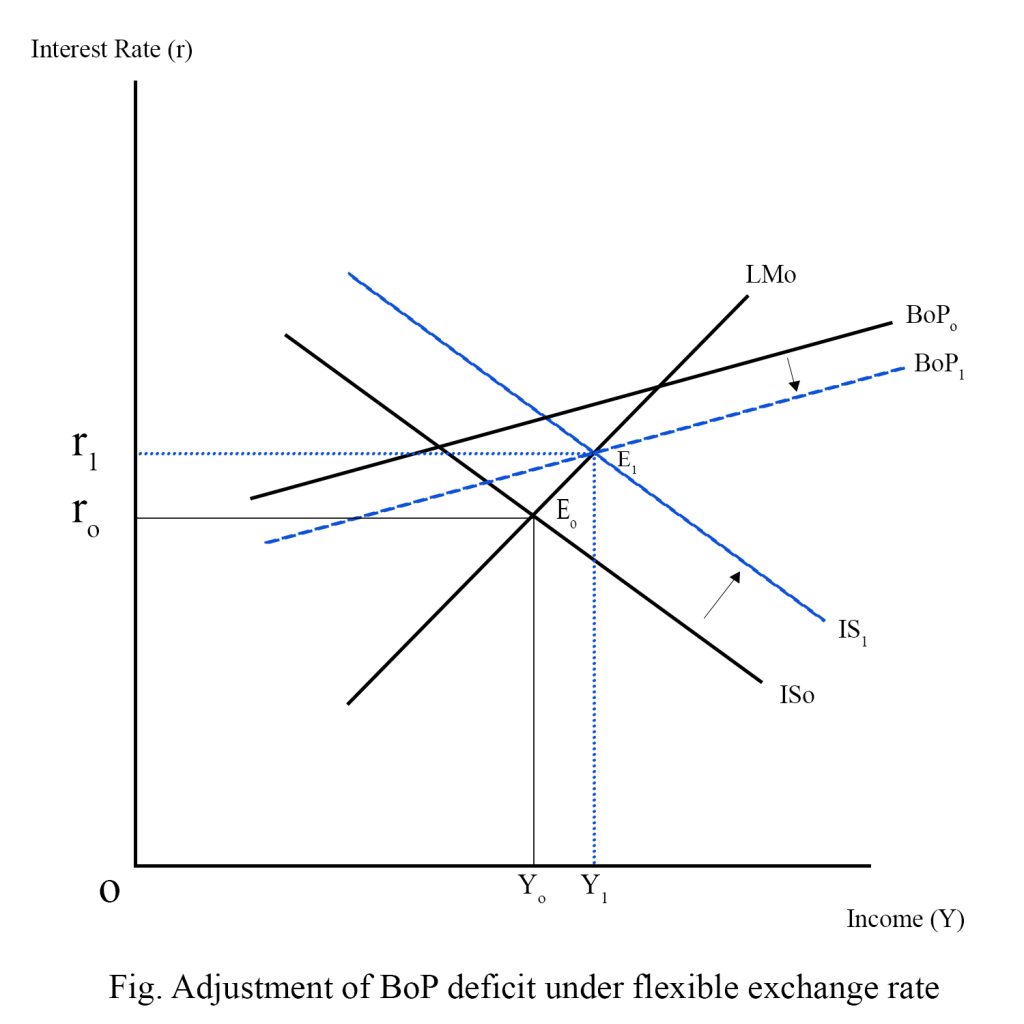
Here, the domestic (Internal) sector is initially in equilibrium at E0 with Ro interest rate and OY0 output (income).
Since, this domestic equilibrium point E0 is below the BoP curve (BoPo), it represents BoP deficit. Such deficit in BoP depreciates the value of domestic currency which increases net export. The increase in net export shifts the IS and BoP curve rightward gradually until they shift IS1 and BoP1 such that they are intersected with LM curve at E1. So the economy attains both interest rate and Oy1 output. This shows that under the flexible exchange rate system, the adjustment in BoP deficit occurs through the market by adjusting the exchange rate which increases both interest rate and output.
2) Fixed exchange rate system & adjustment of BoP disequilibrium
BoP deficit = shortage of foreign currency (FC) = NRB supplier FC to meet the market demand = Supply of NRs. ↓
In the fixed exchange rate system, the central bank or monetary authority is actively engaged in maintaining the fixed exchange rate. So, if there is BoP deficit, central bank supplies the forex to the market in order to meet demand and prevent depreciation of domestic currency. Similarly, is there is BoP surplus, central bank absorbs (buys) the excess forex from market to prevent the appreciation of domestic currency and maintains the fixed exchange rate. So, in the fixed exchange rate system, centra bank’s involvement in the forex market helps to adjust the BoP disequilibrium to BoP equilibrium.
BoP deficit = depreciation of domestic currency in central bank does not interevent the forex market. But to maintain fixed rate, central bank supplies forex to meet shortages & keep fixed exchange rate.

Here, the domestic sector is initially in equilibrium at E0 with ro interest and oyo output. Since, this equilibrium Eo is below the BoP curve, it represents BoP deficit.
This deficit in BoP depreciates the value of domestic currency. It is the fixed exchange rate system and to prevent depreciation of domestic currency, central bank supplies forex to meet the need of the market which ultimately reduces the Nepali currency in the market in such a way that the LM curve shifts leftward from LMo to LM’ and economy attains new equilibrium at E’ with r’ interest rate and oy’ output at which both the internal and external sectors are simultaneously in equilibrium.
If such fall in domestic money supply is not substantial and does not affect the aggregate demand and price level significantly then the economy remains stable at E’ equilibrium with r’ interest rate & oy’ output. However, if such fall in domestic money supply is substantial then it reduces the aggregate demand and price level. The fall in price level increases net export which shifts IS and BoP curve rightward as well as the fall in price level increases the real money supply (M/p) which shifts LM curve rightward from LM’. Such shift of LM, IS, BoP curve continues until LM1, IS1 and BoP1 and intersect with each other at E1 with r1 interest rate and Oy1 output.