What is Market Failure?
Market failure occurs when the market is unable to determine a socially desirable or optimal price and output.
If the market fails, the situation is P ≠ MC and Qd ≠ Qs
Where
- P = Price of the goods
- MC = Marginal cost (some profit is included)
- Qd = Quantity demanded
- Qs = Quantity supplied
It means either that society is paying a higher or lower price than the socially optimal price, or the market is producing an excess or creating a shortage of goods and services within society. In the extreme case of market failure, the market does not exist (because to be a market, there should be a buyer, a seller, and trade should happen between them).
Causes of Market Failure
Basically, 4 major reasons cause a market to fail. They are
- Existence of market power (with seller and or buyer)
- Existence of externality
- Provision of public goods
- Asymmetric/imperfect information
1. Market failure due to market power
- Buyer संग market power हुँदा ⇒ Price घटाउन खोज्छ।
- Seller संग market power हुँदा ⇒ Price बढाउन खोज्छ।
If there is some market power with the buyer or seller, the market fails to provide a socially desirable price and output. If the supplier has market power, then the supplier charges a higher price than the marginal cost by undersupplying the product.
i.e. Price > Marginal Cost & Qs < Qd
Similarly, if the buyer has market power, they pay a price lower than the marginal cost through their power to control the market.
To explain the market failure due to market power, assume that there is a monopoly in the product market that tries to maximize profit.
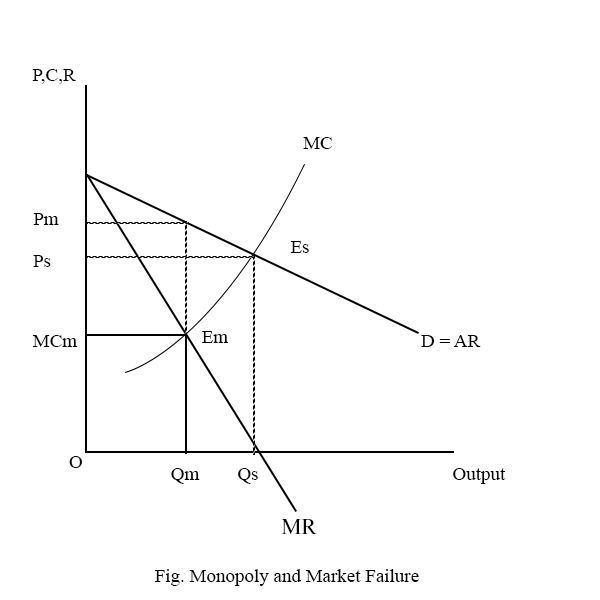
Here, the profit-maximizing monopolist is in equilibrium in Em with Pm price and OQm quantity. Since Pm > MCm at the OQm quantity, the market is said to be in failure.
If the market is efficient, then the socially desirable equilibrium would be Es, where MC =P, and the desirable output and price would be OQs and Ps, respectively.
So, due to a monopoly, the society is paying a higher price. i.e., Pm > Ps and receiving a lesser quantity OQm < OQs. In cases of market failure due to the market power of sellers or buyers, the government can use the following regulatory measures to correct the market failure.
The government’s regulatory measures to solve market failure due to market power
- Encourage new entries and competition
- Regulate the price of the product, such as a price ceiling and a price floor. Minimum support price (MSP तोक्ने )
- Regulate the output of the product, such as maximum output requirement to be fulfilled to meet the market demand. (निश्चित समय सिमा भित्र कम्तिमा यति उत्पादन गर्ने पर्ने भनेर तोक्ने ताकि बजारको माग पुरा गर्न सकियोस।
- Antitrust policy to avoid mergers and acquisitions and the creation of a monopoly. (मर्जर भएर निश्चित समुहको कब्जामा बजार नाजावोस भनेर मर्जर र एक्विजिसन लाई निरुत्साहित गर्ने, किन कि धेरै वटा संस्थामा प्रतिष्पर्धा बढ्दछ)
- Effective and efficient market regulation to control artificial price hikes.
- Promote public awareness and protection of consumers from exploitation.
- Timely amendment (reforms) of the law and directives with appropriate fines and penalties.
2. Market failure due to External Factors
An external factor affects the market by influencing the consumers and producers. It means if the utility or cost of someone else gets affected due to the activities of others, it is an externality.
Such externalities may be positive or negative. In the case of a positive externality, the social marginal cost is lower than the private marginal cost in production, and if there are positive externalities in consumption, the social marginal benefit is higher than the private marginal benefit. So, the market provided output is less than socially desirable.
- Positive Externality (production) – Social Marginal Cost < Private Marginal Cost
- Positive Externality (consumption) – Social Marginal Benefit > Private Marginal Benefit
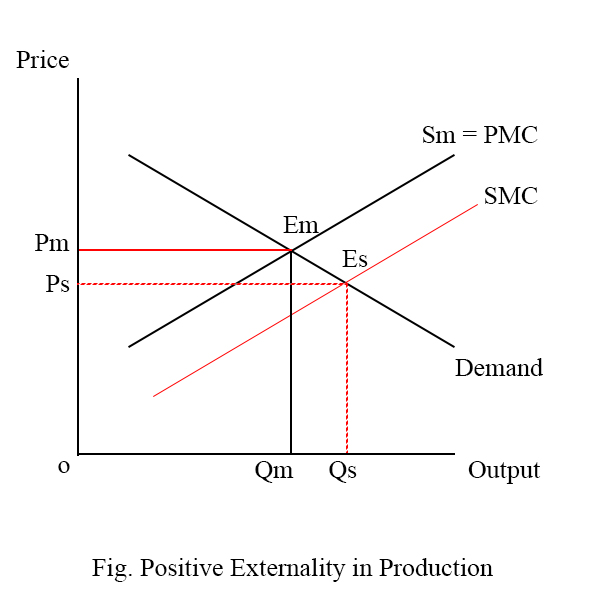
Here, OQm is market-determined output, and Pm is the price where the market makes the decision based on private marginal cost (PMC). Since there is a positive externality, the social marginal cost (SMC) is lower than PMC, and socially desirable price and output are Ps and OQs, respectively. This shows that the market undersupplies if there is a positive externality or society demands more than the market supply.
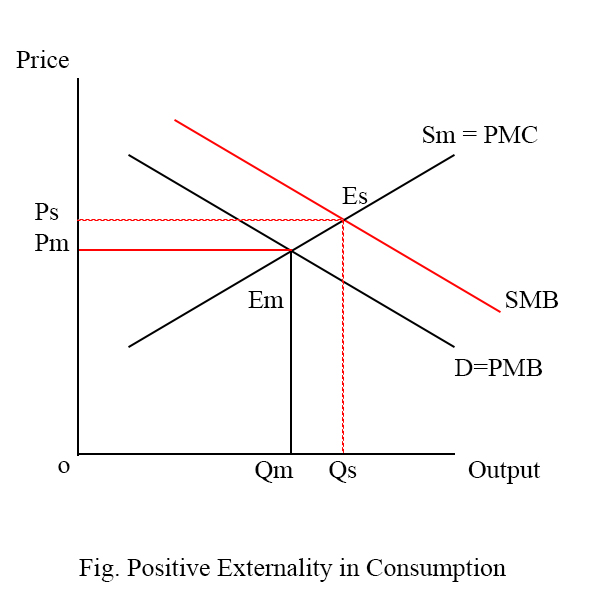
In the case of a negative externality, the social marginal cost is higher than PMC in the case of production, and in the case of consumption, the negative externality results in social marginal benefit less than private marginal benefit. So, the society demands less, or the market oversupplies the products with negative externalities.
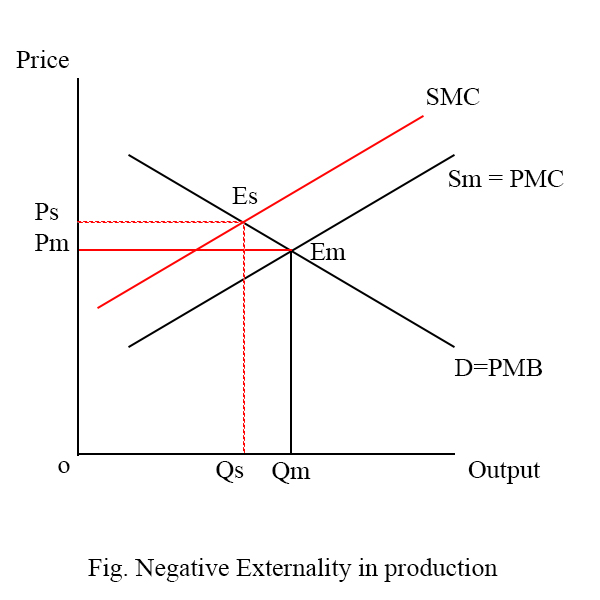
Here, market-determined price and output are Pm and OQm, respectively, which are determined based on PMC. Since there is a negative externality in production, SMC > PMC, and socially desirable prices and outputs are Ps and OQs, respectively. This shows that the market oversupplies the product if there is a negative externality.
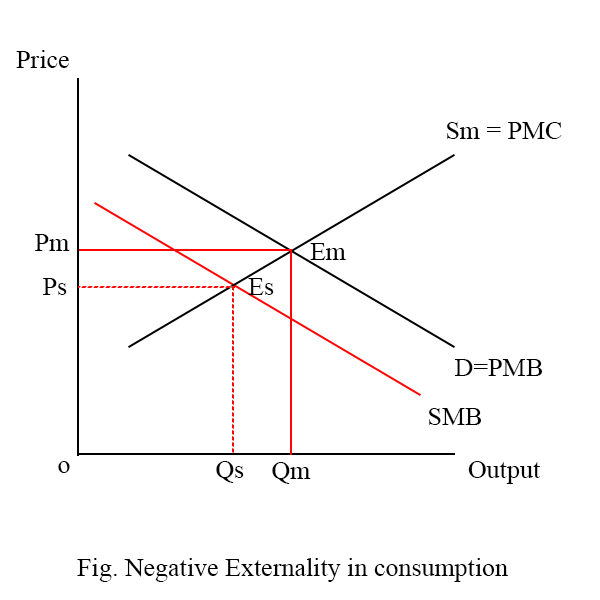
The government’s regulatory measures to solve market failure due to Externality
1) Positive externality case
- Provide subsidies to the private sector to reduce their cost.
- Provide license patent rights, operation rights to secure some profit, and provide the products to society.
- Increase public investment in the sector that creates positive externalities, such as health, education, and sanitation.
- Provide tax incentives to the firms to encourage investment and production.
- Provision of some fiscal and monetary incentives for research and innovation.
2) Negative externality case
- Impose a tax on the firms to control the output
- Direct regulation or command and control policy, such as a ban on plastic bags, pollution control rules/laws, technical certification, etc.
- Tradable pollution permits, such as pollution caps, carbon trading, etc.
- Legal liabilities and compensation rules, such as the polluter pays principle, environmental damages compensation, etc.
- Regulation of timing and place of doing business, such as control of nightlife timing, and the establishment of brick kilns outside of public residences.
- Promotion of public awareness on their production and consumption decisions to reduce negative externalities.
- Appropriate fines, penalties, and rewards to encourage positive externality-related activities and discourage negative externalities.
3. Market failure due to public goods
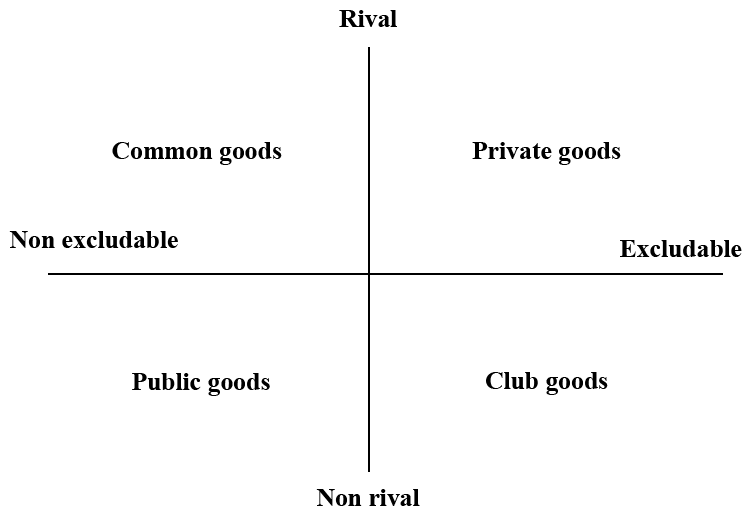
Public goods are non-excludable and non-rival in nature, and so the market or private sector fails to provide the socially desirable or optimum quantity of the public good. Due to the non-excludable nature of the public goods, no one can be restricted or excluded from the use of the public good, which results in the free rider problem.
Free Rider Problem भनेको यस्तो आर्थिक समस्या हो जहाँ केही व्यक्तिहरूले सार्वजनिक वस्तु वा सेवाको फाइदा त लिन्छन् तर त्यसको लागत तिर्दैनन्।
- सार्वजनिक पार्क: सबैले पार्क प्रयोग गर्छन् तर केहीले कर तिर्दैनन्।
- सडक बत्ती: सबैलाई उज्यालो चाहिन्छ, तर सबैले यसको खर्च तिर्दैनन्।
- राष्ट्रिय सुरक्षा: सबै नागरिक सुरक्षित हुन्छन्, तर सबैले प्रत्यक्ष शुल्क तिर्दैनन्।
- सार्वजनिक वस्तु non-excludable हुन्छ (नतिरिकन पनि रोक्न सकिँदैन)
- Non-rival हुन्छ (एकले प्रयोग गर्दा अर्काको उपयोग घट्दैन)
Similarly, due to non-rival nature of the public good, it is given in the lumpsum and available equally to all. So, marginal cost of providing the public good to an additional individual is zero and according to the efficient market principle, the price (P) and marginal cost (MC) should be equal. In the case of public good, the market is efficient only if
P = MC = 0
This means the private or market can not provide the public good for free. Since the public good is freely available, no one has an incentive to pay for the public goods, which results in overuse of the public goods and misutilization of the resources.
Therefore, the market has completely failed to provide the public good due to the free rider problem, where every individual is using the public good without paying for it.
The government’s regulatory measures to solve market failure due to public goods
- Assignment of property right to the users community. (उपभोक्ता समिति गठन गरि सार्वजनिक सम्पतिको बारेमा जिम्मेवार बनाउने)
- Provision of basic public goods by the government itself.
- Appropriate reward and punishment mechanisms for the efficient use of public goods.
- Public-private partnership for the large public infrastructure.
- Provision of the user’s charge whenever possible for the use of public goods.
- Promote public awareness through effective participation of the public in the provision of public goods and their use.
- Subsidies and tax incentives to the private sector to provide public goods by ensuring a minimum return.
3. Market failure due to asymmetric information (Imperfect information)
If the information is not perfect or symmetric, then there is an individual or group who has more information than others. This results in two fundamental problems known as
- Adverse selection
- Moral hazard
The problem of adverse selection occurs due to a lack of perfect information on the particular product, where the individual or society with less information pays a higher price or bears a higher cost. Due to a lack of information, the individual or society is not able to make the right choice, which increases their cost or reduces their utility.
Similarly, the problem of moral hazard occurs when there is no perfect information. In such a case, the individual or firm that has better information tends to exploit those who do not have ample information.
Therefore, if there is no perfect information available to both parties in the market, the market fails to provide an efficient price and output.
The government’s regulatory measures to solve market failure due to asymmetric information
- Mandatory provision of information disclosure (MRP, MFD, Exp. Date, Ingredients, details of the manufacturer).
- Provision of quality standards and certification,
- Incentives for the productive use of ICT for better information.
- Provisions for consumer protection laws, if they are being exploited by the market due to an information gap.
- Public provision of information by the government in major sectors or areas. (Central Bureau of Statistics – CBS, Department of Information and Broadcasting, etc.
- Provision of an information desk and an information officer in the public and private institutions.
- Citizens’ charter (नागरिक बडापत्र) in the public institutions and enforcement of the right to information law.
- Promote public awareness for the use of available and relevant information by avoiding misinformation.
- Effective fines and penalties for creating misinformation and hiding the information.
Limitations of government regulations
- Lack of adequate, reliable, and timely information.
- Higher cost of regulation in both the government and private sectors.
- Chances of over-regulation that discourages the private sector, resulting in an investment crisis.
- Regularity capture by the large corporate houses.
- Chances of government failure while correcting market failure.
- Rent-seeking political protection and policy corruption to favor a certain business group.
- Slow, time-consuming, and costly decision-making and justice under regulation.
- Poor public support and ownership of government regulations.
- The problem of effective coordination among the regulatory authorities.
- Lack of technical, managerial, and human resource competency for effective regulation.
Rent Seeking भनेको कुनै व्यक्ति, समूह वा संस्था उत्पादनशील काम नगरी सरकारी नीति, कानुन, लाइसेन्स, कोटा, कर छुट, एकाधिकार जस्ता माध्यम प्रयोग गरेर अतिरिक्त लाभ (आर्थिक फाइदा) लिन खोज्ने व्यवहार हो।