- By Milton Friedman (1957)
This hypothesis is developed by Milton Friedman in 1957 that argues that people want to smooth out their consumption standard and so their consumption at any period depends on the permanent income.
i.e., Ct = f (Ytp)
Where Ytp is permanent income, which is defined as the present value of expected income from the human and non-human assets times the average rate of return of the economy.
i.e. Ytp = r.Pvt
Where, r = average rate of return
Pvt = present value of expected income from human and non-human assets at ‘t’ period.
It means the permanent income is the expected income, but the actual or measured income at any period may or may not be equal to the permanent income because the measured income at any period consists of permanent and transitionary income.
Yt = YtP + YtT———- (i)
Where,
- Yt = actual or measured income at ‘t’
- Ytp = permanent income at ‘t’
- YtT = Transitionary income at ‘t’
Here, the permanent income is expected, but the transitional income is unexpected, which is a windfall gain or loss, and it is random in nature. This may be positive, negative, or zero.

- If YtT > 0, then Yt > YtP
- If YtT < 0, then Yt < YtP
- and, If YtT = 0, then Yt = YtP
This means the actual income may be higher, lower, or equal to the permanent income, which depends on the transitional income and it is random.
Similarly, the actual or measured consumption (Ct) at any period consists of permanent (Ctp) and transitionary consumption (CtT).
i.e. Ct = Ctp + CtT ——- (ii)
Ctp – योजना बनाएको खर्च
CtT – भैपरी Unexpected आउने खर्च
Here, the permanent consumption is the planned or expected, while the transitionary consumption is unexpected and random. So, the transitionary consumption may be -ve, +ve or zero.
- If CtT > 0, then Tt > TtP
- If CtT < 0, then Tt < TtP
- If CtT = 0, then Tt = TtP
This means the actual consumption may or may not be equal to the planned or expected consumption, which depends on the nature of the transitionary consumption.
According to this hypothesis, the planned or permanent consumption is a constant proportion of the permanent income of the same period.
CtP = K.YtP ———- (iii)
Where K is the proportionality constant. This means the consumption depends on the permanent income but in the short run, income and consumption are positive and non-proportional while the consumption and income are positive and proportional in long run.
To explain this, Friedman has made the following basic assumptions
1) There is no relationship between permanent and transitionary income
i.e. Cov (YtP, YtT) = 0
2) There is no correlation between permanent and transitionary consumption
i.e. Cov (CtP, CtT) = 0
3) There is no relationship between transitionary income and transitionary consumption
i.e. Cov (YtT, CtT) = 0
4) Permanent consumption is a constant proportion of permanent income
i.e. CtP = K.YtP
Based on these assumptions, this hypothesis shows that in the short run, income and consumption are positive and non-proportional due to transitionary income and consumption. For example, if the actual income increases due to positive transitionary income, consumption does not increase in the same proportion because consumption depends on the permanent income only, which does not change due to transitionary income.
In the long run, such positive and negative transitionary income and consumption cancel out with each other, and there remains permanent consumption and income only. So, as the permanent income increases in the long run, consumption also increases at the same proportion.
Reconciliatio of Long run and Short run consumption using Permanent Income Hypothesis (PIH)
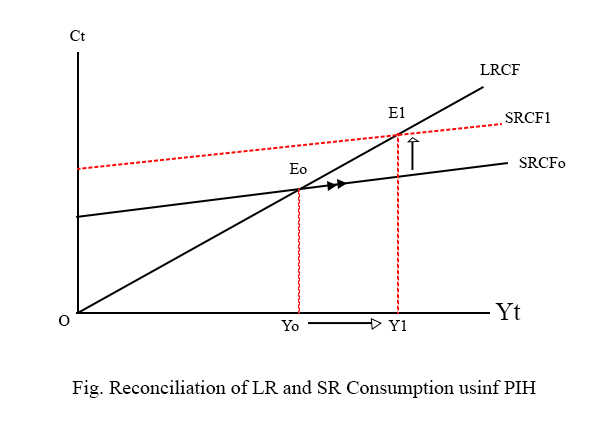
Here, the economy is initially at Eo with OYo income and EoYo consumption. Now, assume that income increases in the short run due to positive transitionary income, then consumption follows the non-proportional line SRCFo. It is because positive transitionary income does not change the permanent income, and the consumption depends on permanent income only.
When income increases to OY1, which takes a long period of time, the positive and negative transitionary income as well as transitionary consumption cancel out, and there is only permanent income. In such a situation, permanent income shifts the SRCF upward from SRCFo to SRCF1. If we compare such long-run points Eo to E1, we find that the increase in income and consumption is the same proportion.

Or, proportionate ΔY = Proportionate ΔC