Monetary policy is the macro policy formulated by the central bank to achieve pre-defined objectives primarily through the regulation of money supply and credit supply.
So, monetary policy consists of the objectives or goals, targets, and instruments.
Objectives ⇐Targets ⇐ Instruments
Objectives of Monetary Policy
The objectives of the monetary policy are macroeconomic in nature. There may be few or many objectives depending upon the need and priority of the economy.
The general objectives of the monetary policy are
- Economic growth
- Stability
- Price stability (5% inflation)
- Exchange rate stability
- External sector (BoP) stability (maintain the Forex reserve enough for 7 months of imports)
- Financial sector stability
- Employment generation (full employment)
- Efficient mobilization of resources
- Inclusive financial sector development, or financial inclusion
However, stability is the primary objective of the monetary policy.
Targets of the monetary policy
There is no direct link between the objectives and instruments of the monetary policy. To bridge the gap, the monetary policy uses some policy targets. Such targets are quantitatively measurable and closely linked with the objectives and the instruments. Generally, monetary policy considers the following as the target variable.
- Money Supply
- Credit Supply
- Interest Rate
- High power (H) money or base money
Once the central bank defines the target, it closely regulates the target variable. It is also assumed that if the targets meet the expectation, then the monetary policy can achieve its objectives.
Instruments/Tools of Monetary Policy
Monetary policy has some specific instruments and tools that the central bank can use to achieve the objectives via achieving the policy targets. Such instruments can broadly be classified into general and quantitative, and specific or qualitative instruments.
- General or quantitative instruments
- Specific or qualitative instruments
1. General or quantitative instruments:
It applies to all equally. For example, CRR, SLR, Bank Rate, Repo, Reverse Repo, Outright Purchase. Outright Purchase भन्नाले कुनै सम्पत्ति, वस्तु वा वित्तीय साधनलाई पूरै रकम एकैचोटि तिरेर पूर्ण स्वामित्व लिने प्रक्रिया हो। यसमा कुनै किस्ता (installment), उधारो, वा सर्त हुँदैन, सीधै नगद वा पूर्ण भुक्तानी गरेर किनिन्छ।
2. Specific or qualitative instruments:
- Credit Rationing: For example, the sectoral ceiling or floor of the credit flow.
- Hire Purchase: Minimum down payment, no. of installments
- Moral sausion:
- Direct control
- Liquidation
Transmission Channel of Monetary Policy
The transmission mechanism of monetary policy refers to the ways or channels through which the monetary policy affects the overall economy, such as AD, Price Level, Employment, and growth.
It means that when the central bank changes the monetary policy instruments, it affects the aggregate economic variables, and the transmission mechanism explains how these variables are affected.
So, the transmission mechanism illustrates the path through which the policy decision of the central bank is transmitted into the economy.
Regarding the nature of the transmission mechanism, there are two schools of thought.
1. The Keynesian Thought
It argues that there is an indirect transmission mechanism of the monetary policy. According to Keynes, the monetary policy is transmitted into the economy indirectly through the interest rate mechanism.
It means the monetary policy does not affect the aggregate demand, price level, etc. directly.
2. Monetarist/Friedman School of thought
It argues that there is a direct transmission mechanism of the monetary policy. According to Friedman, the monetary policy directly affects the aggregate demand. This means that if the central bank changes the money supply, it directly changes the aggregate demand.
These are the theoretical debates only, and the various literatures show that there are five (5) major channels through which monetary policy transmits into the economy.
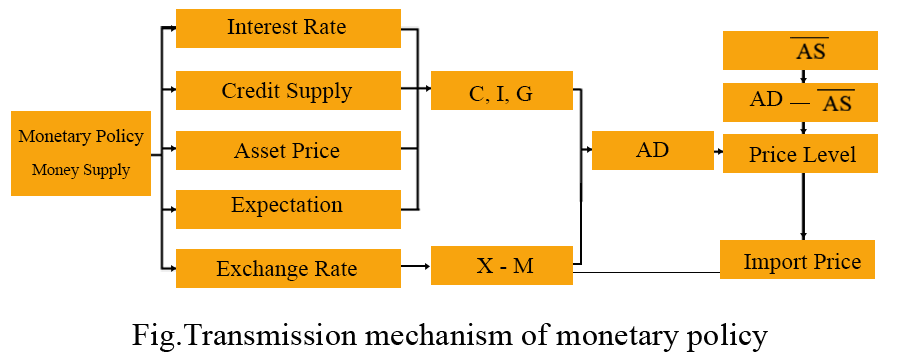
1. Interest Rate Channel
When the central bank changes the money supply through monetary policy, it changes the interest rate, which affects C, I, and G (Consumption, Investment, and Government Expenditure)
This affects the aggregate demand and price level ultimately. For example, if the money supply increases, it reduces the interest rate,, which increases the consumption and investment and aggregate demand.
Since aggregate supply is given, the increase in aggregate demand increases the price level.
2. Credit Supply Channel
The changes in monetary policy change the credit availability in the economy, which changes consumption, investment, government expenditure, aggregate demand, and price level.
For example, if the central bank increases the money supply, it increases the credit supply in the market. This encourages consumption and investment.
So, the aggregate supply increases, and also the price level under the given aggregate supply.
3. Asset Price Channel
The changes in monetary policy change the asset price, which has the wealth effect.
It affects consumption, investment, aggregate demand, and price level.
For example, the increase in money supply increases the asset price, which makes the people feel wealthier, and thus increases their consumption and investment demand. So, it increases the aggregate demand and price level under the given aggregate supply.
4. Expectation Channel
The changes in monetary policy change the expectation of the market, which affects C, I, G, A, D and Price level. For example, if the money supply declines, people expect that the asset price will decline in the future, and so they do not want to invest at present.
Similarly, people postponed their consumption, expecting that the price level will further decline. This reduces C, I, AD, and price level.
5. Exchange Rate Channel
The changes in monetary policy change the exchange rate, which affects net export (X-M) and aggregate demand as well as the import price. This ultimately affects the price level under the given aggregate supply.
For example, if the central bank increases the money supply, it depreciates the value of the domestic currency, which increases the net export and aggregate demand.
Similarly, the depreciation of the domestic currency increases the import price immediately, which increases the price level.
Thus, monetary policy is transmitted through different channels into the economy. The relative effectiveness of the channel depends on the specific structure and situation of the economy.
Q) Which transmission channel of monetary policy is effective in Nepal?
Given the structure and situation of the Nepalese economy, the credit supply channel seems to be more effective because the credit availability determines the consumption and investment decisions in Nepal.
For example, the increase in investment in hydropower is due to the specific credit supply policy to the hydro sector.
Similarly, the expansion and growth of the agriculture sector are also due to the credit supply policy for this sector.
The consumption decision also mainly depends on the credit availability. For example, when the monetary policy is more restrictive to hire purchase, the consumption demand declines.
The other channels, such as the interest rate channels, seem to be less effective in recent years. For example, the interest rate in recent days is lower, but the consumption and investment demand are not growing, slowing the economy.
Similarly, due to a fixed exchange rate system with INR, the exchange rate channel may be less effective because more than 60% of our trade is with India.
Due to poor financial literacy and imperfect information, the expectation channel may also be less effective. The poor monetization of assets also makes the asset price less effective. So, the credit supply channel is more effective in the context of Nepal.
Unconventional Monetary Policy
If the economy is in crisis or an abnormal situation, then the traditional/conventional monetary policy instruments become ineffective, and the central bank should use the unconventional policy instruments to revive the economy.
The unconventional policy is needed if the policy rate falls to zero or a non-zero lower bound, a financial crisis, recession, or deflation risk, or weak credit flow despite a low interest rate, and loss of confidence in the market.
The following are the major tools of unconventional monetary policy
1) Quantity Easing:
The central Bank buys government bonds or other securities to inject more liquidity in the economy.
2) Negative interest rate:
Banks are charged for keeping an excess reserve at the central bank to encourage lending. Similarly, the central bank provides a certain premium in the form of interest to the banks for borrowing from the central bank.
3) Forward Guidance:
The central bank communicates its future policy intervention to shape the inflation expectation and interest rate.
4) Targeted Lending:
The central bank lends directly to a specific sector, such as SMEs and housing, to improve the credit flow where the market fails.
5) Assets purchased by the central bank:
Purchase of the corporate bonds and other securities from the market to inject more liquidity.