In economics, consumption under risk and uncertainty explains how consumers make consumption decisions when future income or prices are not certain. Consumers facing risk and uncertainty try to smooth consumption, avoid large fluctuations, and protect future consumption through saving and insurance.
There are basically two theories of consumption under risk and ucertainty.
- Inter-temporal choice
- Neumann-Morgenstern theory
Inter-temporal choice in consumption
The intertemporal choice in consumption refers to the choices the individual has in consumption over different periods. The individual is said to be rational who tries to maximize lifetime utility, and so she/he allocate the given lifetime income across the different periods of consumption so as to maximize lifetime utility.
It means the individual has the choice to spend the given resource in consumption over different periods. If the individual prefers/values more current consumption, she/he spends more at present, and if the individual values more to future consumption, then she/he sacrifices some part of current consumption and saves for the future. So, the choice is always there to make more consumption today or tomorrow, which is the intertemporal choice in consumption.
In order to explain this, assume that the individual has to make the choice in consumption between two periods today and tomorrow. Let Co and C1 be the consumption, and Mo and M1 be the income of today and tomorrow, respectively.
Assume that the price level is stable and r is the interest rate at which the individual can borrow or lend.
Now, the objective of the individual is to maximize the utility given by the consumption of today and tomorrow under the given income/constraint.
i.e. Max U = f(Co,C1)
Subject to C1 = (1+r)Mo + M1 –(1+r)Co
(1+r) = Current value of tomorrow’s income
Mo = today’s income
M1 = tomorrow’s income
(1+r)Co = tomorrow’s value of today’s income
Since the objective is to maximize the utility, it is assumed that the utility given by the consumption over the period can be represented by the indifference curve (IC), and the utility is said to be maximum if the following two conditions are satisfied.
First order condition:
Slope of IC = slope of budget line
Second order condition:
The IC must be convex to the origin at the point of tangency with the inter-temporal budget line.
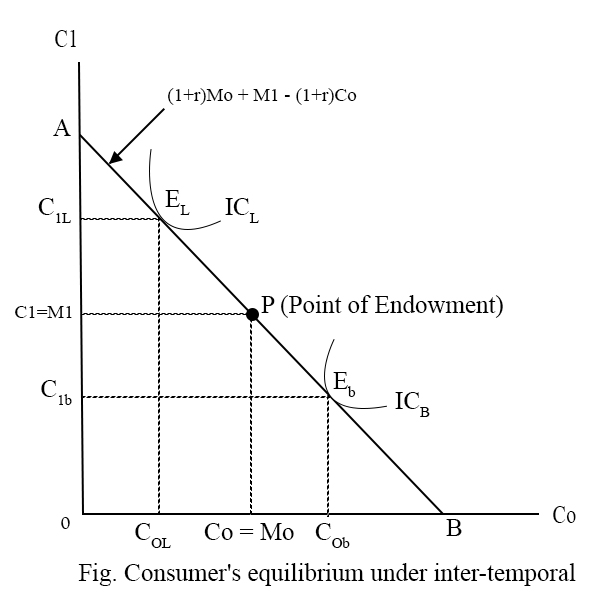
- Co = Mo आज जति कमायो त्यति मात्र खर्च गर्ने
- Co < Mo = कमाएको पैसा सबै खर्च नगरी भोलिको लागि राख्दछ (सेभिंग गर्छ)
- Co > Mo = आज कमाएको भन्दा धेरै खर्च गर्छ (सापटी लिएर)
Here, AB is inter-temporal budget line where P is the point of endowment at which Co = Mo and C1 = M1. It means, if the individual is neither borrower, nor lender, she/he is in equilibrium at the endowment point (P).
If the individual prefers more of the current consumption and borrows against the future income, then the individual attains equilibrium between P and B of the budget line. Similarly, if an individual values future consumption than she/he is in equilibrium between P and A.
Similarly, the lender/saver is in equilibrium at EL with COL current consumption and C1L Future consumption. This shows that the individual who consumes more today has to sacrifice some future consumption in order to maximize lifetime utility. Similarly, if the individual sacrifices some part of current consumption, they will be able to have more consumption in the future. So, the choice is with the individual whether to consume more today or in the future, where the rational consumer allocates the consumption over the different periods in such a way that it maximizes the lifetime utility.
Effect of Change in Interest Rate
A change in interest rate changes the slope and intercept of the inter-temporal budget line, which affects the borrower and lender differently. For example, if the interest rate increases, it harms the borrower while the lenders are better off, and vice versa.
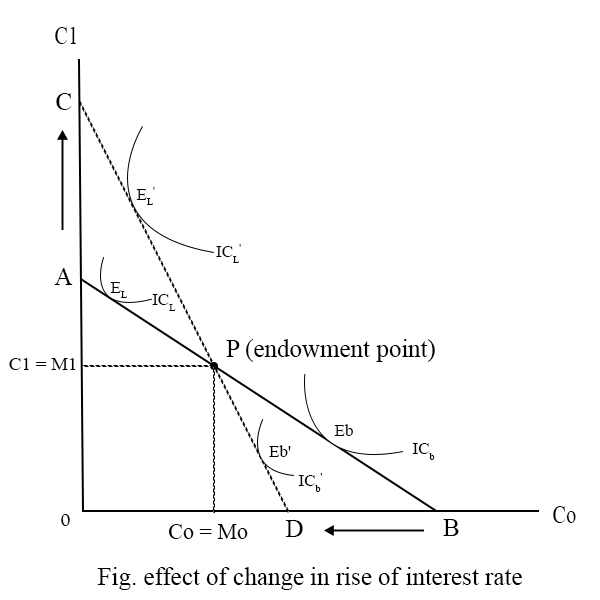
Here,
AB is the initial intertemporal budget line in which the borrower is in equilibrium at Eb with ICb level of utility, while the lender is in equilibrium at EL with ICL level of utility.
Now, assume that the interest rate increases, which increases the intercept and slope of the budget line, which makes the budget line steeper but passing through the endowment point P, and such a budget line is CB in the figure. In this new budget line, the borrower is in equilibrium at Eb’ with a lower level of utility ICb’ and the lender is in equilibrium at EL’ with a higher level of utility ICL’.
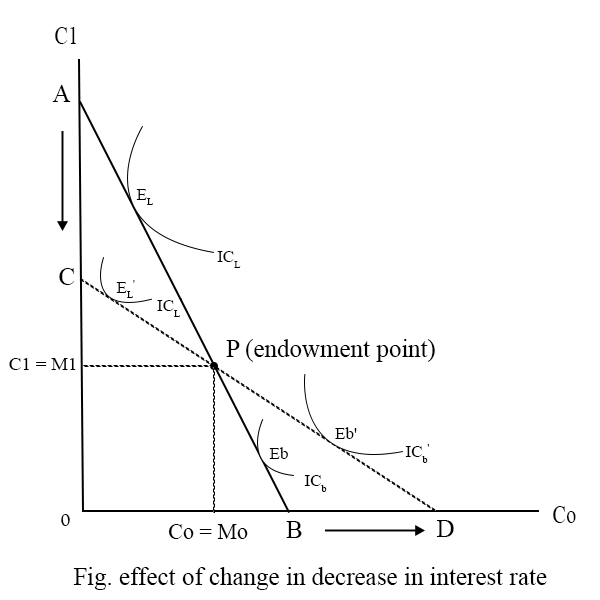
This shows that an increase in interest rate harms the borrower but benefits the lender. Similarly, if the interest rate falls, the borrowers benefit, and the lenders are worse off. However, if the interest rate increases or decreases, it may change the behavior of the individual.
Other posts: