
Firm’s productivity improves
- Only if new methods/equipment are added externally – S-S Growth Model (Exogenous)
- From the same set of inputs/machines – Endogenous Growth Model (Endogenous )
पहिला पहिला कठिन हिसाब सरल गर्न धेरै लामो समय लाग्थ्यो। अहिले आएर क्यालकुलेटर तथा च्याट जिपिटि जस्ता साधान आएर एकै छिनमा हल गर्न सकिन्छ। यस्तो अवस्थामा ति क्यालकुलेटर तथा च्याट जिपिटि Exogenous लाई मानिन्छ। तर यदि आफै Practice गरेर एकै छिनमा हल गरियो भने त्यो चाहि Endogenous हो।
The endogenous growth model was developed during the 1970s & and 80s as an alternative to the neo-classical exogenous (S-S Growth Model). There is no unique or single endogenous growth model, as different economists have contributed to the growth model independently; however, the commonality is that technology is endogenous. Several endogenous growth models have been developed by Arrow (1962), Romer (1986), and Lucas (1991).
The endogenous growth model argues that the ultimate source of economic growth is the endogenous technology, which depends on the investment in human capital and R&D. According to these models, the investment in human capital, such as health, education, sanitation, nutrition, etc, and investment in R&D have a positive spillover effect in the economy, which makes increasing returns to scale. Similarly, the differences in the quality of human capital across the countries result in growth differentials across them.
Spillover effect भनेको कुनै एउटामा गरिएको राम्रो लगानीको प्रतिफलले अन्य क्षेत्रमा पनि सकारात्मक प्रभाव पार्नु। जस्तो कि सहरमा कुनै एक जनाले राम्रो सिप सिकेर गाउँमा फर्किएर गरेको व्यवसायले अन्य गाउँलेलाई पनि फाईदा पुग्छ। सामान्यतय Human Capital र R&D मा गरिएको लगानीले अरु वरिपरि रहेकाहरुलाई पनि फाईदा गर्छ।
Since there is no single model to explain endogenous growth, all of them are some extension of the A-K growth model, which can be considered as a basic endogenous growth model.
The A-K growth model was introduced by Frankel in 1962 in order to show that endogenous technology determines economic growth. This model argues that the ultimate source of economic development is endogenous technology, which depends on the quality of investment in human capital and R&D. Countries grow faster in the long run if they have made more quality investment in human capital and R&D.
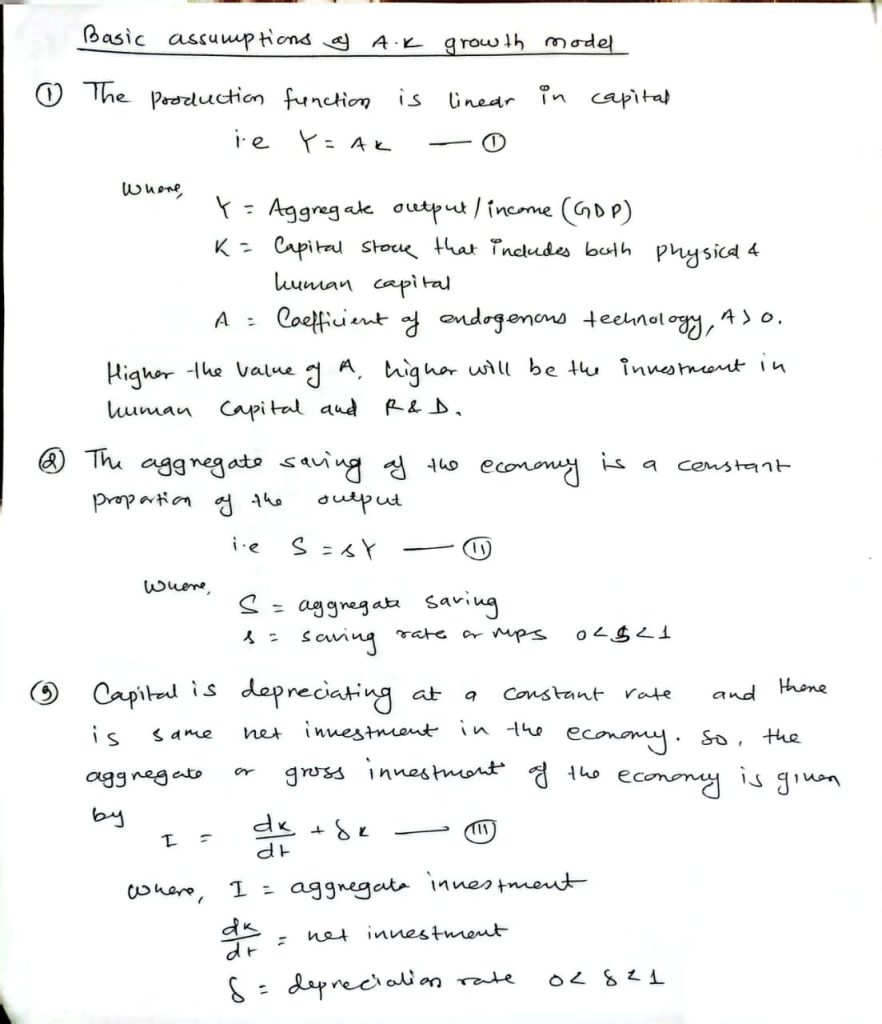
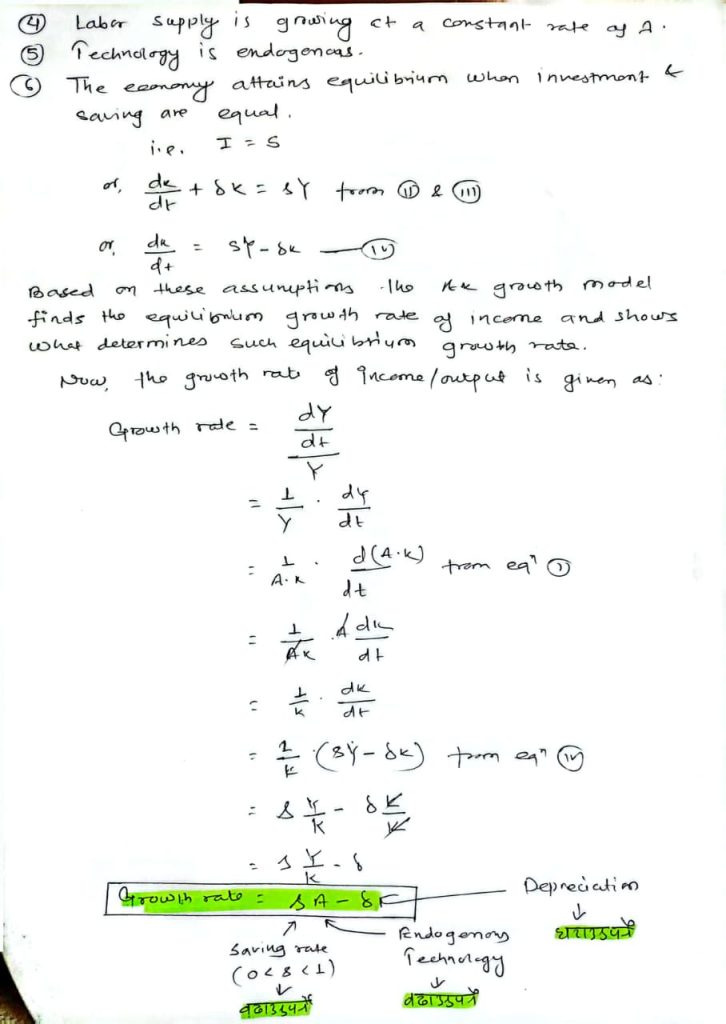
This equation, Growth Rate = sA – δ, shows that the equilibrium growth income or output depends on three parameters, as
- Saving Rate (s)
- Coefficient of endogenous technology (A)
- Depreciation rate (δ)
There is a positive relationship between the economic growth rate with S & A, and a negative relationship with the depreciation rate (δ). It means we can increase the economic growth rate by increasing the savings rate. However, there are limitations to increasing the savings rate because it can not be more than 1.
Therefore, it is only A that is the ultimate source of economic growth. It means the endogenous technology, which depends on the investment in human capital and R&D, is the source of long-term growth.

Here, if the given capital stock (human + physical) is Ko, then the output is Yo at the coefficient of endogenous technology is A, while from the same capital stock Ko, then the output is Yo’ if the coefficient of endogenous technology is A’ while (A’>A).
If we increase the capital stock from Ko to K1, then the output increases in both cases, while the output grows higher in the case of a higher coefficient of endogenous technology. This means, an increase in investment, especially in human capital and R&D, improves the coefficient of endogenous technology and increases the long-run growth of the economy.
Implications/Uses of the Endogenous Growth Model
- Realization that growth is endogenous. It means it is the choice of the government that determines the long-run growth of the economy. This makes the government and policymakers realize that the growth-enhancing policy that the government can formulate and execute itself promotes long-run economic growth.
- The role of human capital and R&D plays a dominant role in long-run growth. The endogenous growth model justifies how the investment in health, education, training in human capital, as well as investment in R&D, contributes to economic growth.
- Explanation of the growth differential across the countries is possible using the endogenous growth model. It means the countries with more quality investment in human capital and innovation can grow faster in the long run. So, the different countries are growing differently dut to the differences in the investment in human capital.
- The role of the knowledge-based economy is justified by this model. So, this model is useful in analyzing innovation and knowledge-based growth. This model can help contribute to the spillover effect of knowledge and innovation in the economy.
- The role of saving and financial market development is important for growth. The advocates of endogenous growth models argue that financial liberalization for increasing financial access and saving mobilization.
Weaknesses/Limitations of the Endogenous Growth Model
- Professor Paul Krugman criticizes the endogenous growth model as difficult to empirically verify because this model considers too many immeasurable, abstract factors related to human capital.
- This model has not incorporated the institutional perspective of economic growth because growth depends not only on the quality of human resources but also on the institutions.
- This model ignores the exogenous technology, which is also possible, but this model considers the endogenous technology only. It means the technology and growth are sometimes exogenous.
- This model emphasizes the supply side, being focused only on productivity and growth, where the demand side is ignored.
- This model is not able to explain why the low-income countries are growing faster than the developed countries despite lower per capita investment or human capital, and R&D.