Solow – Swan Growth Model – A representative of the neo-classical growth model
- Developed by Robert Solow and Trevor Swan in 1956.
Solow and Swan developed their growth model independently based on the neoclassical framework, but we consider them as a single representative neoclassical growth model.
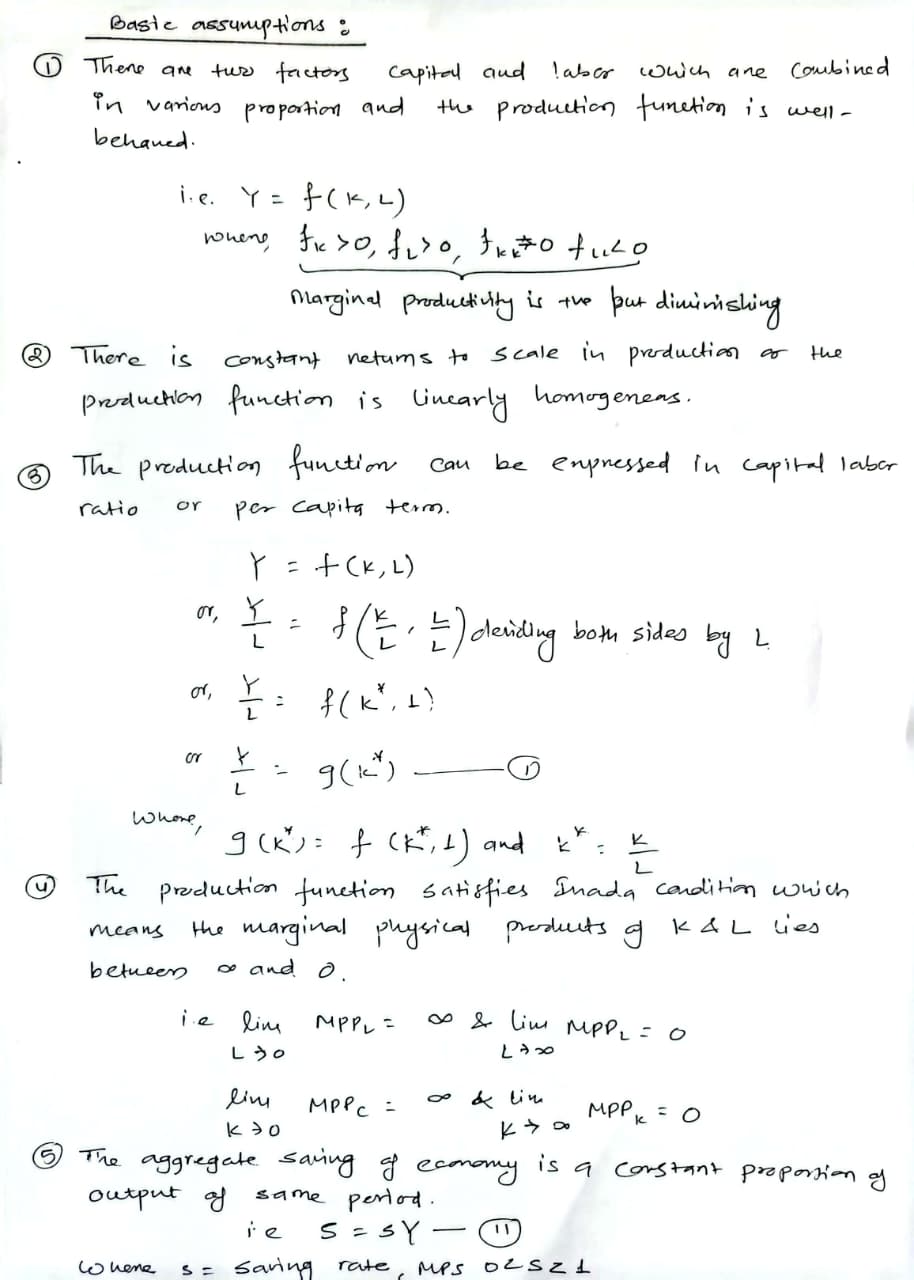
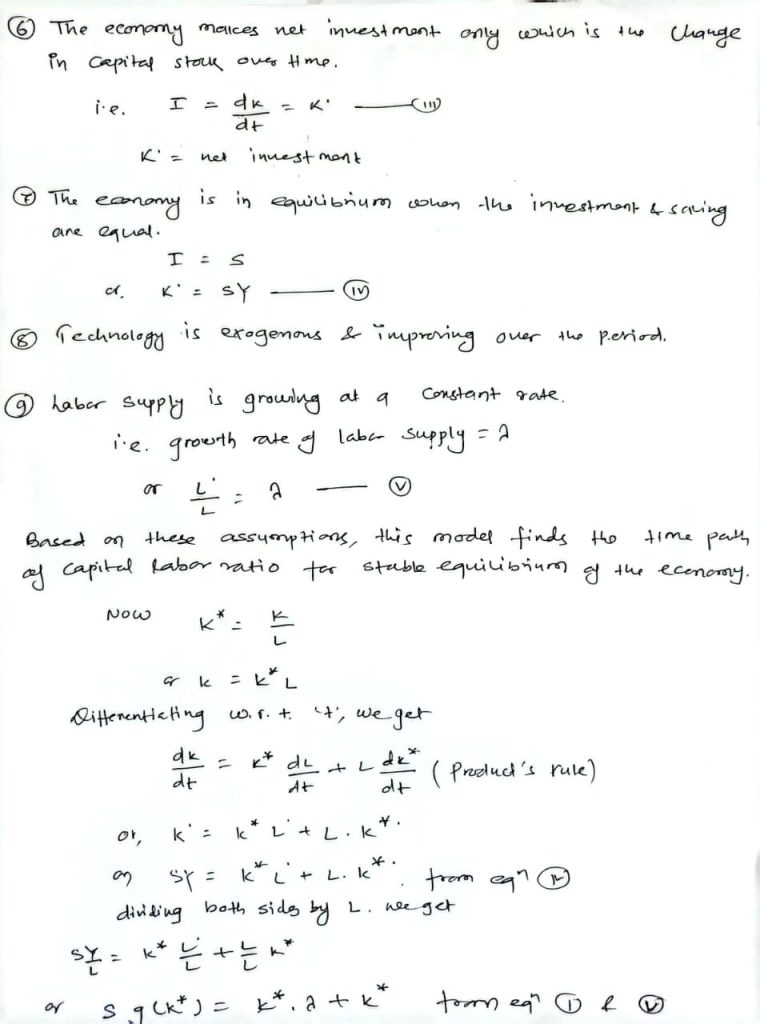
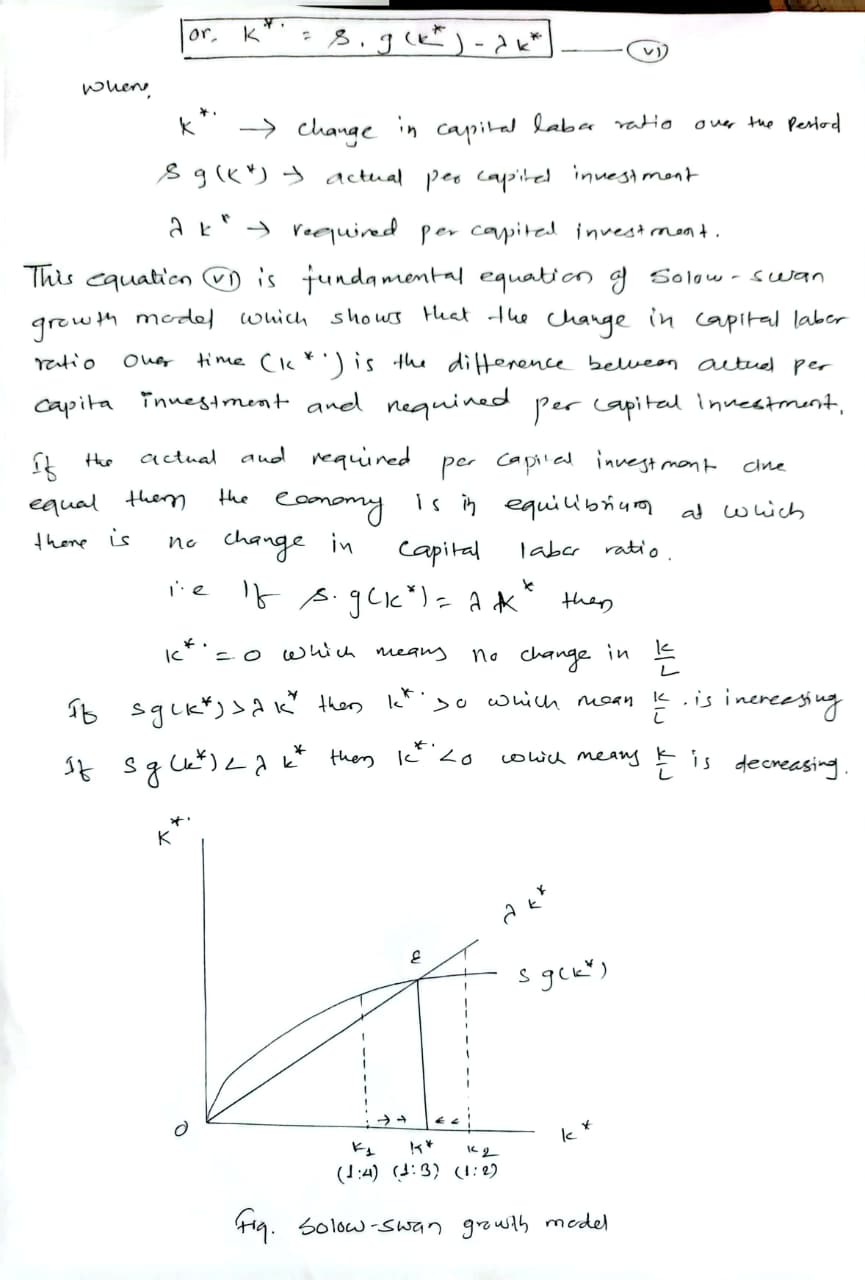
This model argues that capital and labor can be combined in various proportions, and the economy is in a stable equilibrium. So, this model finds the time path of the capital-labor ratio that brings the economy to the stable equilibrium. In this model, technology is improving over the period of time, but it is exogenous, and so this model is also called the exogenous growth model.
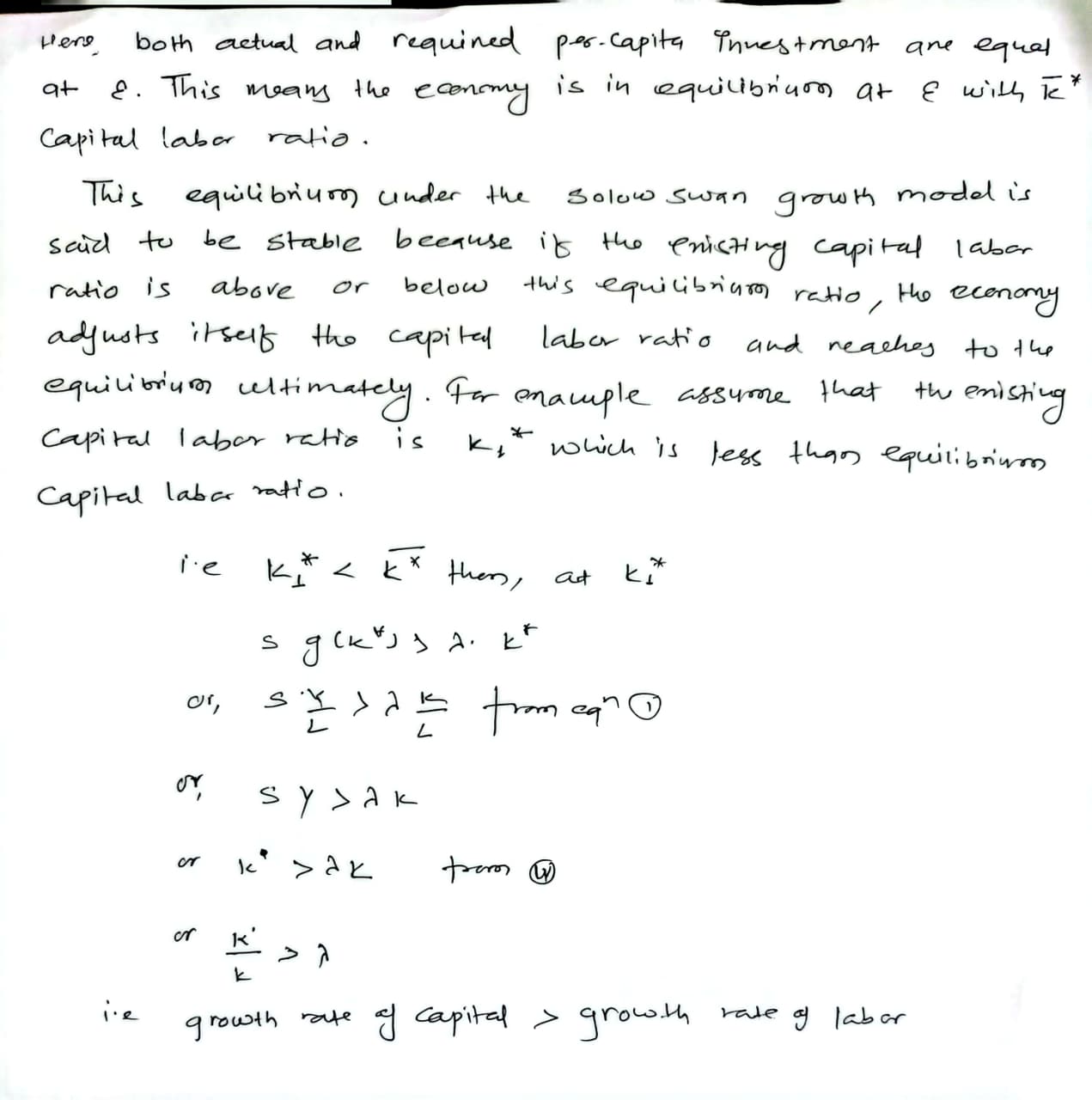
This means if the existing capital labor ratio is less than the equilibrium ratio, then capital is growing faster than labor. So, the capital labor ratio gradually increases and reaches the equilibrium.
Similarly, if the existing capital labor ratio is higher than the equilibrium ratio, then capital is growing more slowly than labor, which gradually reaches the equilibrium capital labor ratio and reaches the equilibrium ultimately.
Once the economy reaches equilibrium, then there is no change in the capital-labor ratio (i.e., K* = 0). Since labor is growing at a constant rate of λ, to keep the capital labor ratio must be kept unchanged. For this, investment, saving, and output all should be growing at the constant rate of λ. As all the variables and parameters are growing at the same constant rate and the economy is in equilibrium, this model is said to rest on the steady state stationary equilibrium.
Implications of the Solow-Swan Growth Model
- Growth determinants/drivers: This model helps the policy makers to identify the determinants of growth, which are identified as saving, investment, and technology.
- Role of Saving: This model shows that an increase in the saving rate has positive implications for economic growth. So, the development of the financial market can help to increase the savings mobilization, which increases the capital-labor ratio and economic growth.
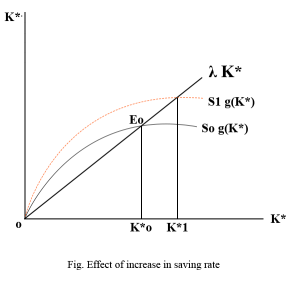
Here, the increase in the saving rate results in a new equilibrium with a higher capital-output ratio. i.e Ko* → K1* such increase in K/L ratio increases the per capital output and growth.
However, there is a limit to increasing the saving rate because it is 0<s<1. Therefore, we cannot increase the saving rate infinitely and cannot grow all the time by increasing savings alone.
- Role of technology: Technology is exogenous in the Solow-Swan growth model. So, the production function with exogenous technology is given as: Y = T(t) f(K, L), where T is the technology that improves over time (t). As the technology improves exogenously, it increases the capital-labor ratio, per capita output, and growth, where technology has unlimited growth potential. So, this model shows that the ultimate source of growth is the exogenous technology.
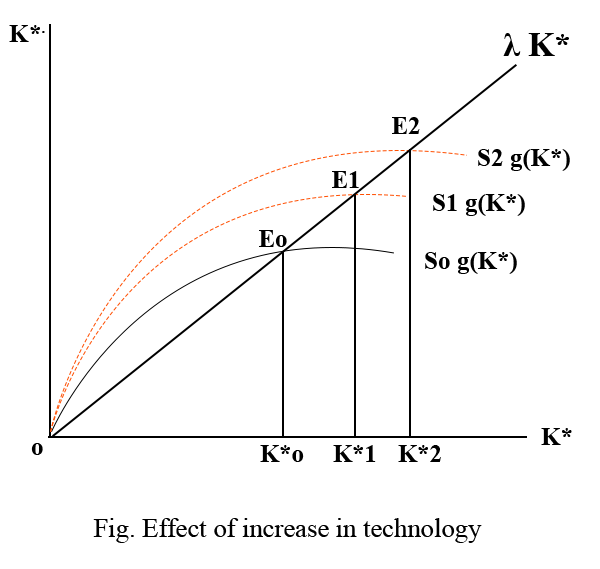
Here, the improvement in technology exogenously shifts the production function upward, which results in the new equilibrium with a higher capital-labor ratio and higher per capita output or growth.
- Explanation of the conditional and convergence hypotheses: This model can be used to explain the conditional convergence hypothesis, which argues that sooner ot later all the economies come to the equal capital labor ratio and equal growth in the long run. This is possible because the developed countries have a higher capital-labor ratio, and there is a lower rate of return on the capital, while in the developing countries, there is a lower capital-labor ratio with higher returns from the capital. So, the capital moves from developed to developing countries while labor moves from developing to developed countries. This reduces the capital labor ratio in developed countries and increases such ratios in developing countries until both countries converge at the same rate of capital labor ratio with the same growth rate. This means the Solow-Swan growth model can explain why the developing countries are growing faster than the developed and the possibility of their convergence in the long run.
Implication of Solow-Swan Growth Model (Summary)
- Growth determinants/drivers
- Role of Saving
- Role of technology
- Explanation of the conditional and convergence hypotheses
Limitations (Criticism) of the Solow-Swan Growth Model
- This model is unable to explain the growth differential across the countries. According to this model, the country with the same growth parameters, such as labor supply and saving rate, should grow at the same rate. However, different countries are growing at different rates despite having similar parameters of growth,
- This model could not explain the increasing returns to scale realized by most of the advanced economies. According to the S-S Growth model, if the exogenous technology is not changed, the economy is growing at a constant rate and shows a constant return to scale. However, the advanced economies were experiencing increasing returns to scale without changing technology exogenously.
- This model ignores the endogenous technology by assuming the technology is exogenous only. This means the model is not able to acknowledge the efficiency and productivity gain through human capital, only through experience, learning by doing, etc.
- The economy can not be in a steady state, a stationary equilibrium, which means the economy can not grow at a constant rate in the long run. Rather, the long-run equilibrium growth rate is found to be increasing over the period.