The effectiveness of the macro policies, such as fiscal policy and monetary policy, depends on the slope or shape of the IS and LM curves. It means the same fiscal and monetary policy may have different outcomes due to the differences in the slope of the IS and LM curves.
1. Slope of the IS curve in monetary policy
Slope of IS Curve = -(1-b)/d
If d is higher = higher interest elasticity of investment. A small fall in interest rate increases investment largely. The flatter the IS curve more elastic it is.
नेपालको सन्दर्भमा IS Curve more steeper छ किन भने Low Elasticity of interest rate छ। किन भने सानो तिनो ब्याजदरमा गरिएको परिवर्तनले लगानीमा खासै धेरै असर गर्दैन। बिकास शिल देशहरुमा लगानी बढाउन अरु धेरै तत्वहरुले भूमिका खेल्ने भएकोले Low interest elasticity of investment हुन्छ र less effective हुन्छ।
The slope of the IS curve determines the effectiveness of monetary policy in terms of growth and employment. If the IS curve is flatter or more elastic, the monetary policy is more effective in promoting growth. This is because the flatter IS-curve implies higher interest elasticity of investment, and so when monetary policy changes, the interest rate changes the investment significantly more than in the case of a steeper IS-Curve.
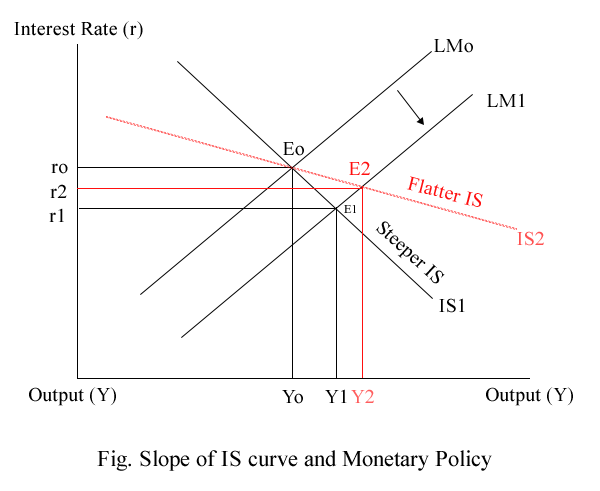
Here, the economy is initially in equilibrium at Eo with ro interest rate and OYo output, irrespective of a steeper (IS1) or flatter (IS2) IS curve.
Now assume that the central bank uses expansionary monetary policy, which shifts the LM-Curve rightward from LM0 to LM1. Then the new equilibrium under the steeper IC-Curve (IS1) is at E1 with r1 interest rate and OY1 output.
Similarly, in the case of a flatter IS-Curve (IS2), such a new equilibrium is at E2 with r2 interest rate and OY2 output.
If we compare these new equilibrium points, we find that the increase in output is higher in the case of a flatter IC-Curve than in the steeper one due to the expansionary monetary policy. This means the flatter the IS curve, the more effective the monetary policy, and it is due to the higher interest elasticity of investment.
2. Slope of the IS curve in Fiscal policy
- The slope is flatter – Monetary policy is more effective
- The slope is steeper- Fiscal policy is more effective
The slope of the IS Curve determines the effectiveness of fiscal policy, where fiscal policy is more effective in a steeper IS Curve. The steeper curve implies the lower interest elasticity of investment, and so if the interest rate increases due to the fiscal policy, the private investment does not fall significantly in comparison to the flatter one. It means there is a lower crowding-out effect in the economy if the IC-Curve is steeper, which makes the fiscal policy more effective.
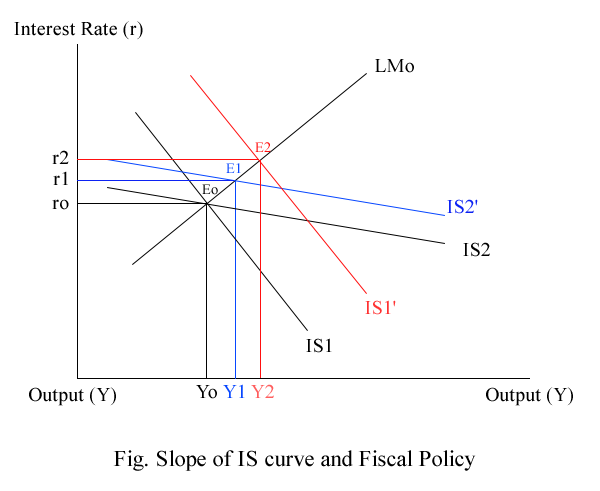
Here, the economy is in equilibrium at Eo with ro interest rate and OYo output, irrespective of a steeper IS curve (IS1) and a flatter IS curve (IS2).
Now, assume that the government uses an expansionary fiscal policy, which shifts IS1 to IS1′ and IS2 to IS2′. Then, the new equilibrium of the economy under the flatter IS-Curve is at E1 with r1 interest rate and OY1 output. Similarly, the new equilibrium of the economy under a flatter IS-Curve will be at E2 with r2 interest rate and OY2 output.
If we compare these new equilibrium points, we find that the increase in output is higher in the steeper IS-Curve than in the flatter one. It is due to the lower crowding effect under the steeper IS-Curve, which represents lower interest elasticity of investment.
3. Slope of the LM curve in Monetary Policy
Slope of LM curve a1/a2, Where
- a1 is the income sensitivity of money demand
- a2 is the interest sensitivity of money demand
The slope of the LM curve determines the effectiveness of monetary policy for growth and employment, where the steeper the LM curve, the more effective the monetary policy. The steeper LM-Curve implies lower interest elasticity of money demand, and so when the monetary policy reduces the interest rate, it increases money demand but lower amount than the case of a flatter LM curve. It means more money comes into circulation, promoting more economic activities and growth if the LM-Curve is steeper.
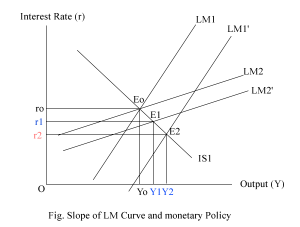
Here, initially the economy is in equilibrium at Eo with ro interest rate and OYo output, irrespective of Steeper LM Curve (LM1) and flatter LM-Curve (LM2).
Assume that the central bank uses an expansionary monetary policy, which shifts the LM curve rightward. The flatter LM Curve shifts from LM2 to LM2′ and the steeper LM Curve shifts from LM1 to LM1′. The new equilibrium point for the steeper LM curve will be attained at E1 and E2 for the flatter LM Curve.
If we compare these new equilibrium points, we observe that the increase in output is greater in the case of steeper than in the flater which is due to the lower interest elasticity of money demand.
4. Slope of the LM curve in Fiscal Policy
The effectiveness of fiscal policy depends on the slope of the LM curve, where the flatter the LM curve more effective the fiscal policy. It is because the flatter LM curve implies higher interest elasticity of money demand, and when the expansionary fiscal policy increases the interest rate, it reduces the money demand significantly, promoting more economic activities and growth.

Here, irrespective of steeper LM1 and flatter LM2, the economy is initially in equilibrium at Eo with ro interest rate and OYo output.
Now, assume that the government uses fiscal policy with the objective of higher growth, which shifts the ISo from IS1. Then, under the steeper LM curve (LM1), the economy attains a new equilibrium at E1 with a higher interest rate r1 and OY1 output. But in the case of a flatter LM curve (LM2), the new equilibrium is at E2 with r2 interest rate and OY2 output.
If we compare these new equilibrium points E1 and E2, we find that the increased output is higher for the flatter LM curve. It means fiscal policy is more effective if the LM curve is flatter. This is due to the higher interest elasticity of money demand represented by the flatter LM curve.
Slope of IS-Curve
- For flatter, Monetary Policy is effective
- For steeper, Fiscal Policy is effective
Slope of LM-Curve
- For steeper, monetary policy is more effective
- For flatter, fiscal policy is more effective