
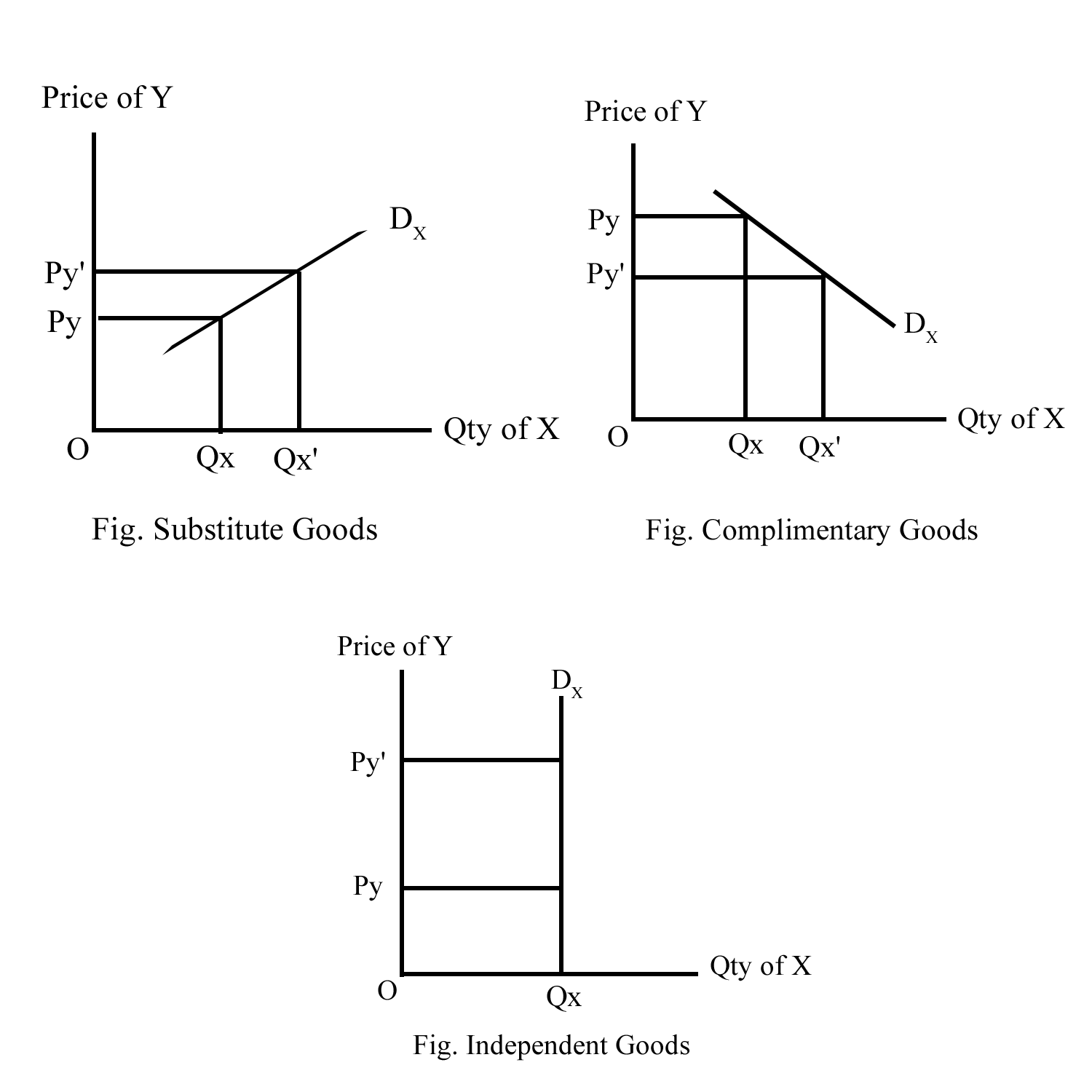
Cross Elasticity of Demand is defined as the change in the quantity demand of X when the price of Y increases and decreases. Cross Elasticity of Demand lets us know the relationship between two products if they are SUBSTITUTE, COMPLEMENT, or INDEPENDENT to each other. Cross Elasticity of Demand (Exy) can be shown as

- Or, Exy = Proportionate Change in quantity demanded of X/Proportionate Change in Price of Y
- Exy = ΔQdx/ΔPy * Py/Qdx
Exy measures the degree of responsiveness of the quantity demanded of a product due to a change in the price of another product. It can be positive, negative, or zero.
Exy > 0, then X and U are substitute products
If price of tea increases, demand of coffee increases or If price of coke increses, demand of pepsi increases. If चियाको भाऊ बढ्यो भने कफीको माग बढ्छ किन कि कफी र चिया एक अर्काको Substitute Product हुन्। मान्छेले चिया खानुको सट्टा कफी खान थाल्दछन।
Exy < 0, then X and U are complementary products
If price of ball pen increases, the demand of refill will decrease. बल पेनको मूल्य बढ्यो भने धेरै बल पेन खरिद हुदैन र Refill को माग पनि घट्छ। किन कि जति धेरै बल पेन त्यति धेरै Refill आवश्यक पर्दछ।
Exy = 0, then X and U are independent products
There exists no relationship between the two products.
Uses/Importance of Cross Elasticity of Demand
- To identify the nature of related products
- To design appropriate pricing and output strategy
- If X and Y are substitutes, then the firm producing X should either increase its price or produce more quantity if the competitive firm producing Y increases its price.
- Similarly, if X and U are complements, then the firm producing X should increase its output, or the price of the other firm producing Y should reduce the price.
- To identify the competitor firms and design the appropriate policy.
- If the products are substitutes, then the firms are competitive. Where the limited substitution between X and Y indicates limited competition, and higher substitution means serious competition between them. So, the firms producing X and Y can compete through price reduction and other facilities to the clients, or can go for collusion (cartelization).
- To make a merger and acquisition decision
- If the Exy is highly positive, i.e., a high degree of substitution between the products of the firm, then it is better to go for mergers and acquisitions to reduce costs and increase profit.
- To design appropriate pricing of complementary products
- If the products are complements, the firms may sell the base product at a lower price and the complement at a higher price for higher profit.
- To design appropriate government policy
- If the products are substitutes, then there is a chance of merger and acquisition to control the market by creating a monopoly. Here, the government should regulate the market as well as execute anti-trust policy to avoid private monopoly creation through mergers and acquisitions.
- Similarly, if there is a substitution between domestic and foreign products where the domestic products are not able to compete, then the government can provide tax incentives and subsidies to domestic products.
- In the case of compliments, the government can design an appropriate tax or subsidy policy. For example, electricity and EVs are complements. Where the government has priority to use more domestically produced electricity and discourages the importation of petroleum products. So, the government offers tax incentives for EVs.
Other posts
- Price Elasticity of Demand (Ep) – Examples and Uses
- Income Elasticity of Demand (EI) – Examples and Uses