
Income Elasticity of Demand (EI): उपभोक्ताको आयमा आएको परिवर्तनले मागमा आउने परिवर्तनको मात्रा
It is the change in the quantity demanded due to the change in the income level of the consumer.

Or, EI = Proportionate Change in Qd/Proportionate Change in Income (I)
- EI measures the degree of responsiveness of the quantity demanded due to a change in the income of the consumer.
- EI can be positive or negative.
- If EI > 0, then it is a normal good
- If EI < 0, then it is an inferior good.
i.e. Normal good: If I↑, Qd↑ or I↓ Qd↓ = Ei > 0 and,
Inferior Good: If I↑, Qd↑ or I↓, Qd↓ = Ei < 0
* If Ei>1, it is a Luxurious product
* If 0<Ei<1, it is a necessary product
i.e. Luxurious product: % change in Qd > % change in income.
Necessary product: % change in Qd < % change in change in income
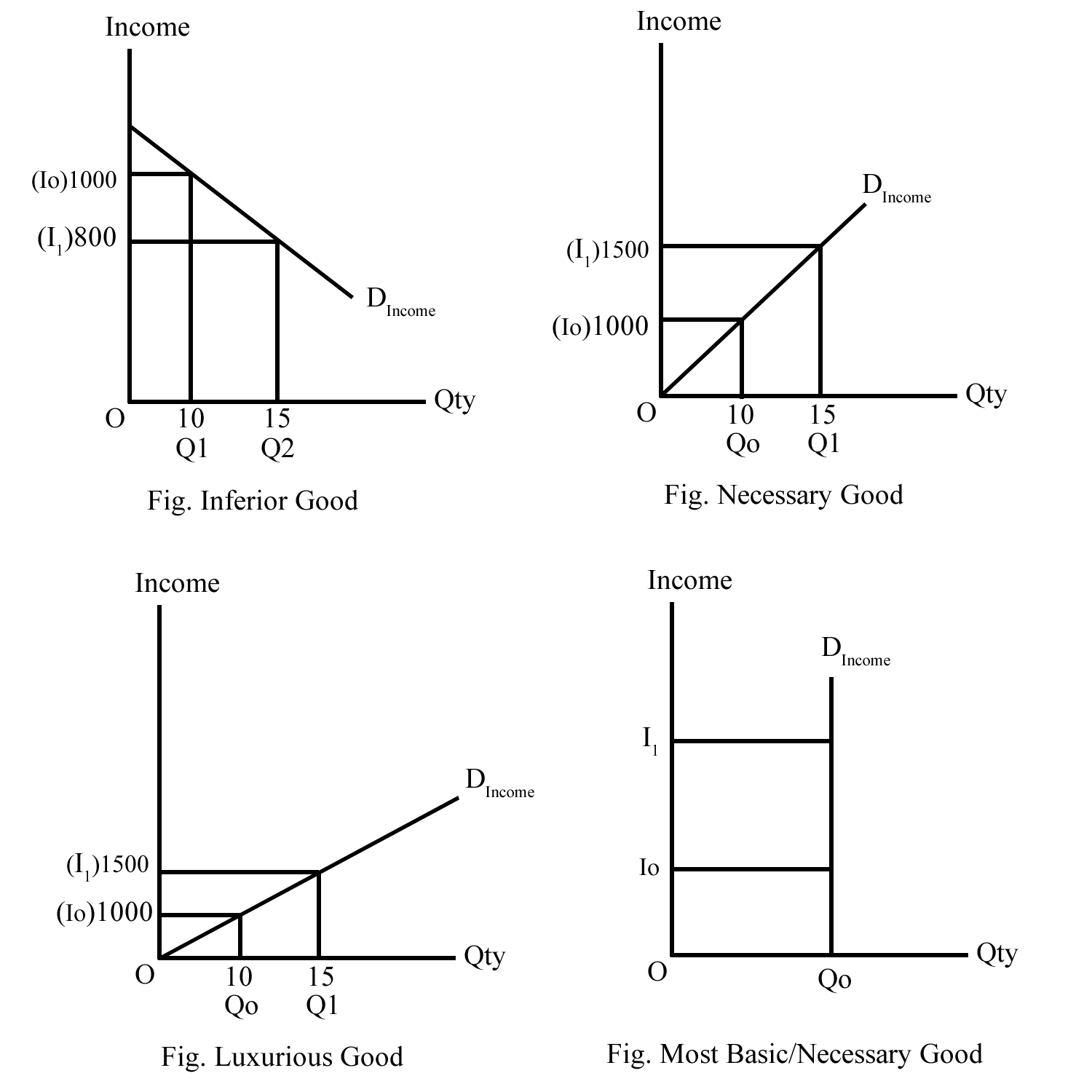
Uses/Implications of EI:
- To identify the nature of the product and market segmentation.
- If EI <0, then the inferior product
- If EI >0, then the luxurious product
- If 0<EI <1, then the necessary product
- If EI =0, then the most necessary product
- To design an appropriate strategy for the firm.
- If the product is luxurious, its demand declines rapidly during a recession and increases more quickly than consumer income grows during economic prosperity. So, the firm can have appropriate production planning and pricing decisions.
- In the case of inferior, their demand increases during a recession and decreases during economic recovery and prosperity. So, the income elasticity helps the firm make appropriate pricing and output decisions.
- To decide on market expansion.
- If the product is luxurious, then its demand grows faster in an economy where income is increasing. So, the firm can expand the market in those areas where income is growing.
- Similarly, in the case of an inferior good, the demand increases when income is lower. So, the firm producing an inferior product should diversify or expand into areas where the income is low.
- To make demand forecasting and production decisions.
- Due to the nature of the product, its demand changes differently in different economic situations. For eg, the demand for luxurious products increases faster than income when the economy is in recovery or prosperity. So, based on EI, it is possible to forecast the demand of the product during the business cycle and make appropriate output and pricing decisions.
- To design appropriate government policy on taxation and subsidy
- The government generally imposes a higher tax on luxurious products and a lower tax on necessary products. So, income elasticity helps to identify the nature of the product and the tax accordingly.
- Similarly, some products that are important for the local economy but over the period of time become inferior, as the economy develops due to poor quality, branding, and marketing.
So, the government should provide subsidies and other support for those inferior products to improve their standard and make them normal.