Inflation is defined as a continuous and substantial rise in the general price level. It is a situation in which the value of money or purchasing power is continuously declining, increasing the cost of living in society.
Types of inflation based on speed/intensity
- Annual below 3% ⇒ Creeping or Crawling
- Annual 3% – 5% ⇒ Walking
- Annual 5% – 10% ⇒ Running
- Annual 10% – 20/25% ⇒ Galloping
- Monthly 25% or more ⇒ Hyper Inflation
There are different approaches to explain inflation, and they are
1) Classical Approach to Inflation (Due to Money Supply)
For the classicist, there is a positive and proportional relationship between money supply and general price level. So, an increase in money supply increases the general price level in the same proportion and creates inflation.
To explain this, the classicist uses the quantity theory of money, where the Fisherian equation of exchange given by this theory is
Where:
- M = Quantity of money (Stock)
- V = Velocity of money (constant)
- P = General Price level
- Y = Real output (given)
Here, the velocity of money (V) is assumed to be given because it depends on the spending behavior of the general public, which is not changed in the short-run.
Similarly, for the classicist, the economy is always at full employement and so real output (Y) is given that the increase in money supply increases the price level in the same proportion.
This means the increase in money supply is the sole reason for inflation in the classical approach.
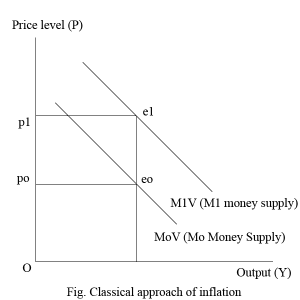
Here, the economy is initially in equilibrium at eo with P0 price level when the money supply is Mo, i.e. MoV = PoY
Now, assume that the central bank increases the money supply from Mo to M1, then the economy attains a new equilibrium at e1 at a higher price level p1. i.e. M1V = P1Y
Such an increase in price level and money supply is equal in proportion.
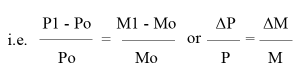
This means inflation is a purely monetary phenomenon and can be controlled by the monetary policy according to the classical view (approach).
2) Keynesian View Approach to Inflation (Due to Aggregate Demand)
Under the Keynesian view, inflation is due to an increase in aggregate demand, and if the increase in aggregate demand increases both the price level of output, it is semi inflation where as if the increase in AD increases the price level only but not the output, it is real inflation.
- AD↑⇒ Price Level↑ & Output ↑ = Semi Inflation
- AD↑ ⇒ Only Price Lecel ↑ – Real Inflation
वस्तुको माग बढ्दा मुल्य संग संगै आपूर्ति पनि बढ्यो भने Semi Inflation मात्र हुन्छ तर माग बढ्दा मूल्य मात्र बढ्यो आपूर्ति बढेन भने त्यो Real Inflation हुन्छ।
So, if the economy is below full employment, the increase in AD creates semi-inflation, and if the economy is in full emplpyement then the increase in AD creates real inflation. The AD can increase from both monetary sector or real sector.
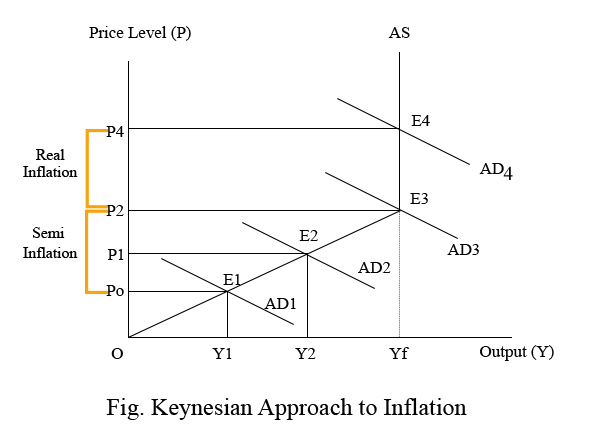
Here, OYf is the full employment level of output at which the aggregate supply curve is perfectly inelastic (vertical), but below OYf, the AS curve is upward sloping, implying that the economy can supply more if the price level increases because the economy has not reached its full capacity or full employment.
Initially, the AD is AD1 and the economy is in equilibrium at E1 with P1 price level and OY1 output, which is less than the full employment level of output.
Now, assume that aggregate demand increased to AD2, then the economy attains a new equilibrium E2 with a higher price level p2 and higher output OY2. This shows that both price level and output are increasing, which is semi-inflation, and such inflation continues until the AD increases to AD3, and the economy attains full employment equilibrium at E3 with price level P3.
If the aggregate demand further increases to AD4, then only the price level increases to P4, and the output is given as OYf; such an increase in price level only is called real inflation.
3) Modern View/Approach to Inflation: (Due to Aggregate Supply)
This approach to inflation shows that inflation is due to the supply side of the economy, with the fall in aggregate supply under the given aggregate demand, which increases the general price level.
This approach to inflation come to existance due to the Oil Shock Crisis of the 1970s when the OPEC countries reduced the production or supply of the petroleum products hugely. This led to the shortage of products and ultimately caused the price hike.
Before the 1970s, inflation was regarded as the demand side issue, but the oil crisis of the 1970s made inflation a supply side issue as well, which is known as the modern view of inflation.

Here, the economy is initially in equilibrium at E1 with P1 price level and full employment level of output OYf. Now assume that due to any reasons as a fall from AS1 to As2 then the new equilibrium is at E2 with a higher price level p2.
This increase in price level from P1 to P2 is due to a fall in AS, and such inflation is explained by the modern approach.
Inflation Status and Causes in Nepal
The Nepalese economy is experiencing moderate inflation, with average annual inflation around 5% over the last decade. However, inflation volatility is a common phenomenon globally.
The Consumer Price Index (CPI) is the primary measure of inflation, and while CPI-based inflation was estimated at around 5.4 % in FY 2023/24, it moderated significantly in FY 2025/26, with year-on-year inflation reported at approximately 2.4 % in mid-January 2026, reflecting much lower price pressures in the current fiscal year.
In Nepal’s case, the inflation for the food and beverage group is generally higher than non-food items over the year. This is due to lower agricultural productivity and the growth of this sector.
Causes of Inflation in Nepal
Theoretically, inflation can originate from demand, supply, or structural factors, but the actual or measured inflation is the result of all such demand, supply, and structural factors.
In Nepal as well, inflation is due to all of such factors, though the extent or degree of them may be different.
The major factors responsible for inflation in Nepal are:
- Increase in consumption expenditure due to disposable personal income, mainly from the increasing inflow of remittance income.
- Increase in Government expenditure specially recurrent expenditure, due to state restructuring and increasing social security expenses.
- Increase in private investment specially the urban-centric sector and in less productive sectors such as real estate and the stock market.
- Increase in wage rate faster than productivity due to shortage of labor, trade union pressure, and government policy of increasing wage rate.
- Imports of Indian inflation due to the trade concentration with India and the pegged exchange rate system between NPR and INR.
- Frequent natural disasters such as floods, droughts, landslide etc.
- Poor government regulation due to capacity constraints, political protection for businessmen, and poor public support.
- Highly imperfect market structure with common cartelization, syndicate, artificial shortage, and price hike practices.
- Increasing layers of middlemen due to poor supply chain management.
- Depreciation of NPR against foreign currencies like USD, EURO, etc.
- Increase in price of the petroleum products and pass through its price on overall goods and services.
- Poor public awareness on value of money and the growing consumerist culture.
- Increasing price of the commodity in the global market and its effect being importer countries.
- Lack of timely updated policies and laws related to the control of unfair market practices, with effective reward and punishment instruments.
Other Notes