- If Aggregate Demand < Aggregate Supply = Price fall Recession/Depression
- If Aggregate Demand > Aggregate Supply = Price rises = Hyperinflation
- If AD = AS, then optimim price level is constant to full employment equilibrium.
Price stabilization refers to maintaining the price level consistent with the full employment equilibrium of the economy. It means the price level is to be regulated so as to maintain AD = AS at the full employment level of output.
i.e. AD = ASF
If AD > ASF then, there is recessionary pressure in the economy. If AD < ASF then, there is inflationary pressure in the economy. So, to maintain If AD = ASF is the stabilization of the economy and the price level that is maintained, AD = ASF is the optimum or desired price level.
The monetary policy can be used for price stabilization, where the policy regulates the AD and maintains AD = ASF at full employment. To stabilize the price level at full employment, the central bank uses the contractionary policy if AD > AS.
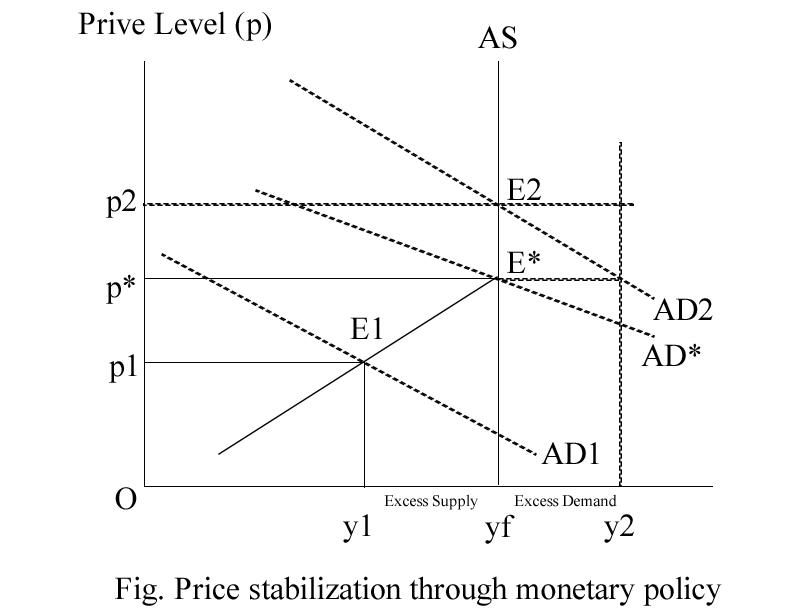
Here, P* is the optimum/desired price level at which the economy attains full-employment equilibrium at E* with a full-employment level of output Oyf, where AD* is the aggregate demand compatible to full-employment.
To maintain such an optimum price level p*, monetary policy regulates the aggregate demand in such a way that such AD becomes AD*. If the AD is AD1, then the economy is in equilibrium at E1 with below full-employment output. i.e. Oy1 and p1 price level. Since the capacity of the economy is not fully utilized, it discourages investment, aggregate demand and price level declines from p1, and the economy falls into recession and ultimately to depressiom. So, monetary policy can react by executing expansionary instruments, such as a reduction in CRR, SLR, Bank Rate, purchase of financial instruments from the bank through repo, and outright purchase as well as liberal credit policies. To increase the AD in such a way that the AD increases to AD*, and the economy is to attain the desired level of price level at p*.
Similarly, AD is AD2, then there is excess AD of E*D’ or yfy2 at the desired price level p*. And so the economy is in equilibrium at E2 with a higher price level p2. This price level is higher than the optimum or desired level p*, and so the central bank enforces contractionary MP with the instruments, such as increasing CRR, SLR, Bank Rate, Repo, outright sale, including credit restriction or tightening. This helps to reduce the AD, and the economy can attain full employment at E* with the desired or optimum price level.
This process of attaining a desirable price level by regulating AD through monetary policy is price stabilization.