This theory is primarily concerned with explaining why people demand money. According to Keynes, people demand money primarily for 3 different purposes.
- Transaction motive (दैनिक खर्च चलाउन)
- Precautionary motive (भैपरी आउने खर्च टार्न)
- Speculative motive (लगानी गरेर मुनाफा कमाउन)
1. Transaction Motive of Money Demand (LT)
People demand money for financing their daily (regular) and planned expenditures. Such demand for money is called transaction demand for money, and it is assumed to be a positive function of income.
i.e. LT = f(Y), f’>0
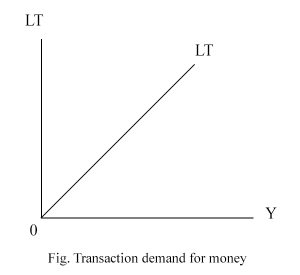
This shows that as the income increases, money demand also increases because the higher the income, the higher the expenditure, and to finance such higher expenditure, people demand more money.
2. Precautionary Motive of Money Demand (LP)
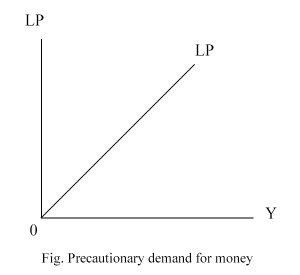
People hold some money to meet some unexpected or contingency expenses, which is the precautionary demand for money, and it is also a positive function of income.
LP = f(Y), f’>0
3. Speculative Motive of Money Demand (LP)
People hold some money for investment on bond, which is the speculative demand for money. Under the Keynesian theory, the assets portfolion consists of either cash or bonds. So, if the interest rate is higher, people buy bond the reduce the cash holding in the economy.
Similarly, is interest rate is low, which means the return from the bond is low, at that time people hold more money. This means the speculative demand for money is an inverse function of interest rate.
i.e. LSP = f(r), f’ < 0
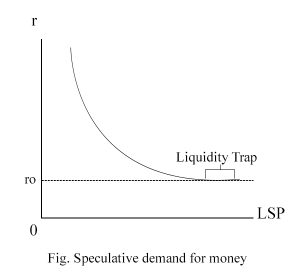
This shows that as the interest rate declines, LSP increases. At the critically low level of interest rate (ro), the speculative demand for money is perfectly elastic, indicating the situation of liquidity trap. In this situation, the interest rate (rate of return) is already at a critically low level, and the whole money is trapped or held by the public.
Therefore, the Keynesian theory of money demand shows that people demand money for transaction, precautionary, and speculative motives. Both transaction and precautionary demand for money are the positive function of income, whereas speculative demand for money is an inverse function of interest rate. So, the Keynesian money demand function is given as
Md = f(Y,r) fY > 0 and fr < 0