In the previous note, we discussed the different approaches to inflation. Now we explain the types of inflation based on the causes. Basically, there are three types of inflation.
- Demand Side or Demand Pull Inflation
- Supply Side or Cost-Push Inflation
- Structural Inflation
1. Demand Side or Demand Pull Inflation
If aggregate demand increases under the given aggregate supply, it increases the general price level, known as demand-side inflation.
It means the excess aggregate demand pulls the general price level or creates inflation.
When AD↑ ⇒ AS’ then Price ↑
Aggregate demand increases due to the following reasons
- Increase in government expenditure (G↑)
- Increase in private investment (I ↑)
- Increase in net export (X-M) ↑
- Reduction in tax ↓
- Reduction in savings ↓
- Increase in transfer income ↑
- Increase in money supply (MS↑)
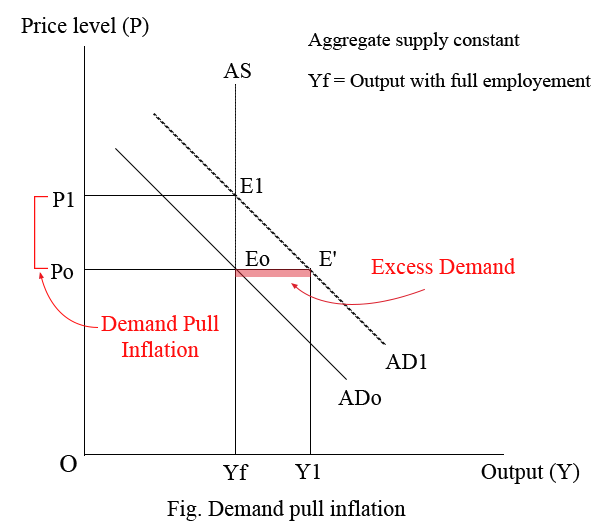
Here,
- The economy is initially in equilibrium at Eo with Po price level and full-employment level of output OYf.
- Now, assume that government expenditure increases, which increases the aggregate demand from ADo to AD1, and under the given price level P,o there is excess demand of EoE’ = YfY1.
- This excess demand increases the general price level gradually, and once it reaches E1, the economy attains a new equilibrium with a full employment level of output. This increases the price level from Po to P1, and it is the demand-pull inflation.
- So, demand-pull inflation occurs due to excess Aggregate Demand in the economy.
2. Supply Side (Cost Push) Inflation:
If aggregate supply (AS) declines under the given aggregate demand, it increases the general price level known as supply-side inflation.
i.e. If AS↓ but AD (constant) = then P↑
Generally, aggregate supply declines due to the increased cost of production if the AD is given. So, the supply-side inflation is also called cost-push inflation, but all supply-side inflation may not be cost-push.
The major factors responsible for creating supply-side inflation are:
- An increase in the wage rate faster than labor’s productivity (wage-push inflation).
- Shortage of all factors, such as the raw materials, land, labor, and capital (input shock inflation).
- Intentional operation of the plants below full capacity by the firms with monopoly power (profit push inflation).
- Natural disasters such as landslides, floods, droughts, or any other crisis.
- Political crises such as political instability and strikes, political conflicts with major trading partners, etc.
- Social crises such as civil war, religious war, and social conflicts and uncertainty.
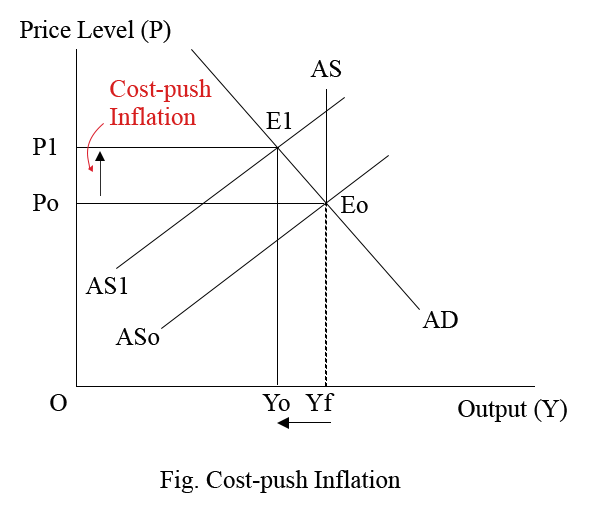
Here,
- The economy is initially in equilibrium at Eo with Po price level and full-employment level of output OYf.
- Now, assume that there is a shortage of labor in the economy, which increases the labor cost, and the AS declines so that ASo shifts to AS1, and under the given AD (fixed), the economy attains a new equilibrium at E1 with a higher price level of P1 and a lower level of output OY1.
- This increasing price level from Po to P1 is cost-push or supply-side inflation. Such supply-side inflation shows that not only does the price level increase, but also the output declines.
- When the output or production declines, the unemployment increases, which means on the supply side, both inflation and unemployment are simultaneously increasing, which is known as the problem of stagflation. This is why supply-side inflation is more dangerous than demand-side inflation. Because the supply side decreases the existing output, while the demand side only increases the demand.
- Unemployment + Inflation = Stagflation
3. Structural Inflation
If the general price level is increasing despite the given AD and AS, it is structural inflation. It is said that there are various structural barriers to the economy which create inflation, and such structural problems are more serious in developing countries than in developed.
The major structural problems that create inflation are:
- Infrastructural bottlenecks/problems: Poor transportation, communication, infrastructure, storage facilities, and poor quality of human resources.
- Imperfect market structure: Cartelization, syndicate, artificial shortages, price hike, asymmetric information, moral hazard, adverse selection.
- Poor government regulation: Irregular and seasonal types of regulation, poor capacity of regulation, and political protection for businessmen.
- Poor public awareness: Poor awarness on value of money, poor awareness of consumers’ rights and responsibilities, consumerism culture, and demonstration effect.