Theories of Demand in Microeconomics
In microeconomics, the theories of demand explain how consumers decide what and how much of a good or service to buy, given their income and the prices of goods. Here is an explanation of major demand theories:
Types of consumer behavior
A) Cardinal Approach of Utility Analysis (Marshallian Approach): This approach to utility analysis argues that utility or satisfaction can be quantified or measured in cardinal numbers, i.e, absolute numbers. It means a consumer can express the amount of utility in a numerical value derived from the consumption of a particular commodity.
Basic Assumptions:
- Rationality: Consumer tries to maximise the utility
- Cardinal measurement of utility
- Diminishing marginal utility of a commodity
- Marginal utility of money remains constant
- Independence of utility from different commodity (प्रत्येक वस्तुहरुबाट प्राप्त हुने utility फरक फरक हुन्छन )
Two basic laws under Cardinal Utility:
#Law of diminishing marginal utility (First law of Gossen): This law states that the additional utility from an additional unit of a particular commodity continuously declines. It means the total utility of a commodity is increasing at a decreasing rate and it reaches a maximum, then ultimately declines when the marginal utility is ZERO.
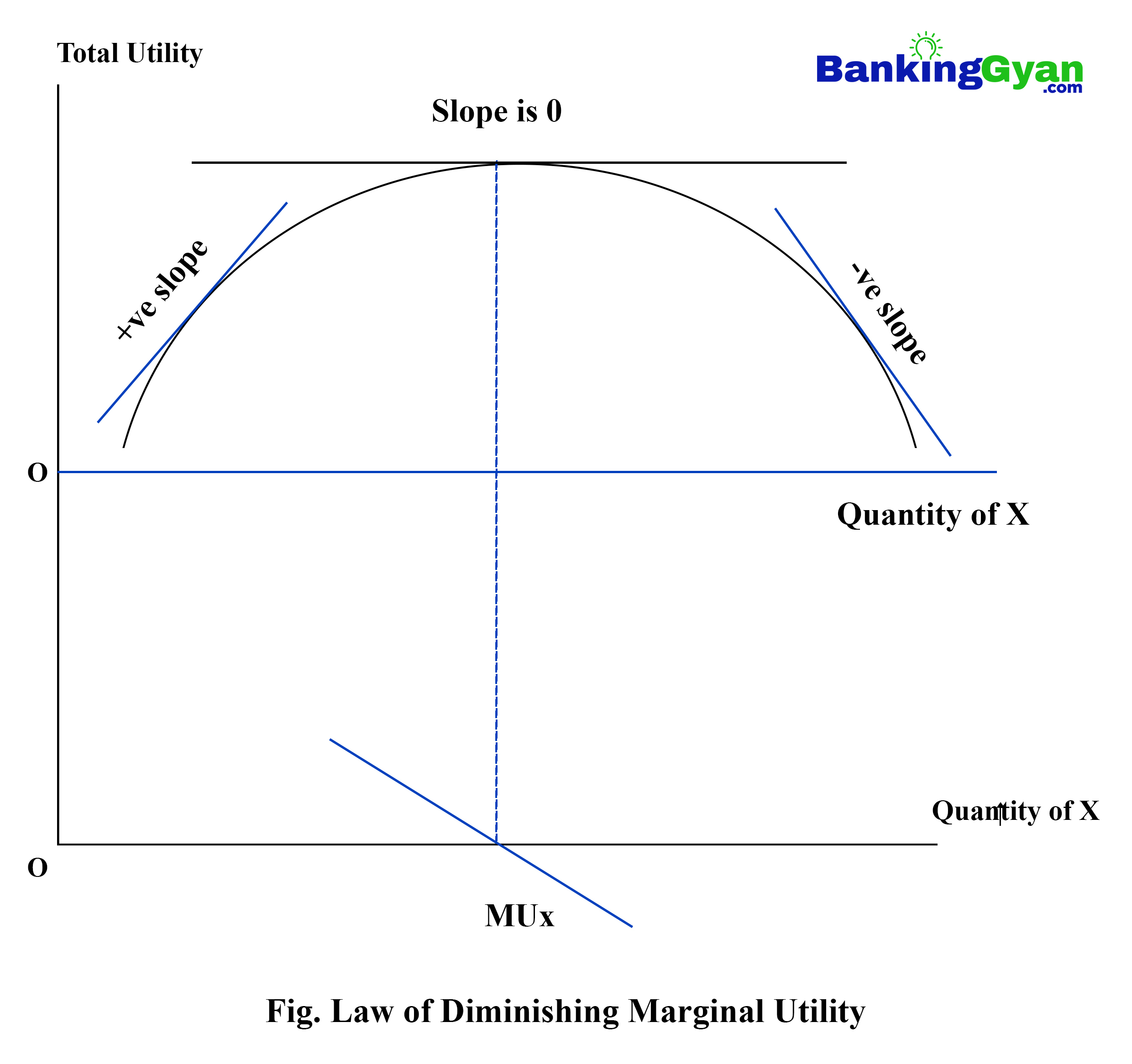
Marginal Utility (MU) = ΔTotal Utility/ΔQ. Marginal utility is the slope of the total unit. It is also the rate of change of the total unit.
Here,
Initially, total utility from X is increasing at a decreasing rate, which makes marginal utility decreasing but positive.
At Q* units of consumption, total utility is maximum MU = O
If the consumer consumes more than Q*, total utility declines, or marginal utility is negative. In this case, the rational consumer consumes Q* unit of X at which the total utility is maximum, or the marginal utility is ZERO.
#Law of equi-marginal utility (Second law of Gossen):
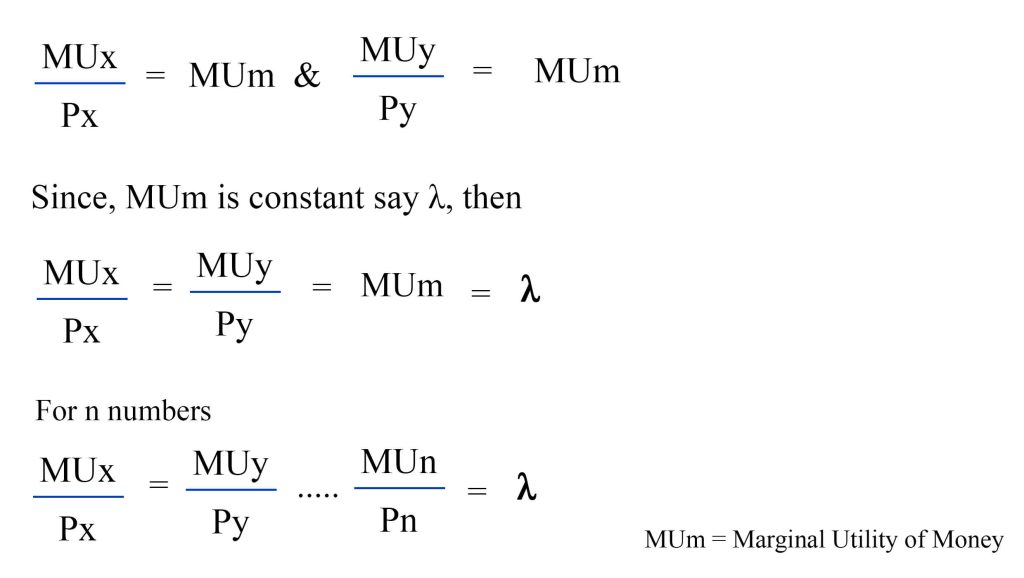
This law states that a rational consumer allocates his or her given income in different commodities in such a way that the ratio of marginal utility and its respective price of each should be equal to the marginal utility of money.
Let X and Y be two commodities with respective prices Px and Py, then according to the law of equi-marginal utility, the consumer maximizes utility when
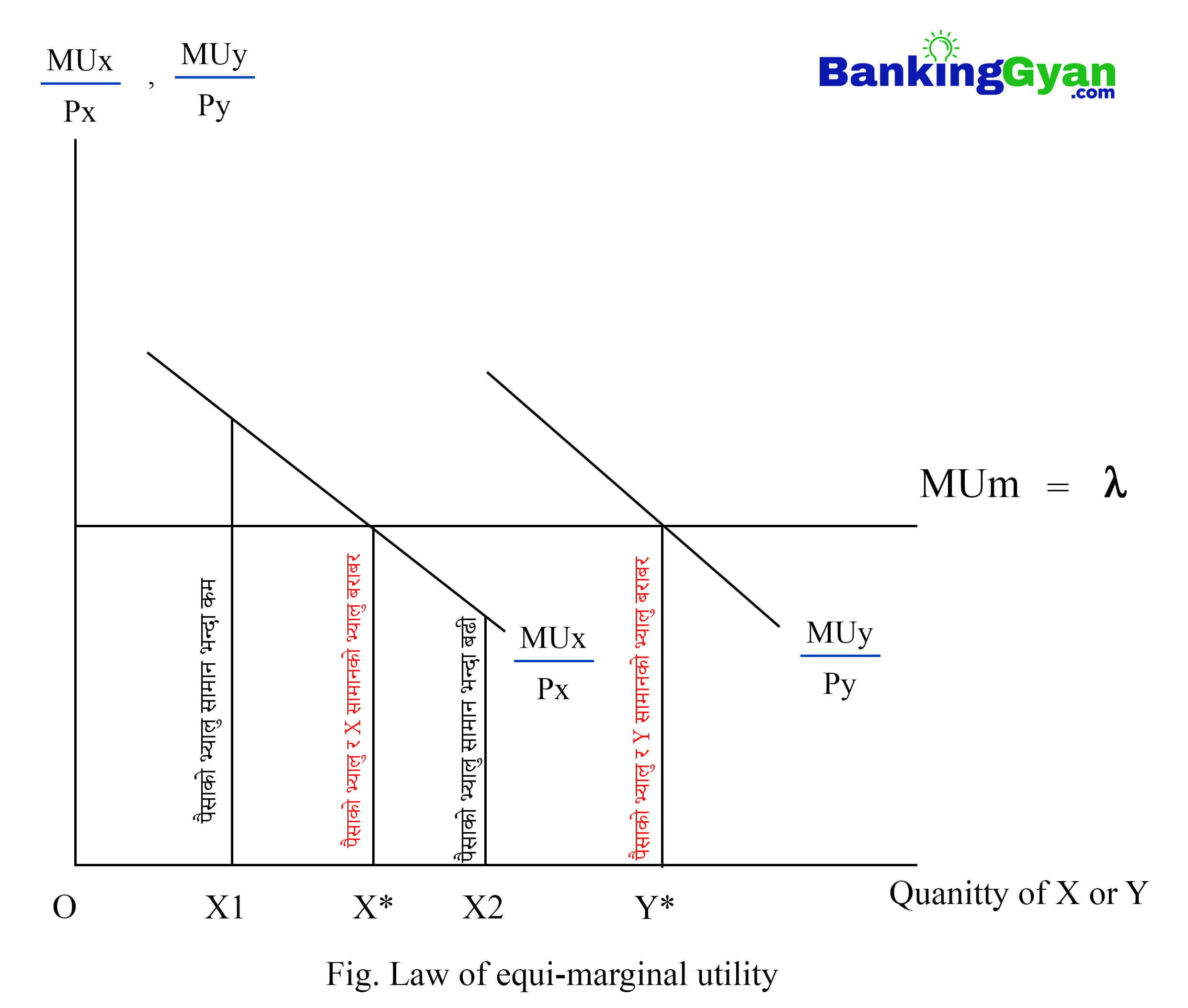
When the marginal utility (MU) of money is equal to λ, it is the optimum point where the consumer buys the good. Consumer does not buy below and above the (MU) = λ.
Here, when a consumer consumes OX* quantity of X and OY* quantity of Y, they tend to attain the maximum utility.
A) Ordinal Approach of Utility Analysis (Hicks-Allen Approach):
This approach is also called the Indifference Curve (IC) approach of demand analysis. This approach of utility analysis can not quantify the exact utility/satisfaction in numbers from the assumption of any bundle. Rather, we can rank the preferences based on the utility or satisfaction. This means preference can be ranked in ordinal numbers but can not be quantified.
Basic Assumptions:
- Rationality: Consumer tries to maximize the utility
- Consistency: The choices A and B are said to be consistent if A>B then B≠B.
- Transitivity: The choices A, B, and C are said to be transitive if A > B, B > C, then A>C.
- Completeness: The preference/choice between A and B is said to be complete if the consumer can express his/her preference as A>B or A=B or A<B.
- Diminishing marginal rate of substitution (DRS): It is the rate at which a commodity is substituted for another to keep the same level of satisfaction/utility, and such a rate is diminishing.
- Non-satiety (Not satisfied): Not fully satisfied, and so more quantity is preferred. i.e., A consumer is not fully satisfied, so he/she prefers more and more. (More quantity gives more satisfaction)