What is an Indifference Curve?
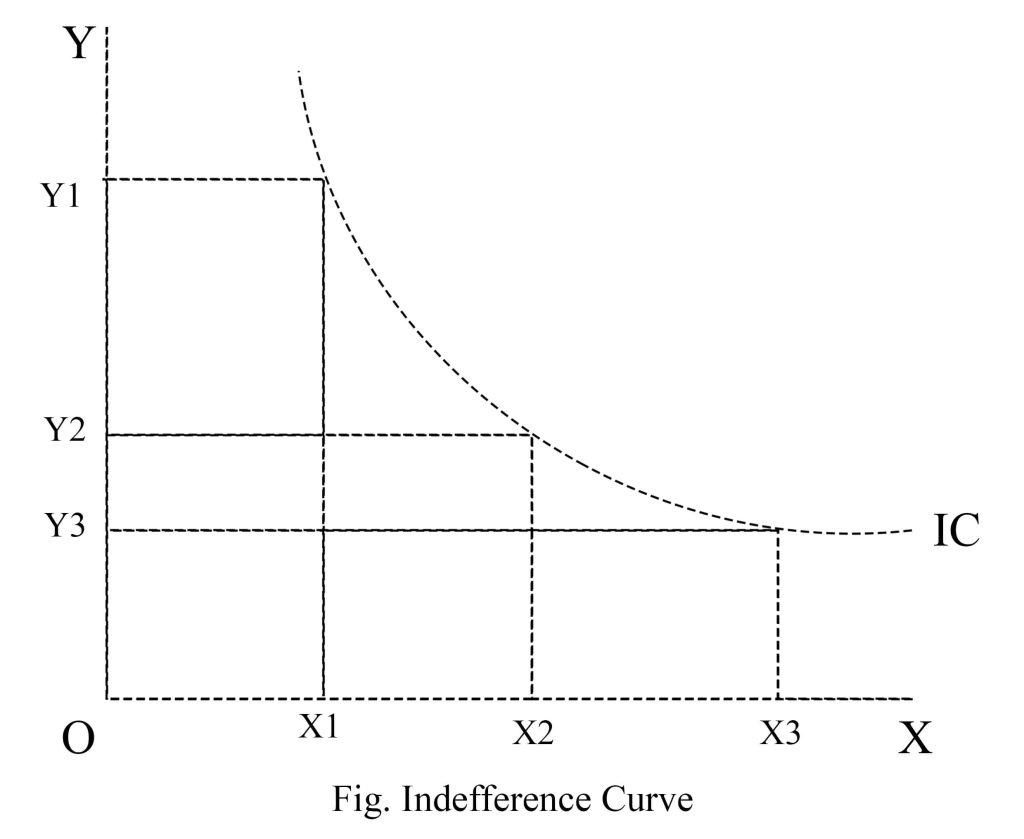
- An indifference curve (IC) is the locus of a point that represents the same level of utility given by various combinations of any two commodities.
- An IC is an analytical tool used under the ordinal approach of consumer behavior.
- Every point of IC has the same level of utility. If one commodity decreases, the other commodity fills the need to meet the consumer’s satisfaction level.
Basic Properties of Indifference Curve (IC)
#Downward sloping:
Due to substitution between the same commodities (X and Y), to keep the same level of satisfaction.
In order to keep the constant level of utility, the consumer has to reduce the quantity of one product as the quantity of another product is increased.
Let U =f(x,y) be the utility function of the customer. Along the indifference curve, the is no change in utility level. i.e ΔU = ZERO. Or MUx Δx + MUy Δy = 0
MUx Δx = – MUy Δy
Δx / Δy = – MUx/MUy
Slope of IC = Δx / Δy = – MUx/MUy < 0 [Since MUx > 0, MUy > 0]
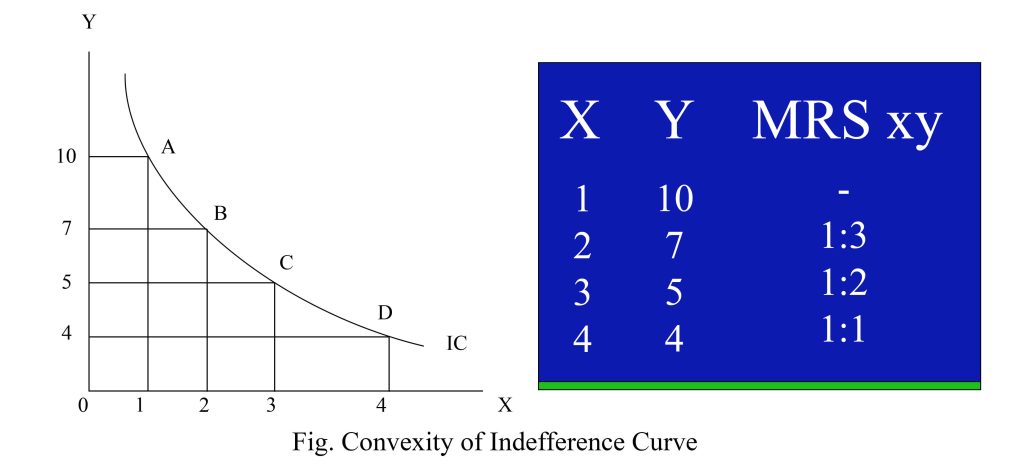
#Convex to the origin:
Due to the diminishing marginal rate of substitution between two commodities.
#Does not touch either of the axis:
Because X and Y are not perfect substitutes so the utility given by both X and Y can not be received from either X only or Y only.
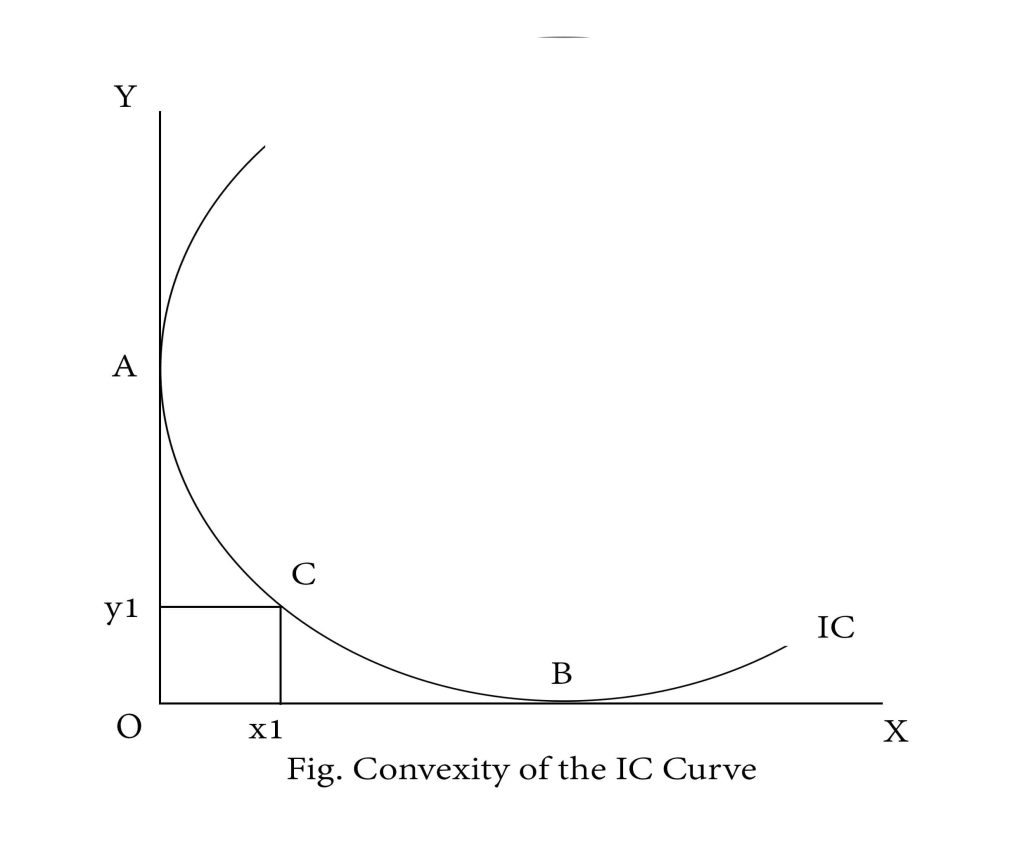
Here, if the IC touches the X-axis at B only y-axis at A, it shows that OB quantity of X alone or OA quantity of Y alone can give the same level of satisfaction given by Ox1 and Oy1 units of X and Y combined. This is ruled out because the utilities from X and Y are different can not be a perfect substitution.
#Higher IC means higher satisfaction (utility):
Due to the non-satiety assumption, a higher bundle of commodities gives a higher level of satisfaction.
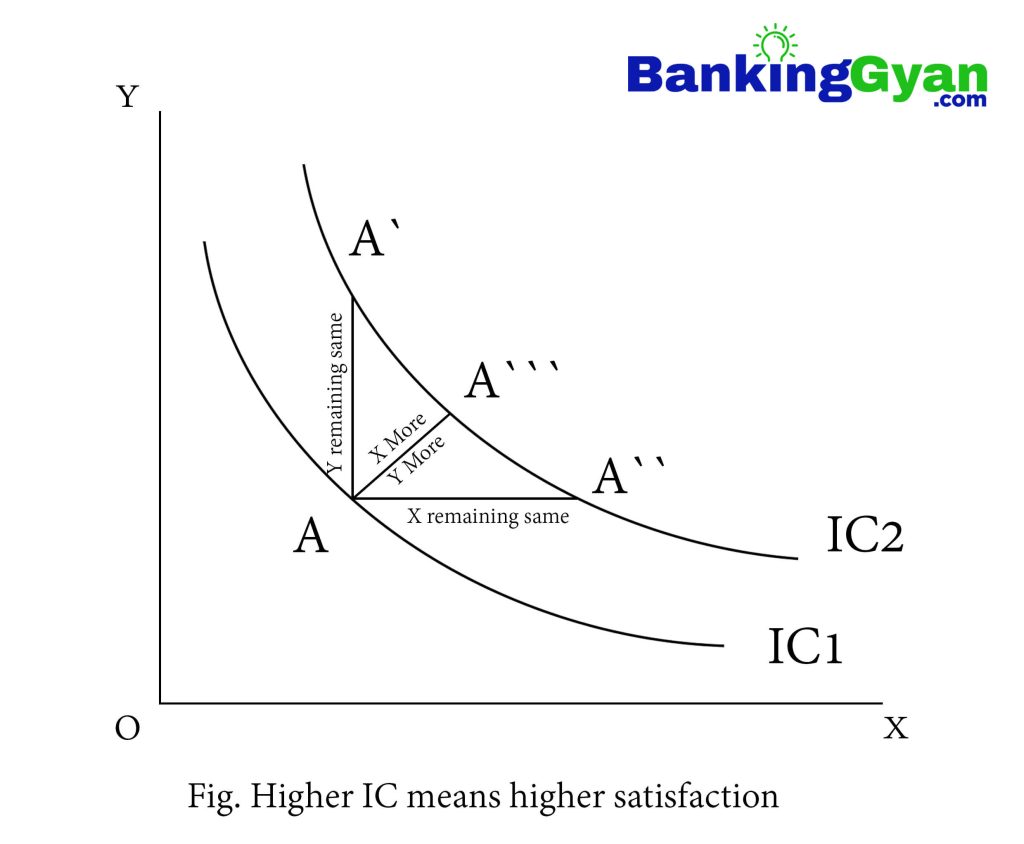
A` A“ A“ are on a higher IC (in IC2), where at A`, though the quantity of X is the same, the quantity of Y is higher than at A.
Similarly, at A“, the quantity of X is higher, though the quantity of Y is the same as at A.
At A“`, the quantities of both X and Y are more than at A. It means a higher IC contains higher satisfaction (Utility).
#Do not intersect with each other:
Due to the transitivity assumption.
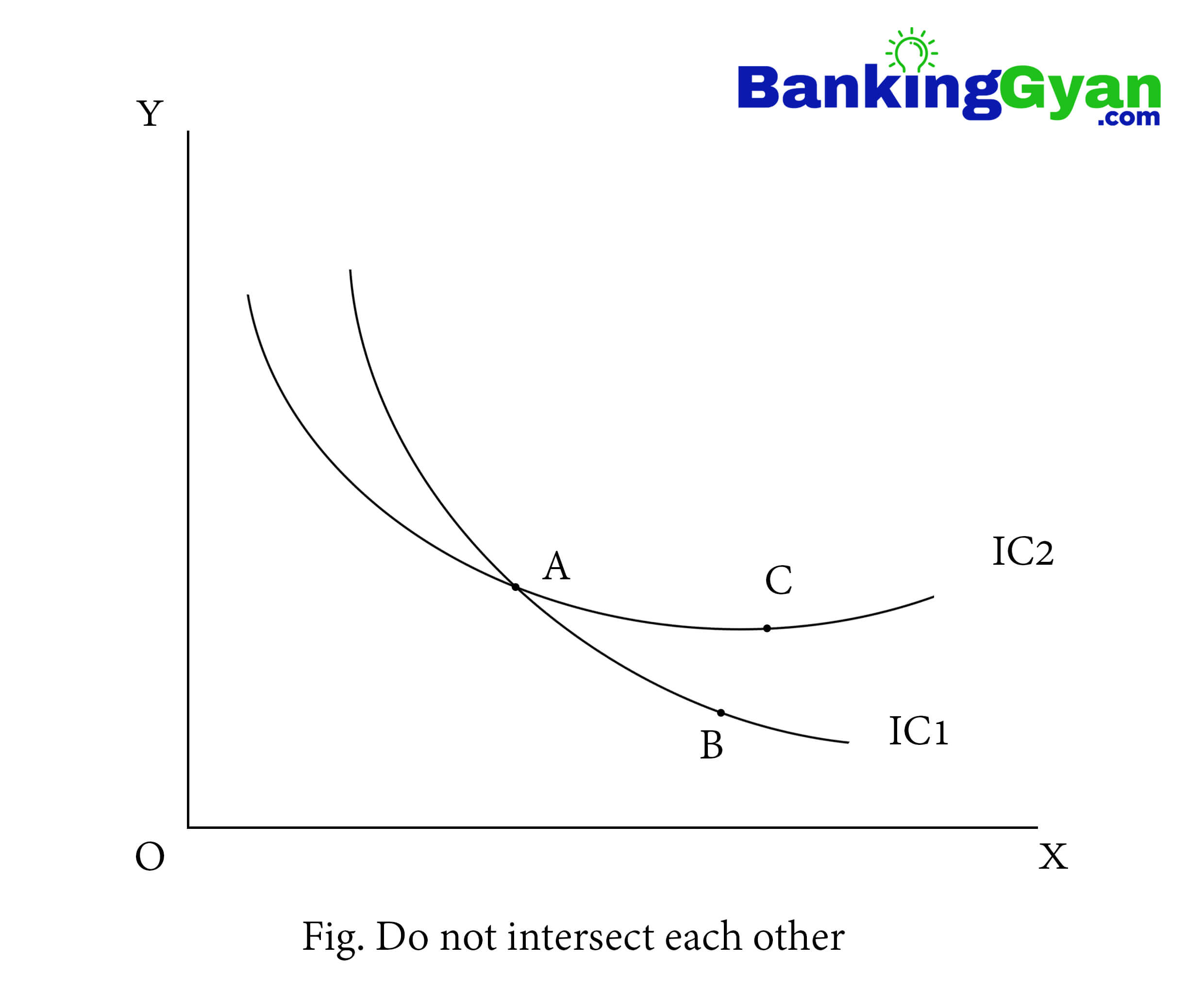
Here,
U (A) = U (B) along IC1
U (A) = U (C) along IC2
U (B) < U (C) Comparing IC1 and IC2
But from transitivity,
U (B) = U (C). This means the transitivity assumption is violated if any ICs intersect with each other.
Unusual/Abnormal/Non-standard Shape of IC
#Negative-sloped straight line
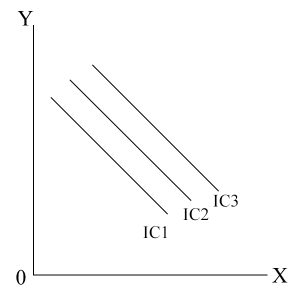 MRSXY is negative and constant
#Positive-sloped IC
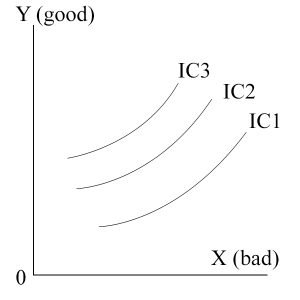 When one of the commodities is better than another
#Concave to the origin
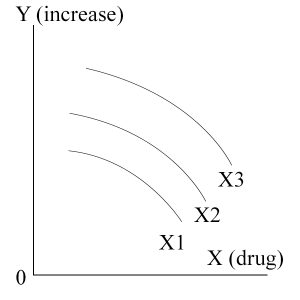
If the marginal rate of substitution between X and Y is increasing, then the IC curve becomes concave to the origin.
MRSXY ↑ ⇒ To get an extra unit of X, S/he is ready to sacrifice more and more units of Y. If one of the commodities is related to addiction, and the other is usual/normal. MRS for the addictive commodity is increasing.
# Right-angled shaped
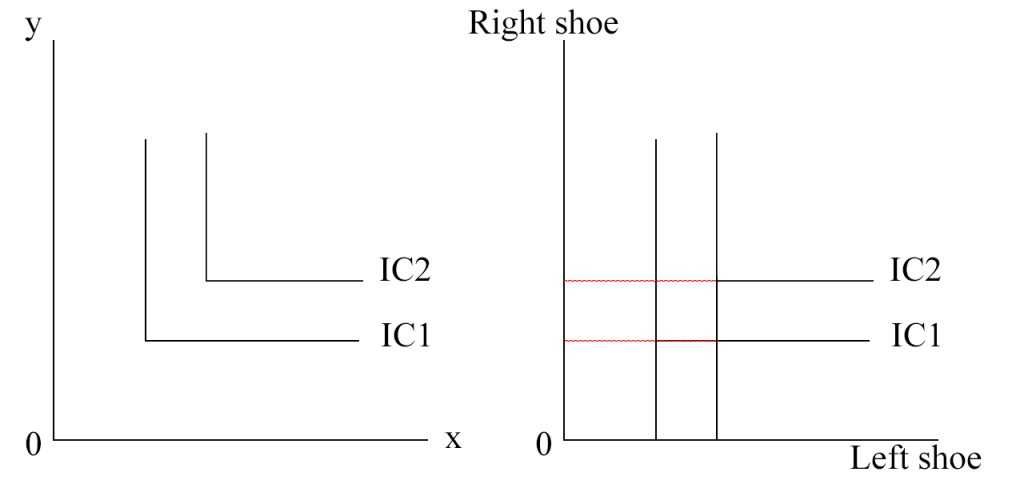
Both commodities are perfectly complements.
# Straight line and parallel to the axis
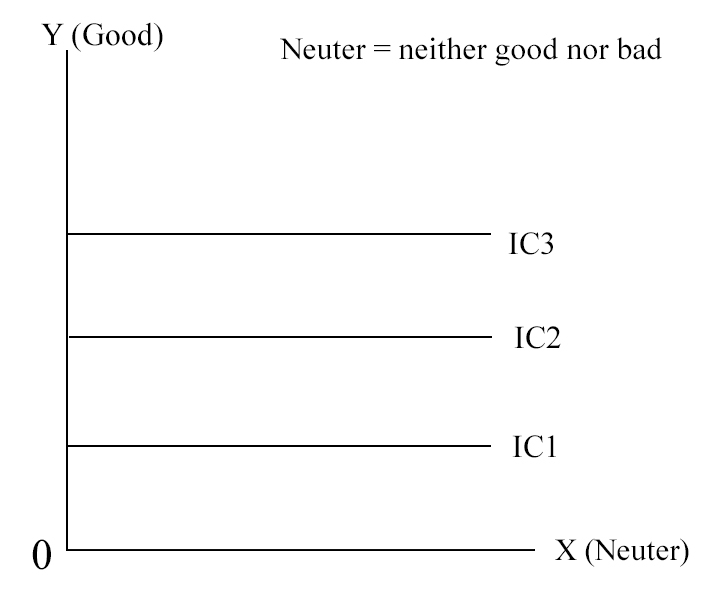
If one of the commodities is good and another is “neuter”, then IC is a straight line parallel to the axis of neuter.
Past Questions
Q. According to the standard assumption of preferences, why can’t indifference curves between two goods x1 and x2 slope upwards? Explain with an example. [NRB Assistant Director, Admin Officer III, 2081]