
Price elasticity of Demand (Ep)
Price elasticity of demand (PED) measures how sensitive the quantity demanded of a good is to a change in its price. It is calculated as the percentage change in quantity demanded divided by the percentage change in price. (अर्थात् कुनै वस्तुको मूल्य घटाउँदा वा बढाउँदा त्यस वस्तुको मागमा कति प्रभाव पर्दछ भन्ने कुराको मापन नै Price elasticity of demand हो।)

Ep = (ΔQd/ΔQd)/(P/Δp)
Or Ep = ΔQd/ΔP * p/Qd
Here, Ep can be positive or negative. If Ep>0, then it is a Giffen good, and if Ep<0, it is a normal good. Since Giffen is an exception, we often consider normal goods that have a negative price elasticity of demand.
Types of price elasticity (Ep)
- Perfectly Inelastic (Ep = 0)

When demand does not change with price, this condition is called perfectly inelastic. For example, the most necessary products are medicine and life-saving products.
- Relatively Inelastic (0< |Ep| < 1)
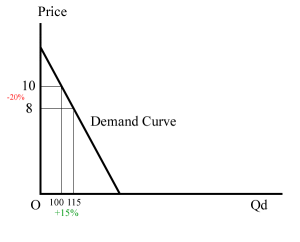
In this condition, the percentage in quantity demanded is less than the percentage change in price.
- Unitary Elastic Demand (|Ep| =1)
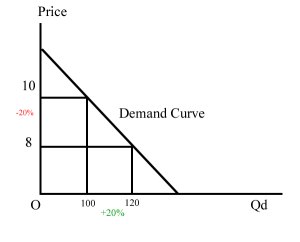
%ΔQd = %ΔP. In this case, the percentage change in quantity demanded equals the percentage change in price.
- Relatively Elastic Demand (|Ep| >1)
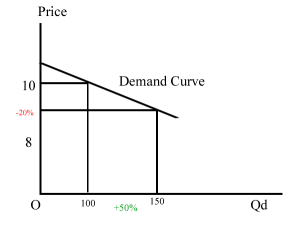
The percentage change in quantity demanded is > the percentage change in price.
- Perfectly Elastic (|Ep| = infinity)

A nominal change or a very small change in price changes the quantity demanded indefinitely.
Measurement Methods of Price Elasticity of Demand
- Point Method
- Arc Method
- Total Outlay Method
- Point Method: This method is used to measure the price elasticity if the demand curve is linear and there is a small change in price and quantity. This method helps to find the price elasticity at a specific point of the demand curve.
Under this method, Ep is calculated as
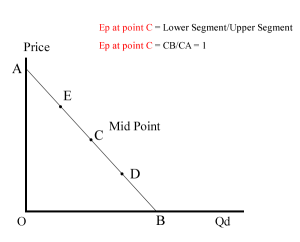
- Arc Method: If the demand curve is non-linear and the change in price and quantity are significant, then we use the arc method.
- Total Outlay Method: In this method, we assess the Ep of the product by comparing the total expenditure on the product before and after the change in price. So, this method is used if we have information on the different prices and corresponding expenditures on the product.
-
- If Total Expenditure remains the same despite the change in price |Ep| = 1
- If Total Expenditure increases when the price of the product declines, |Ep|>1
- If Total Expenditure declines when the price of the product declines, |Ep|<1
-
Uses/Importance of Price Elasticity of Demand
- Price elasticity of demand is used to classify the nature of the product based on the response to price.
- If Ep> 0, it is a Giffen good, which is an exceptional case, and if Ep<0, it is the normal product. So, the businessman or manager can identify the nature of goods and design an appropriate policy.
- The firm or business sector can design the appropriate pricing and output strategy based on the value of Ep.
For Example,
- If Ep = 0, then the best strategy of the firm is to increase the price because the demand for the product remains the same despite the increase in price.
- If |Ep|>1, then a price-decreasing strategy is the better choice for a profit-maximizing firm.
- If |Ep|<1, then the firm can increase the price to maximize profit.
- If |Ep| = infinity, then the price strategy does not work or is not a better choice.
The government can use Ep as a tool for designing appropriate policies, such as:
- If Ep = 0, then the government should fix the price ceiling to protect the masses from exploitation by the market.
- Similarly, the government should regulate the market to control price hikes for the product with a lower Ep.
Ep can also be used for demand forecasting, which helps to make appropriate planning and strategy by the firm.