1. Wagner’s Theory of Government Expenditure
- Developed by Adolf Wagner in 1880.
This theory was developed by Adolf Wagner using the empirical studies on the relationship between government expenditure and national income. This theory posits a functional relationship between government expenditure and national income, in which the growth of government expenditure exceeds that of national income or output.
i.e. G = f(Y) and dG/dY>1
Where G = government expenditure, Y = national income/output.
According to Wagner, government expenditure increases continuously over time. As the economy develops and income rises, the growth of such expenditure exceeds the growth of output. It means that when the economy grows, the demand for public expenditure increases faster than income.
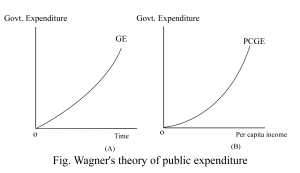
Here, in Figure (A), the government expenditure (GE) is continuously increasing or trending upwards, and in Figure (B), the per capita government expenditure (PCGE) is increasing faster than the per capita income. This indicates that the government expenditure increases smoothly over the period, where increases in per capita government expenditure are faster than the growth of per capita income. This justifies the higher per capita government expenditure of the developed countries than that of the developing countries. Such growth of government expenditure is due to the following reasons.
- Expansion of the traditional function of government: As the economy grows, the demand for the traditional functions of government, such as administrative and protective functions, also increases due to their increased demand. When the economy develops over the period, the people demand more government expenditure on law and order, defence, protection of property, public service delivery, etc. As the people get richer, they demand more for security, better law and order and public services. This increases the government expenditure.
- Emergence of new functions of government: When the economy develops over the period, there emerge new responsibilities of the government, such as social welfare functions, including social security, poverty reduction, public health and education, sanitation, etc. Similarly, new economic functions of the government are increasing, such as better quality of infrastructure, incentives and facilities for industrialisation, etc. As income rises, people demand better government services. So, the government takes new developmental and welfare roles, leading to higher government expenditure.
- Ambition of being a global power/influence: When the economy is developed, it aspires for international recognition, strategic influence, diplomatic strength, and economic competency to be a global power. This demands higher expenditure on defence and military modernisation, international diplomacy, mega infrastructure, and hosting international events. This increases the government expenditure. Therefore, the government expenditure is persistently increasing over the period due to the increasing demand for the role of the government in the economy and society. So, if the economy develops or people get richer, they demand more expenses of government in administrative and judiciary functions as well as increased expenditure on public services, infrastructure and an improved global image. This makes the government expenditure increase faster than the income/output of the economy.
2. Peacock-Wiseman Theory of Government Expenditure
This hypothesis argues that the government expenditure increases not smoothly or exponentially but in a step-like pattern over the period. It means the government expenditure is increasing but shows some ups and downs because the economy does not always have normal movement; rather, there are some abnormal situations. In order to deal with such abnormal or crisis periods, the government expenditure behaves like a staircase of ups and downs.
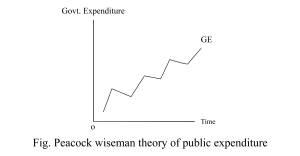
This shows the government expenditure is increasing over the period, but not smoothly. There are some ups and downs in such expenditure. This hypothesis argues that such ups and downs in government expenditure are due to the ups and downs of the economy or society. If there are no ups and downs in society, then the government expenditure would increase smoothly, but the economy often faces some shocks or crises, which make the government expenditure increase like a staircase.
Such pattern of government expenditure is due to the displacement, inspection and contraction effect of the government expenditure. When the government tries to deal with the crisis or shocks in the economy.
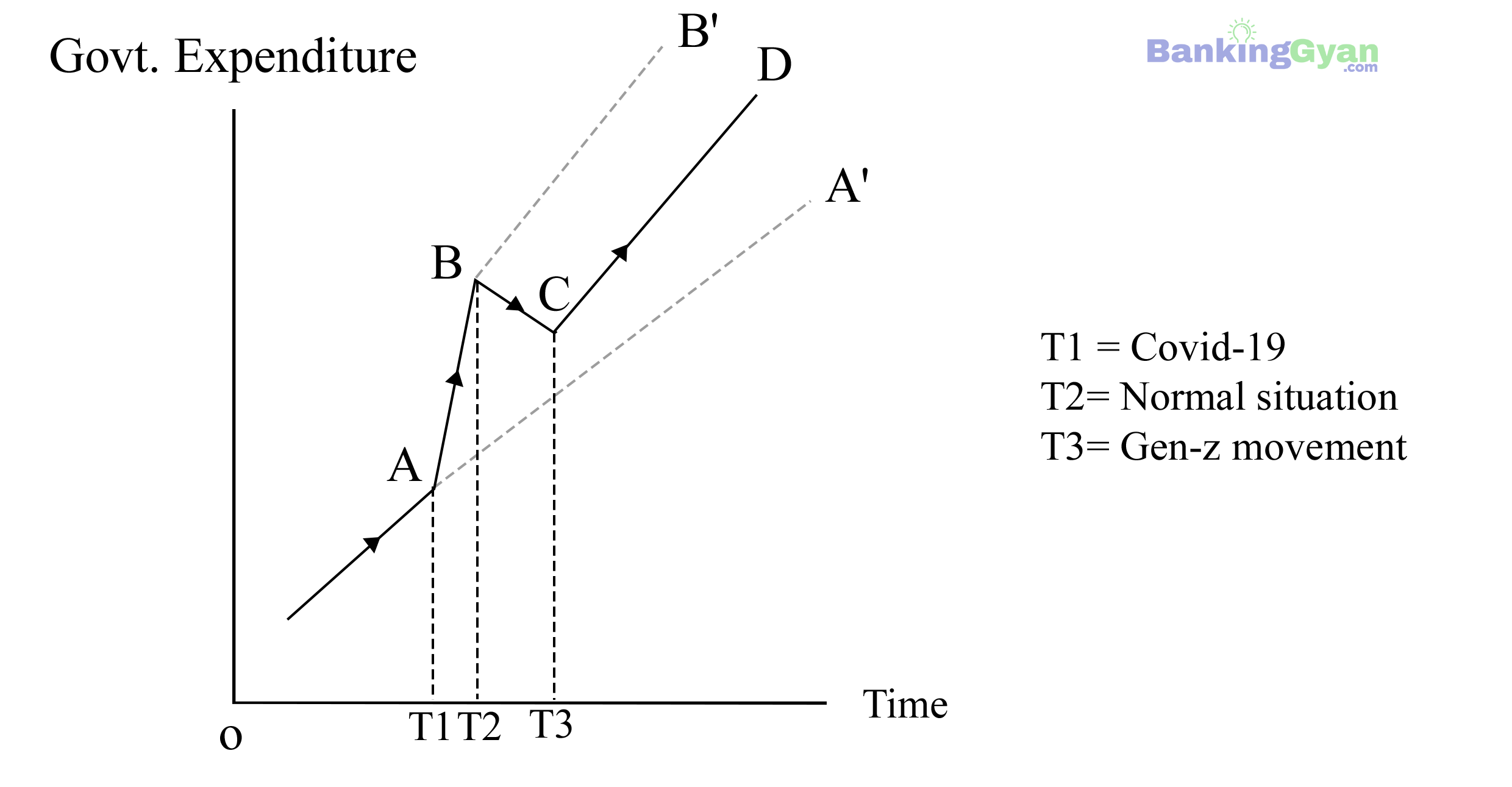 Here, the economy does not have any shock or crisis, so the government expenditure would be increasing smoothly along AA’. However, assume that there is a negative crisis (COVID-19), in the economy at T1 time period, the government expenditure abruptly increases from A to B to deal with the crisis. This movement from A to B is a displacement effect.
Assume that the crisis is over at the T2 period, then the government expenditure declines, but not at the initial trend of A’. It is because the government and people expect such a crisis in the future, and as a readiness for the future, the infrastructure and institutions remain in existence. So, the government expenditure declines from B to C only, which is the inspection effect.
Once the economy is at the T3 period, then a new priority of the economy is that the government expenditure is contracted in such a way that it increases government expenditure from C to D. This is the concentration effect.
Therefore, the government expenditure increases over the period but not smoothly. There are some ups and downs in the economy which makes the government expenditure increasing like a staircase which is due to the displacement, inpection and concentration effect of government expenditure.