
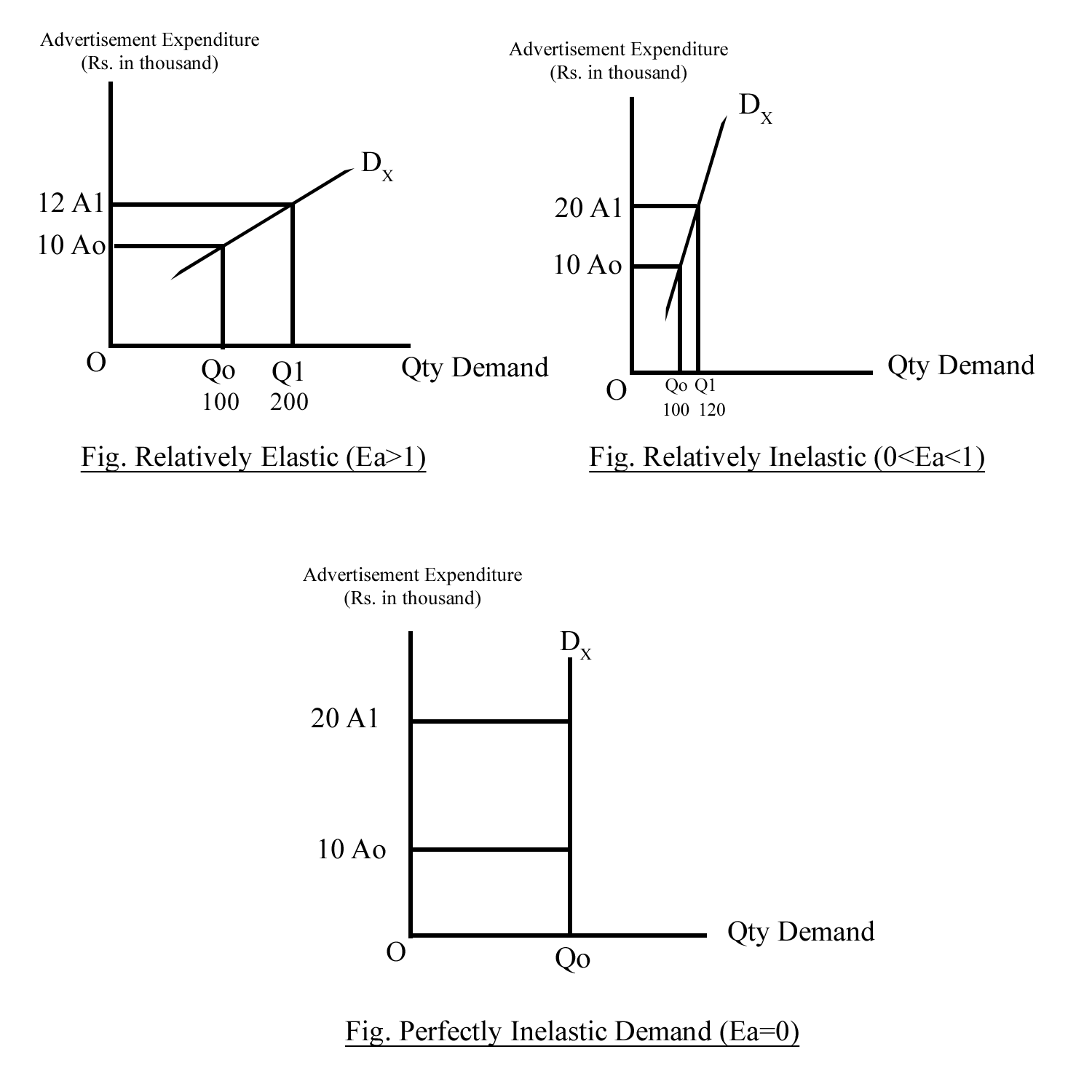
Advertisement Elasticity of Demand is the degree of responsiveness of the quantity demand of a product to a change in advertisement expenditure.

or, Ea = (ΔQd/ΔA) * (A/Qd)
Advertisement elasticity of demand is generally positive, which implies that an increase in advertisement expenditure increases its sales or demand.
If Ea = 0, there is no effect of advertisement on the sales.
If Ea>1, the demand for the product is more elastic to the advertisement, and if Ea<1, then the demand is relatively inelastic.
Uses/Importances of Advertisement Elasticity of Demand
- To assess the effectiveness of advertising on sales or demand of the product:
- If Ea>1, then the advertisement is better because it increases the sales or demand faster than the advertisement expenditure.
- IF Ea<1, the advertisement may be less effective in promoting sales or demand.
- If Ea=0, then the advertisement cannot change the demand for the products, so advertisement expenditure is useless.
- To decide on an appropriate advertisement strategy
- There are different ways of advertising that affect sales differently. So, the firm can select the best advertising media, timing, and targeted group based on the value of Ea.
- The higher the value of Ea, the better the media for advertising.
- To design an appropriate government policy for advertising
- The government can design appropriate taxation and subsidy policy on the advertisement industry and the sector based on the Ea.
- If Ea is higher, the firms are making more expenses on advertising, and so the government can collect more revenue from those firms/industries. It helps the government with proper tax planning. Similarly, if the products produced by SMEs are highly advertisement elastic, but due to resource constraints, they are not able to spend on advertising.
- Then the government can design an appropriate subsidy policy for those SMEs for their branding and advertisement (marketing).
- To make sales or demand forecasting
- Based on the value of Ea, the firm can make demand forecasting based on the changes in advertisement expenses. This helps the firms to have proper planning on production, resources, and inventory.
Other posts
- Price Elasticity of Demand (Ep) – Examples and Uses
- Income Elasticity of Demand (EI) – Examples and Uses
- Cross Elasticity of Demand (Exy) – Examples and Uses