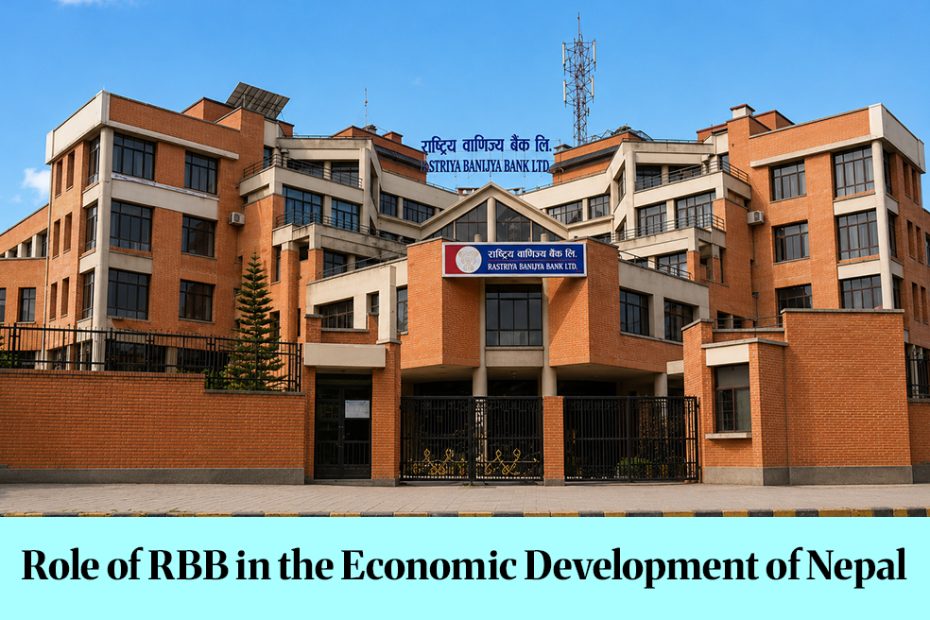
Introduction of RBBL
Rastriya Banijya Bank Limited (RBBL) was established on January 23, 1966 (BS 2022 Magh 10). It is one of the pioneer banks in Nepal with a long history. Earlier constituted under the RBB Act 2021 with the full ownership of the Government of Nepal, the Bank has been running under the Bank and Financial Institute Act (BAFIA) and Company Act (CA) 2063 at present. The Bank is licensed by NRB as an ‘A’ class commercial bank by the Nepal Rastra Bank.
Rastriya Banijya Bank has made a glorious history of contributing to the monetization of the economy, eliminating dual currency in the market, and initiating preliminary financial literacy. It has helped flourish the industrial, commercial, and financial sector of the country. This bank has now emerged as a modern and strong financial institution of the country.
The Bank with the highest public confidence- reflected in the highest deposit base and growing demand for branch establishment in various parts -has stood as a pyramid in the financial arena of the country.
Role of RBBL in Banking Development in Nepal
The role of RBBL in Banking development in Nepal can be explained in the following headings:
1. Developed Banking Behavior for People
Before the establishment of RBBL, there were only 35 branches of Nepal Bank in the country. After the establishment of RBBL, it opened its branches in 68 districts. At present, RBBL has over 300 branches all across Nepal. The Bank served more than 226,000 credit clients ranging from poor to elite ones and millions of indirect ones, and has drawn an important imprint in the picture of the country’s economy through its significant involvement in the best use of its resources to enhance production, income, and employment opportunities.
2. Banking Access
As of 2083, Rastriya Banijya Bank Limited (RBBL) operates 307 physical branch offices and 71 extension counters distributed across all 77 districts and 7 provinces of Nepal. Its massive network of branches has facilitated the people for east banking access.
3. Creating Capital for National Development
With the help of a nationwide network, RBBL has been able to create small to small saving from the public in rural areas as well as urban areas and utilize it through investment in needed sectors, which helped in the economic development of the country.
4. Development of Banking Manpower
As one of the oldest and pioneer commercial banks, it has produced many banking manpower. At present, many RBBL human products are working in different banks at the top level. Besides this, RBBL also provides different training to its staff, which helps to develop competent manpower in the banking sector.
5. Establishment of Financial Institution
RBBL has played a vital role in the establishment of some financial institutions through capital investment, such as Indosuez Bank, Grammi Bikash Bank, NIDC Capital Market, Nepal Housing and Financing Co, Alpic Everest Finance, Neco Insurance, etc.
6. Remittance Service
RBBL has played a vital role in the transfer of money within and outside the country with the help of its worldwide network.
7. Development of Government Fund
RBBL works as a government Bank. Since NRB does not have branches all over the country, it works through NBL and RBBL for the operation of government funds.
8. Use/practice of Nepali Currency
At the time of establishment of RBBL, Indian currency was prevalent in Nepal. But after the establishment of RBBL, RBBL was able to replace IC with Nepalese currency.
9. Customer-oriented Modern Banking Service
RBBL provided different modern banking services to its customers. ATM, BLB, Debit card, Mobile banking, and e-banking are some examples of modern banking services provided by RBBL.
Role of RBBL in Development of Economy
1. Capital formation
Capital formation is one of the essential parts of economic development. There is a lack of capital formation in most of the developing countries like Nepal. So, bank collects ideal money from the people and invest that shaving on the productive sector. That causes capital formation as well as development of the nation.
2. Encourages Innovation
The banking system encourages entrepreneurial innovation because with the development of the banking system, banks can provide the requested amount of loan to the entrepreneur at a reasonable rate of interest, thereby increasing the participation of the private sector.
3. Monetization of Money
Establishment of banks and their branches in remote and rural areas helps to increase the banking habits of people. People keep their excess income in the bank and withdraw the money at the time of need. It helps the government to implement fiscal and monetary policies. Monetization – use of money. Fiscal policy – budgetary, tax, expenditure policy. Monetary – rate of interest
4. Influence the Economic Activity
The bank can influence economic activities by changing the rate of interest. If a bank charges a low rate on loans, then there is more demand for funds for investment. As a result, economic activities increase and vice versa.
5. Facilities of Monetary and Fiscal Policy
An effective banking system is necessary for effective implementation of fiscal and monetary policy of the nation. The instruments of fiscal and monetary policy, such as regulation of credit, interest rate, tax, etc are properly used only if the banking system of the country is sound.
6. Raising Deposits and Financing Loans
By offering an attractive rate of interest can increase savings and deposits; then, the collected money can be provided to the investors at a reasonable rate of interest.
7. Remittance of Money
The bank remits the money to its customers from one place to the other place without any risk. It helps to promote economic activities inside the country.
Past Questions of Loksewa
- Explain the emerging challenges in Nepal’s banking sector? (RBB level 3- 2070)
- Define a bank? Explain the evolution of Banking in Nepal? (RBBlevel-3 2069)
- Define the central bank. Explain the role of the central Bank (NRB) in the economy?
- Describe in brief the development of the banking sector in Nepal? (ADBL- level 6 -2067)
- What are the functions, objectives & duties of the central Bank (NRB)? (RBB level 3 – 2069)
- Explain the growth opportunities in the Nepalese Banking industry?
- Explain the function of a commercial bank for economic development? What is the context in Nepal?
- Explain the major functions of a central bank? How central bank maintain financial stability?
- What are the opportunities & challenges in the banking sector in Nepal?