Agricultural Development Bank Limited (ADBL) was established in B.S. 2024 Magh 7 (AD January 21, 1968) to provide financial assistance to rural and deprived agricultural sectors. Its primary focus remains rooted in rural financing, poverty alleviation, and supporting the agricultural sector. At present, ADBL is full fledge commercial bank of Nepal that provides all the modern banking services to its customers.
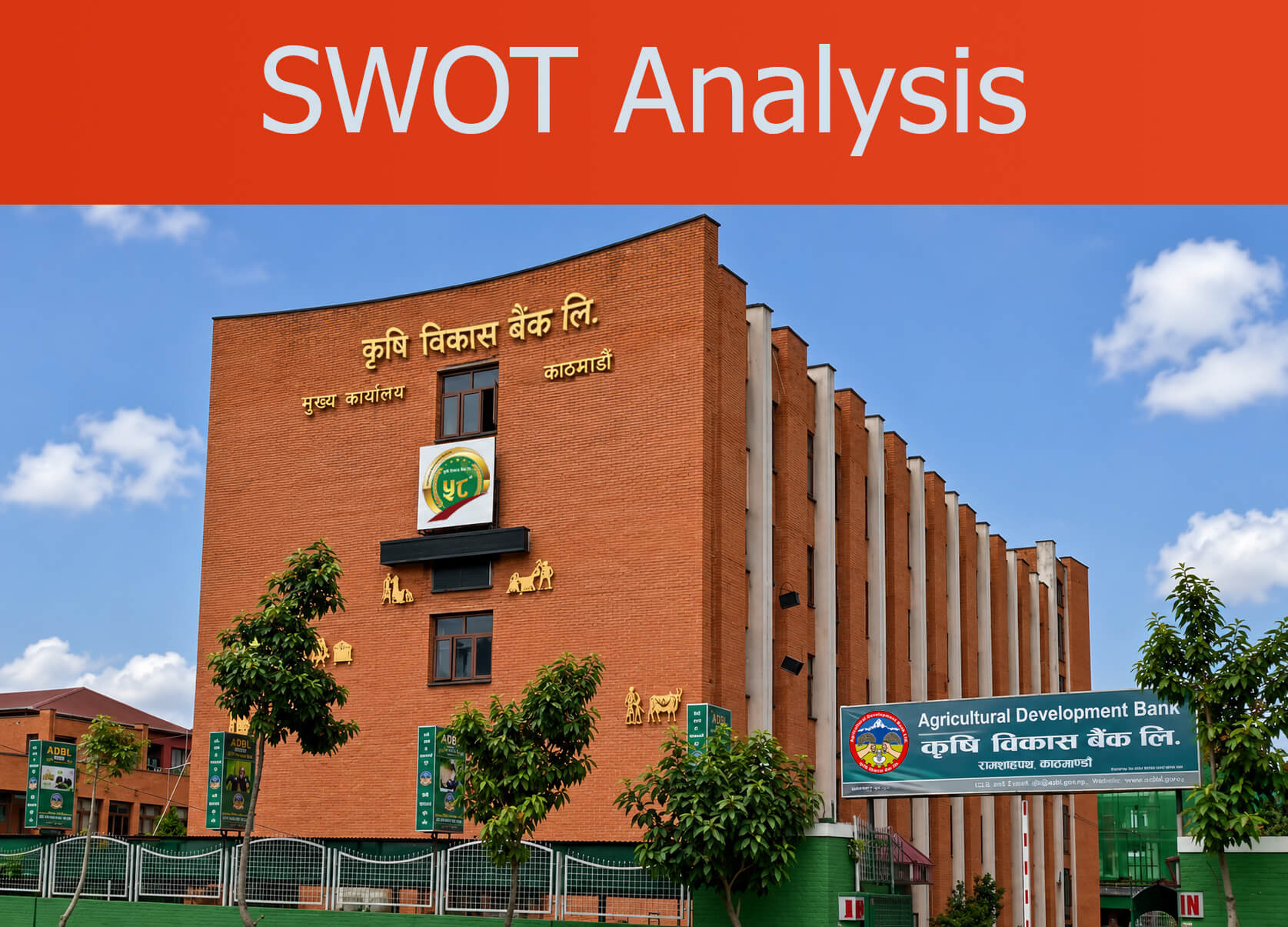
In this article, we are primarily discussing the SWOT analysis of ADBL. We list out the Strengths, Weaknesses, Opportunities, and Threats of ADBL.
Strength of ADBL
- Strong Government Backing: The Government of Nepal has 51% ownership in ADBL, which gives it high market credibility and financial stability.
- Widespread branch network: ADBL has wide geographical coverage from rural to urban with 286 branches, 10 provincial offices reaching deep into all areas of the country.
- Long legacy: ADBL has been in the market for almost 6 decades of expertise and trust in agricultural and rural financing.
- Strong capital base and assets: Large capital structure and loan volume of customers. The bank has strong tangible assets, including land building worth more than 3.8 kharba.
Weakness of ADBL
- Bureaucratic complexity: Slower decision-making processes due to government-linked legacy institutions. It drags the bank behind, as making changes is a complex process.
- Digital Lag: Although ADBL provides all the digital products available in the market, it lacks active digital products. ADBL is far behind in capturing the mass customer base compared to other commercial banks.
- High Operational Costs: Maintaining physical branches and deploying field staff in difficult terrains requires heavy expenditures.
- High Non-Performing Loans (NPLs): Vulnerability to crop failures, natural disasters, and fluctuating market prices.
Opportunity of ADBL
- Taping the agriculture financing: ADBL has a long legacy in agriculture sector financing. It can expand its credit lines across agriculture production, storage, processing, and marketing ecosystem.
- Digital Expansion: Potential to capture unbanked rural populations by scaling mobile and fintech-driven financial services.
- Leveraging its expertise: Since ADBL has long experience in agro-financing, it can leverage its expertise in the development of agricultural economics as well as business of the bank.
- Green Financing & Subsidies: Tapping into global climate funds and government green initiatives to finance sustainable, climate-resilient agriculture.
Threat of ADBL
- High competition: Fierce rivalry from private commercial banks expanding aggressively into semi- urban and rural markets:
- Regulatory pressure: Strict compliance, capital adequacy, and provisioning guidelines enforced by NRB.
- Policy Instability: Sudden shifts in government agricultural policies, subsidy structures, or interest rate caps.
- Rapid technological changes: Technological changes and shifts in client can be a threat for ADBL.
- Economic downturn: Global and domestic downturn in economic activities is a threat for ADBL to maintain credit sales and recovery.
- Political interfere— as majority of the stake is held by the government of Nepal, ADBL may be more exposed to political influence in leadership appointments or strategic priorities than privately-run peers.
Other posts: