About Rastriya Banijya Bank (RBB)
Rastriya Banijya Bank Limited (RBBL) is a pioneering commercial bank of Nepal. This bank was established on 10 Magh 2022 (23 January 1966) with the objective of providing banking and financing access to every nook and corner of Nepal. Rastriya Banijya Bank Limited (RBBL) is a fully government-owned commercial bank and one of the largest commercial banks in Nepal with a 99.97% stake of the Government of Nepal.
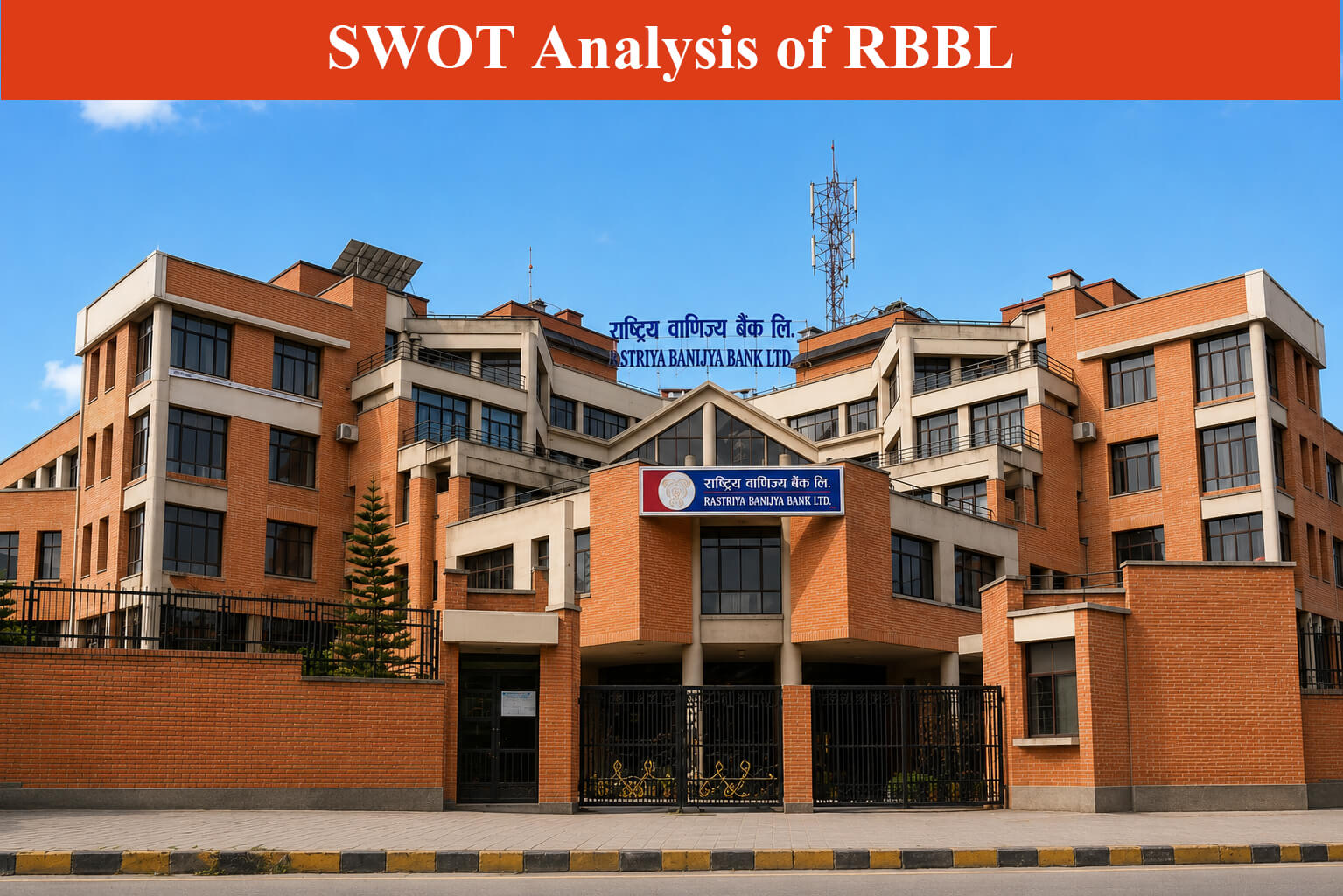
SWOT Analysis of Rastriya Banijya Bank Ltd.
Strength
- Long history: RBB has a long history of trust and experience of banking in Nepali market.
- Strong government backup: 99.97% ownership of the Government of Nepal ensures high public trust and financial safety.
- Widespread network: Over 300 branches spanning all seven provinces, reaching remote and rural areas where private banks do not go.
- Customer Base: Massive, loyal base of individual and institutional depositors built over decades.
- Scale and legacy — one of the country’s oldest and largest banks by customer base, with roughly 1.7 million direct customers, 300+ branches, and about 2,600 employees nationwide, including deep rural/semi-urban reach.
Weakness
- Bureaucratic complexity: Slow decision-making due to rigid, traditional government-style organizational structures.
- Legacy Issues: Remnants of past operational inefficiencies and management bottlenecks.
- Slow adoption of technology: Due to the slower decision-making process, it lags in technology adoption compared to other private commercial banks.
- Thin capital buffer relative to peers — RBBL’s core capital to risk-weighted assets ratio was 9.46%, the thinnest core-capital buffer among the three state-owned banks (versus 10.05% for Nepal Bank and 11.93% for Agricultural Development Bank), even though total capital adequacy remains above regulatory minimums.
Opportunities
- Digital Growth: Expanding mobile and internet banking to younger, tech-savvy urban customers.
- Utilization of its massive network: Reaching unbanked rural populations with microcredit and branchless banking with the proper utilization of its widespread network and structure.
- New Products: Tailored digital loans and green financing for modern enterprises.
- Government-linked business flows — as a state bank, RBB is well placed to capture government payroll, subsidy disbursement, treasury, and infrastructure-financing business.
Threat
- Private competitor: Intense rivalry from modern private commercial banks with faster services poses a serious threat.
- Technological Risks: Rising cybersecurity challenges and digital fraud risks can be another threat.
- Regulatory Pressure: Stricter capital and compliance rules from Nepal Rastra Bank.
- Political Interference— as a fully state-owned entity, RBB may be more exposed to political influence over lending decisions, leadership appointments, or strategic priorities than privately-run peers.
Conclusion: RBB’s core strength is its scale, government backing, and comparatively better asset quality than the private banking sector — but that’s set against real weaknesses in capital buffers, rising bad loans, and governance gaps that echo challenges facing the entire Nepali banking sector right now. Its state-bank status is simultaneously its biggest asset (trust, distribution, government business) and potential liability (political risk, bureaucratic drag).
Other posts: