According to this theory, the exchange rate between the currencies of any two countries is calculated by comparing their purchasing power in their local market. It is assumed that each currency has some purchasing power in its local market. So, the exchange rate is determined by comparing such purchasing power.
For example, a 500 mL Coke costs Rs. 100 costs in Nepal and $1 in the USA. Therefore, in terms of purchasing power, the exchange rate of USD in terms of NPR is $ 1 = NPR 100.
This theory is used to determine the exchange rate if the market exchange rate is not available. And if the objective is to compare the quality of life between the countries.
Due to differences in the purchasing power of the same currency in different markets, the market exchange rate may differ from the purchasing power parity rate. To use this theory to determine the exchange rate, we select a representative common basket of products between the countries and find its cost in their local currency.
By using this theory, we can calculate the exchange rate between the currencies in both absolute and relative version.
In the absolute version we compute the exchange rate at the given point of time and so, it does not explain the effect of changes in purchasing power due to change in domestic price level.
Whereas in relative version the exchange rate shows the effect of changes in domestic price level on the exchange rate.
Let A and B are two countries, then the exchange rate between their currency is
- Absolute Version
RA = PBQ/PAQ
= PB/PA
Where,
- PA = Price index of country A in their local currency
- PB = Price index of country B in their local currency
- RA = Exchange rate of currency of country A
2. Relative Version
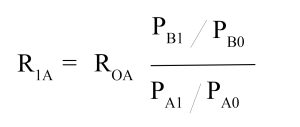
Where,
- PAO = Price index of country A in base period (0)
- PA1 = Price index of country A in current period (1)
- PBO = Price index of country B in base period (0)
- PB1= Price index of country B in current period (1)
- ROA= Exchange rate of country A at base period
- R1A = Exchange rate of country A at current period
Such relative version of exchange rate help us to examine the effect of change in domestic price level on the exchange rate. If domestic price level is increasing faster than the foreign price level it depreciates the value of domestic currency.
The market exchange rate may be different from the exchange rate determined by the purchasing power. It depends on the BoP position of the economy for the actual market exchange rate.
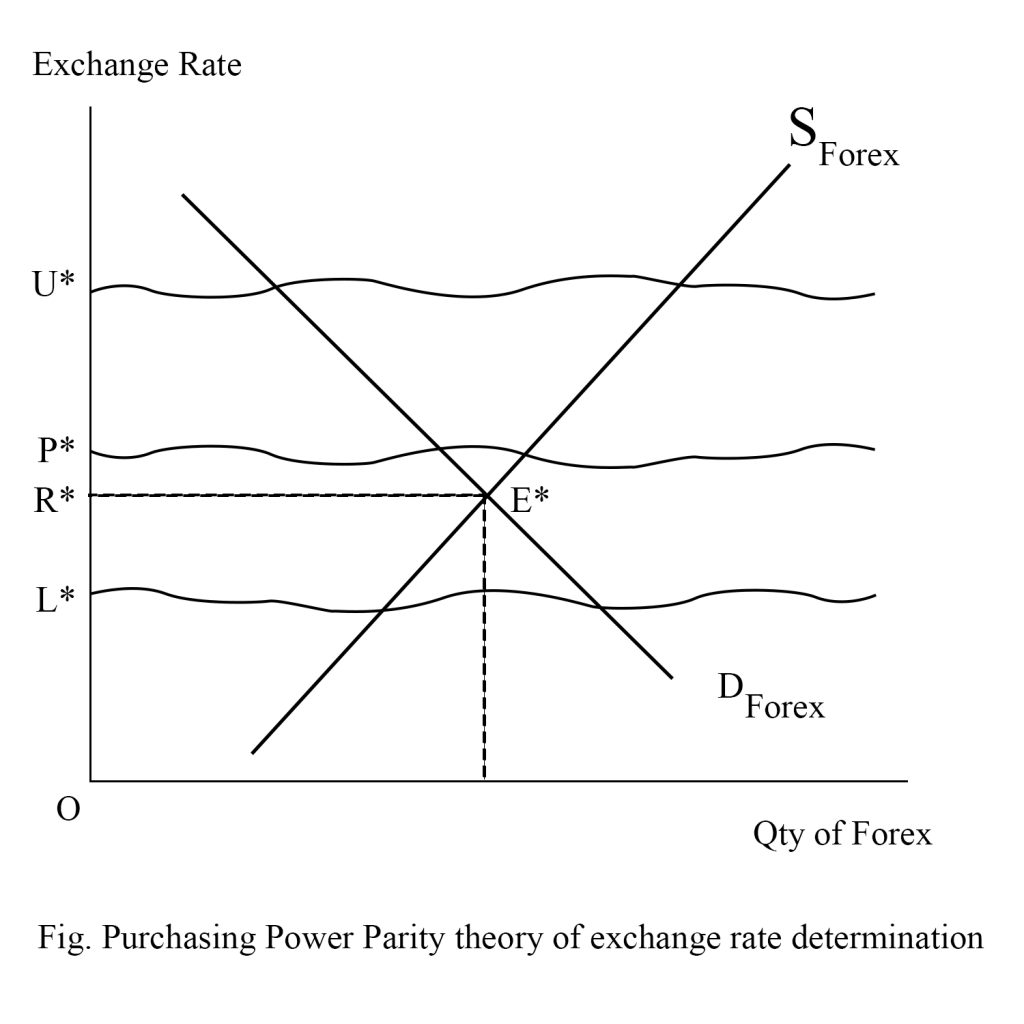
Here
P* is purchasing power exchange rate which is volatile/changing due to changes in domestic price level and the purchasing power.
L* is lower exchange rate and known as commodity import point because it is profitable to import if the exchange rate falls below L*.
U* is upper exchange rate and also known as commodity export point because if the exchange rate is above U*, or below, there is no export.
The gap between P* & L* or U* & P* is the per unit cost of import or export. And if the exchange rate is in between P* & L* import is not profitable as well as export is not profitable if the exchange rate is between U* and P*.
The exchange rate in the market is determined by the interaction between market demand and supply of the forex. In the above figure, the forex market is in equilibrium at E* with Q* quantity and R* exchange rate. Such market exchange rate may be equal to or above or below the exchange rate determine through PPP.