It refers to the standard framework and procedure that the International Monetary Fund (IMF) follows while assisting the member countries suffering from an external sector crisis. If any member country suffers or is likely to suffer from an external sector crisis, such as a crisis in the forex, then they can approach to IMF for support to rescue the economy from such a crisis. The IMF provides both technical and financial support to the member country to recover from or prevent from crisis. But there is a specific framework of the IMF to provide such stabilization support, known as the IMF approach to stabilization.
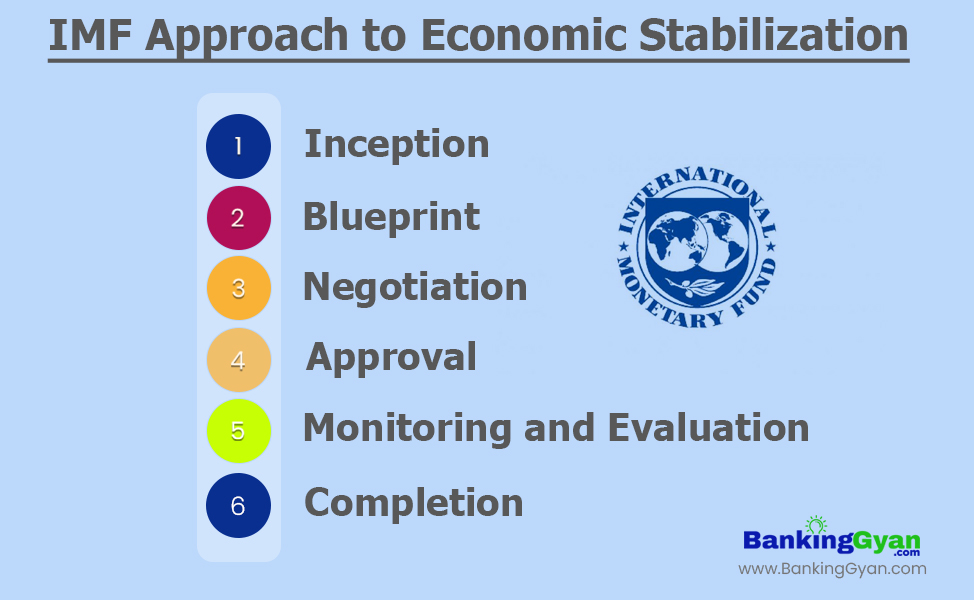
In order to provide stabilization support, the IMF program follows the following steps.
- Inception
- Blueprint
- Negotiation
- Approval
- Monitoring and Evaluation
- Completion
Phases of IMF stabilization Support
Phase I – Inception:
It is the phase in which the member country realizes the external pressure/crisis and communicates to the IMF for support. It may be before the crisis or while the economy is in crisis, and the communication to the IMF to receive such assistance may be formal or informal by the government of the member country.
Phase II – Blueprint:
Once the IMF is requested by the government of the member country to utilize the stabilization support package, then the IMF staff representative prepares a detailed proposal or blueprint of the support program. Such a blueprint is comprehensive, detailing the reasons or origin of the crisis, the macro fundamentals framework, terms and conditions of the program, quantitative indicators to assess the performance of the government and the whole economy. It also comprises the condition that the government and economy should fulfill before and during the receipt of support.
The blueprint prepared by the IMF staff representative for the country is submitted to the IMF headquarters.
Phase III – Negotiation:
Once the blueprint of the IMF support program for stabilization is prepared, the representative from the IMF headquarters visits the member nation for negotiation. Usually, this phase is longer because of the strict terms and conditions drafted in the blueprint. The government of the receiving country wants more flexible and less conditional support, whereas the IMF has some strict policies and conditions. So, it may take some time for negotiation. In some of the cases, the negotiation phase may be postponed for further preparation, and in some other cases, it does not proceed.
Phase IV – Approval:
After the negotiation between the IMF and the government of the receiving country, the government formally sends a request letter along with the negotiated documents to the IMF headquarters. Then the headquarters sends the document to the different relevant departments for their comments and feedback. Then, such departments send their comment and feedback back to the headquarters regarding the stabilization support program. Then, finally, IMF management approves the program with a release of the first tranche (installment).
Phase V – Monitoring and Evaluation:
When the IMF receives the first tranche, the stabilization program is said to begin. Then the country representative of the IMF staff, as well as the IMF headquarters, continuously monitor and evaluate the performance of the government and the economy in terms of quantitative indicators agreed in the program document.
If the performance indicators are not found to be satisfactory, then the support program may be postponed for a period or it may be terminated.
Phase VI – Completion:
If the performance indicators of the government in the economy are found to be satisfactory by the IMF, then the stabilization support program continues as per the agreement, and it comes to an end, releasing the last tranche.
Usually, the completion of the program may take a longer period, and the amount of assistance may also be larger than the initial agreement.
Therefore, the IMF’s approach to stabilization is systematic and follows the specific phases. It is designed to support member countries that are suffering or likely to suffer from the external sector crisis.
Criticism of the IMF Approach to Stabilization
- Too much conditional or restrictive
- One-size-fits-all policy or program
- Inappropriate for the low-income countries. Generally, the IMF has the condition of lowering or reducing government expenditure or social security, etc.
- Interference to the domestic issues or priorities.