- It was developed by Kelvin Lancaster in 1966
- It is also called the attribute approach of demand analysis
According to Lancaster, consumers get utility not from the product itself but from the attributes/characteristics of the product. Since the characteristics are inseparable from the product, people demand the product not for the product itself but for the attribute inherent in it.
This theory assumes that people get utility from the attributes, and the attributes are inseparable from the product. Such attributes can be qualitatively measurable, and the different goods may have similar attributes. Due to the similarity in the attributes of characteristics, they are substitutable for each other.

Lancaster shows that utility is given by the attributes, and such utility can be represented by the usual shape of the indifference curve, which is downward sloping and convex to the origin.
Since the consumer is rational, they try to maximize utility given by the attributes under the given budget constraints.
i.e Objective => Maximize Utility
U = f(Zi) Where Zi is the subject attribute
Subject to: Px = M
Where,
- Z = Vector of attributes
- P = Price of product X
- X =Vector of the products
- Z = AX
- A = Vector of attributes on X
Max U = f(Z1, Z2)
Subject to: PxX + PyY = M
- z1 = a11X + a12Y
- z2 = a21 X + a22 Y
It means the consumer spends the given income M in between two products X and Y in such a way that the attributes z1 and z2 given by X and Y maximize the utility. The utility is said to be maximum if the following two conditions are satisfied.
1. First Order Condition
Slope of IC = Slope of budget constraint
2. Second Order Condition
IC must be convex to the origin at the point of tangency with the budget constraint or the budget constraint must be tangent to the highest possible IC.
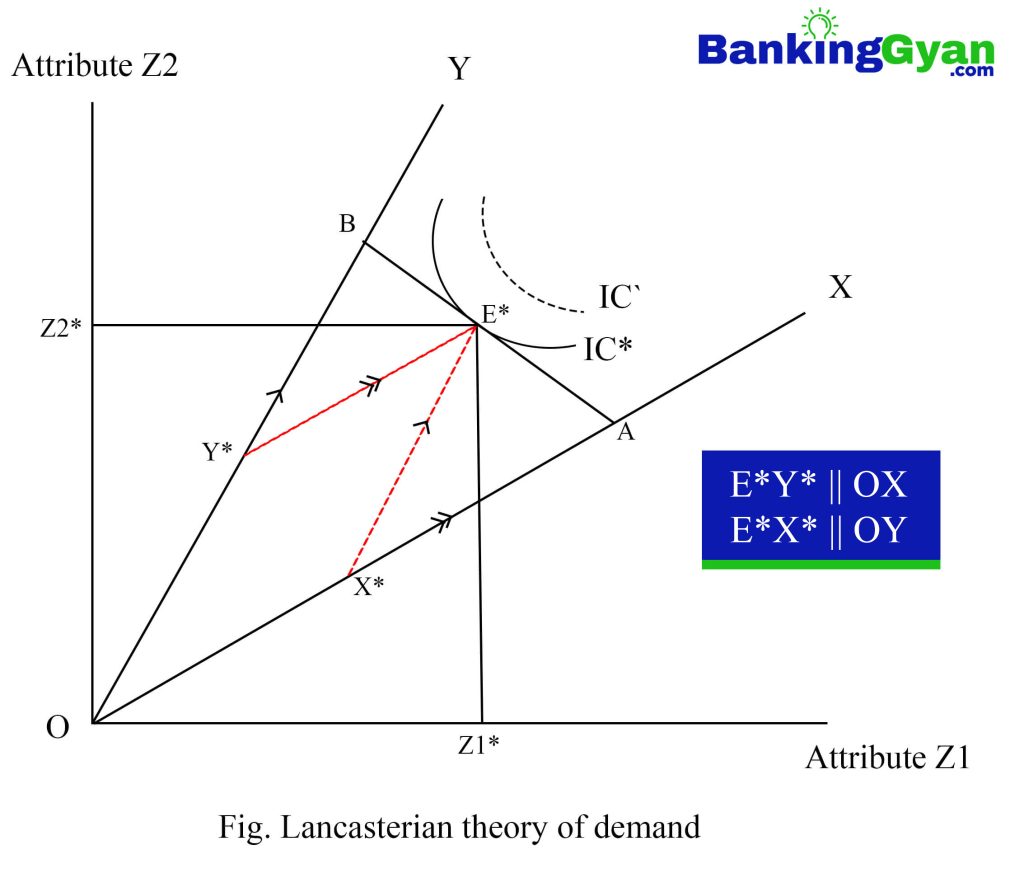
Here, OX is the product ray of X commodities, which represents various combinations of attributes z1 and z2 given by the different quantities of X.
Similarly, OY is the product ray of Y commodities, which represents various combinations of attributes z1 and z2 given by different quantities of Y.
If the consumer spends the whole of his/her income on X, he/she can have OA units of X.
i.e. OA = M/Px
Similarly, if a consumer spends their whole income on Y, then he/she can have OB units of Y.
i.e. OB = M/Py
If we join A and B, we get the consumer’s budget constraints or efficiency frontier.
IC* and IC` represent different levels of utility given by the z1 and z2 attributes. For the utility maximizing consumer, IC` is preferable but under the given budget, it is not attainable.
Both conditions of utility maximization are satisfied at E*, and so the consumer attains equilibrium at E* with the maximum possible utility IC*. For this level of utility, the consumer requires z1* and z2* units of attributes z1 and z2, respectively.
Since these attributes are not separable or found individually (independently), the consumer has to consume the X and Y products to get such attributes. To find the quantity of X and Y, we draw
E*X* || OY & E*Y* || OX
These parallel lines help to identify the quantity of X and U required to maximize utility given by the attributes z1 and z2. So, in the figure OX* and OY* are the quantities of X and Y, respectively. Which jointly give z1* and z2* units of the attributes z1 and z2 and maximize utility.
Therefore, under the Lancasterian theory of demand, consumers demand not the product but the attributes. Since attributes can not be separated out from the product, the consumer consumes the product in order to get the maximum utility.
Implications | Importance | Uses of Lancasterian Theory
- Innovation and product differentiation: Changing the attributes (adding or subtracting) makes the product more unique than others.
- Effective Marketing Strategy: Highlights the features or characteristics of the product that are preferred by the customers.
- Pricing of the Product: A higher price for the product with highly demanded attributes. It helps to determine the optimal price of the product.
- Hedonic pricing: Pricing of the product based on attributes. Hedonic Pricing is a method used to estimate the economic value of a good or service by breaking it down into its individual attributes or characteristics. The idea is that the price of a product reflects the value of all the features it possesses.
-
Real Estate Example:
-
The price of a house depends on factors like:
-
-
-
- Location
- Number of bedrooms
- Size of land
- Proximity to schools, parks, and transport
- Air quality, noise level, scenic views
-
Hedonic pricing analyzes how much each feature contributes to the house price.
-
-
-
Pricing of environment: Price based on the attributes of the natural environments or natural things such as mountains, animal etc. For e.g. determination of price tickets to enter into the park to observe the wild animals, or determination of royalty amount for Mt. Everest summit.
- Formulation of public policies: The policy formulation of the government can be determined based on this theory, such as the tax rate or subsidy.
Weaknesses/Limitations of the Lancasterian Theory
- Some quantitative nature of attributes: It can not quantify the attributes of all products.
- Non-homogeneity in attributes: Each unit of product may not have the same or homogeneous attributes.
- Unknown about attributes: Consumers may not know the actual attributes of the products.
- Asymmetric information about the attributes: May not be able to maximize utility.
Past Questions
Q. Explain the Lancasterian demand theory with examples. [NRB Assistant Director, Admin Officer III, 2081]