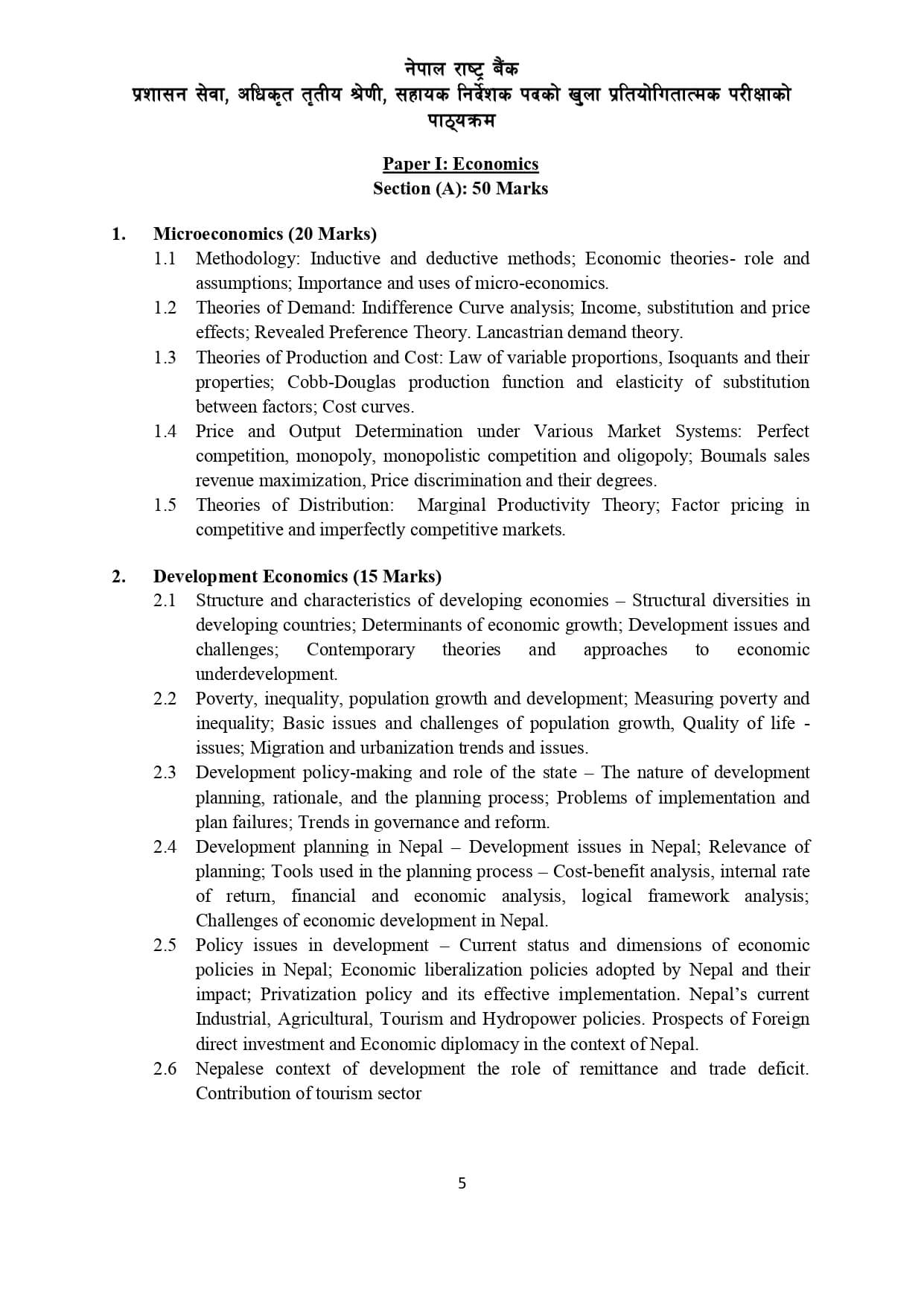
Paper I: Economics
Section (A): 50 Marks
1. Microeconomics (20 Marks)
1.1 Methodology:
Inductive and deductive methods; Economic theories – role and assumptions; Importance and uses of micro-economics.
1.2 Theories of Demand:
Indifference Curve analysis; Income, substitution and price effects; Revealed Preference Theory; Lancastrian demand theory.
1.3 Theories of Production and Cost:
Law of variable proportions, Isoquants and their properties; Cobb-Douglas production function and elasticity of substitution between factors; Cost curves.
1.4 Price and Output Determination under Various Market Systems:
Perfect competition, monopoly, monopolistic competition, and oligopoly; Baumol’s sales revenue maximization; Price discrimination and its degrees.
1.5 Theories of Distribution:
Marginal Productivity Theory; Factor pricing in competitive and imperfectly competitive markets.
2. Development Economics (15 Marks)
2.1 Structure and characteristics of developing economies:
Structural diversities in developing countries; Determinants of economic growth; Development issues and challenges; Contemporary theories and approaches to economic underdevelopment.
2.2 Poverty, inequality, population growth, and development:
Measuring poverty and inequality; Basic issues and challenges of population growth; Quality of life issues; Migration and urbanization trends and issues.
2.3 Development policy-making and role of the state:
The nature of development planning, rationale, and the planning process; Problems of implementation and plan failures; Trends in governance and reform.
2.4 Development planning in Nepal:
Development issues in Nepal; Relevance of planning; Tools used in the planning process – Cost-benefit analysis, internal rate of return, financial and economic analysis, logical framework analysis; Challenges of economic development in Nepal.
2.5 Policy issues in development:
Current status and dimensions of economic policies in Nepal; Economic liberalization policies adopted by Nepal and their impact; Privatization policy and its effective implementation; Status of Privatization in Nepal, Nepal’s current Industrial, Agricultural, Tourism, and Hydropower policies; Prospects of Foreign Direct Investment and Economic diplomacy in the context of Nepal.
2.6 Nepalese context of development:
The role of remittance and trade deficit; Contribution of the tourism sector.
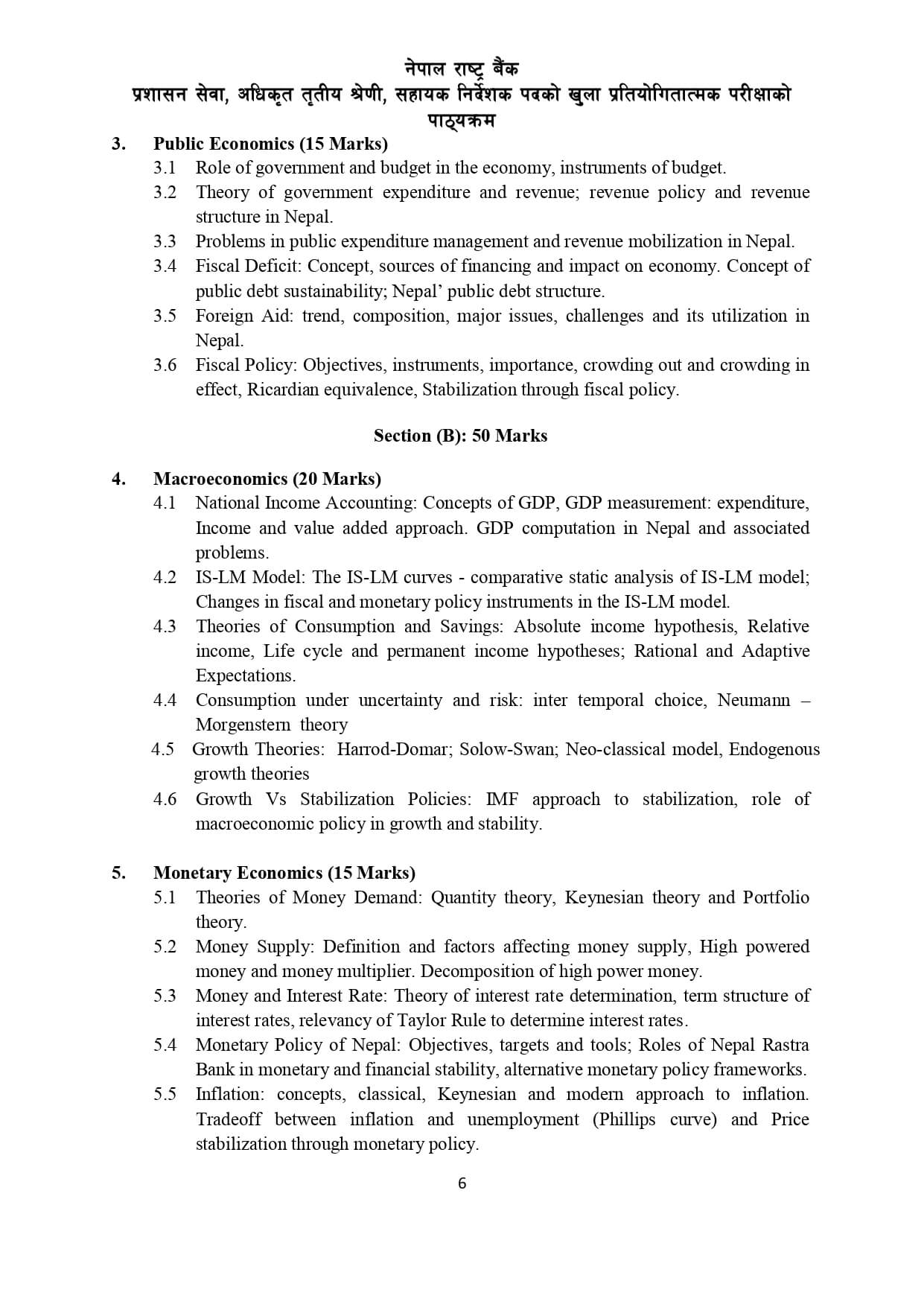
3. Public Economics (15 Marks)
3.1 Role of government and budget in the economy, instruments of budget.
3.2 Theory of government expenditure and revenue; revenue policy and revenue structure in Nepal.
3.3 Problems in public expenditure management and revenue mobilization in Nepal.
3.4 Fiscal Deficit: Concept, sources of financing, and impact on the economy. Concept of public debt sustainability; Nepal’s public debt structure.
3.5 Foreign Aid: trend, composition, major issues, challenges, and its utilization in Nepal.
3.6 Fiscal Policy: Objectives, instruments, importance, crowding out and crowding in effect, Ricardian equivalence, Stabilization through fiscal policy.
Section (B): 50 Marks
4. Macroeconomics (20 Marks)
4.1 National Income Accounting:
Concepts of GDP, GDP measurement: expenditure, income, and value added approach. GDP computation in Nepal and associated problems.
4.2 IS-LM Model:
The IS–LM curves – comparative static analysis of the IS-LM model; Changes in fiscal and monetary policy instruments in the IS-LM model.
4.3 Theories of Consumption and Savings:
Absolute income hypothesis, Relative income, Life cycle and permanent income hypotheses; Rational and Adaptive Expectations.
4.4 Consumption under uncertainty and risk:
Inter-temporal choice, Neumann–Morgenstern theory.
4.5 Growth Theories:
Harrod-Domar; Solow-Swan growth (Neo-classical model), Endogenous growth theories.
4.6 Growth Vs Stabilization Policies:
IMF approach to stabilization, role of macroeconomic policy in growth and stability.
5. Monetary Economics (15 Marks)
5.1 Theories of Money Demand:
Quantity theory, Keynesian theory, and Portfolio theory.
5.2 Money Supply:
Definition and factors affecting money supply, High powered money and money multiplier. Decomposition of high power money.
5.3 Money and Interest Rate:
Theory of interest rate determination, term structure of interest rates, relevancy of Taylor Rule to determine interest rates.
5.4 Monetary Policy of Nepal:
Objectives, targets and tools; Roles of Nepal Rastra Bank in monetary and financial stability, alternative monetary policy frameworks.
5.5 Inflation:
Concepts, classical, Keynesian and modern approach to inflation. Trade off between inflation and unemployment (Phillips curve) and Price stabilization through monetary policy.
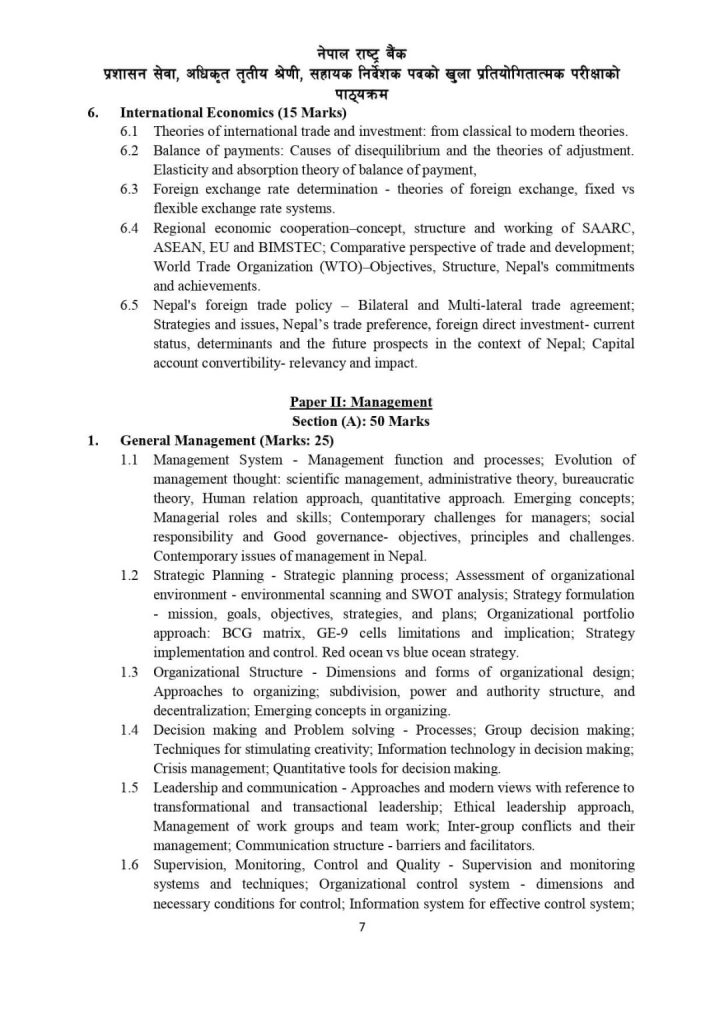
6. International Economics (15 Marks)
6.1 Theories of international trade and investment: from classical to modern theories.
- Classical – Mercantilism, Absolute Cost Advantage, Comparative Cost Advantage
- Modern – Relative Factor Endowment
6.2 Balance of payments: Causes of disequilibrium and the theories of adjustment. Elasticity approach of BoP, absorption approach of balance of payment.
6.3 Foreign exchange rate determination – theories of foreign exchange, Fixed vs flexible exchange rate systems.
6.4 Regional economic cooperation – concept, structure and working of SAARC, ASEAN, EU and BIMSTEC; Comparative perspective of trade and development; World Trade Organization (WTO) – Objectives, Structure, Nepal’s commitments and achievements.
6.5 Nepal’s foreign trade policy – Bilateral and Multi-lateral trade agreement; Strategies and issues, Nepal’s trade preference, foreign direct investment – current status, determinants, and the future prospects in the context of Nepal; Capital account convertibility – relevancy and impact.
Paper II: Management
Section (A): 50 Marks
1. General Management (Marks: 25)
1.1 Management System:
Management function and processes; Evolution of management thought: scientific management, administrative theory, bureaucratic theory, Human relation approach, quantitative approach. Emerging concepts; Managerial roles and skills; Contemporary challenges for managers; Social responsibility and Good governance – objectives, principles and challenges. Contemporary issues of management in Nepal.
1.2 Strategic Planning:
Strategic planning process; Assessment of organizational environment – environmental scanning and SWOT analysis; Strategy formulation – mission, goals, objectives, strategies, and plans; Organizational portfolio approach: BCG matrix, GE–9 cells limitations and implications; Strategy implementation and control; Red ocean vs blue ocean strategy.
1.3 Organizational Structure:
Dimensions and forms of organizational design; Approaches to organizing; subdivision, power and authority structure, and decentralization; Emerging concepts in organizing.
1.4 Decision making and Problem solving:
Processes; Group decision making; Techniques for stimulating creativity; Information technology in decision making; Crisis management; Quantitative tools for decision making.
1.5 Leadership and communication:
Approaches and modern views with reference to transformational and transactional leadership; Ethical leadership approach; Management of work groups and team work; Inter-group conflicts and their management; Communication structure – barriers and facilitators.
1.6 Supervision, Monitoring, Control and Quality:
Supervision and monitoring systems and techniques; Organizational control system – dimensions and necessary conditions for control; Information system for effective control system.
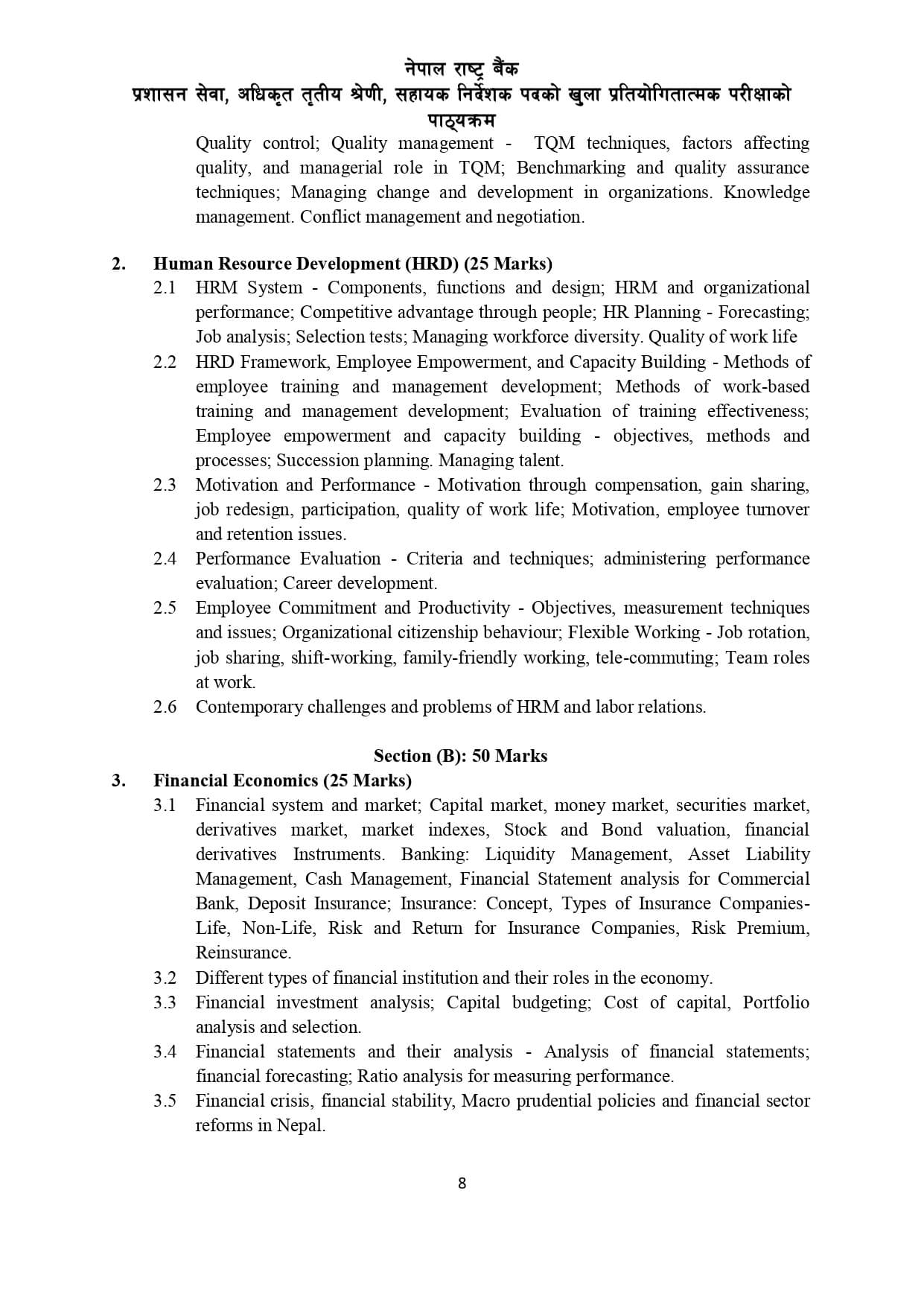
Quality control; Quality management – TQM techniques, factors affecting quality, and managerial role in TQM; Benchmarking and quality assurance techniques; Managing change and development in organizations. Knowledge management. Conflict management and negotiation.
2. Human Resource Development (HRD) (25 Marks)
2.1 HRM System – Components, functions and design; HRM and organizational performance; Competitive advantage through people; HR Planning – Forecasting; Job analysis; Selection tests; Managing workforce diversity. Quality of work life.
2.2 HRD Framework, Employee Empowerment, and Capacity Building – Methods of employee training and management development; Methods of work-based training and management development; Evaluation of training effectiveness; Employee empowerment and capacity building – objectives, methods and processes; Succession planning. Managing talent.
2.3 Motivation and Performance – Motivation through compensation, gain sharing, job redesign, participation, quality of work life; Motivation, employee turnover and retention issues.
2.4 Performance Evaluation – Criteria and techniques; administering performance evaluation; Career development.
2.5 Employee Commitment and Productivity – Objectives, measurement techniques and issues; Organizational citizenship behaviour; Flexible Working – Job rotation, job sharing, shift-working, family-friendly working, tele-commuting; Team roles at work.
2.6 Contemporary challenges and problems of HRM and labor relations.
Section (B): 50 Marks
3. Financial Economics (25 Marks)
3.1 Financial system and market: Capital market, money market, securities market, derivatives market, market indexes; Stock and Bond valuation, financial derivatives instruments.
Banking: Liquidity Management, Asset Liability Management, Cash Management, Financial Statement analysis for Commercial Bank, Deposit Insurance.
Insurance: Concept, Types of Insurance Companies – Life, Non-Life, Risk and Return for Insurance Companies, Risk Premium, Reinsurance.
3.2 Different types of financial institutions and their roles in the economy.
3.3 Financial investment analysis; Capital budgeting; Cost of capital; Portfolio analysis and selection.
3.4 Financial statements and their analysis – Analysis of financial statements; Financial forecasting; Ratio analysis for measuring performance.
3.5 Financial crisis, financial stability, Macro-prudential policies, and financial sector reforms in Nepal.
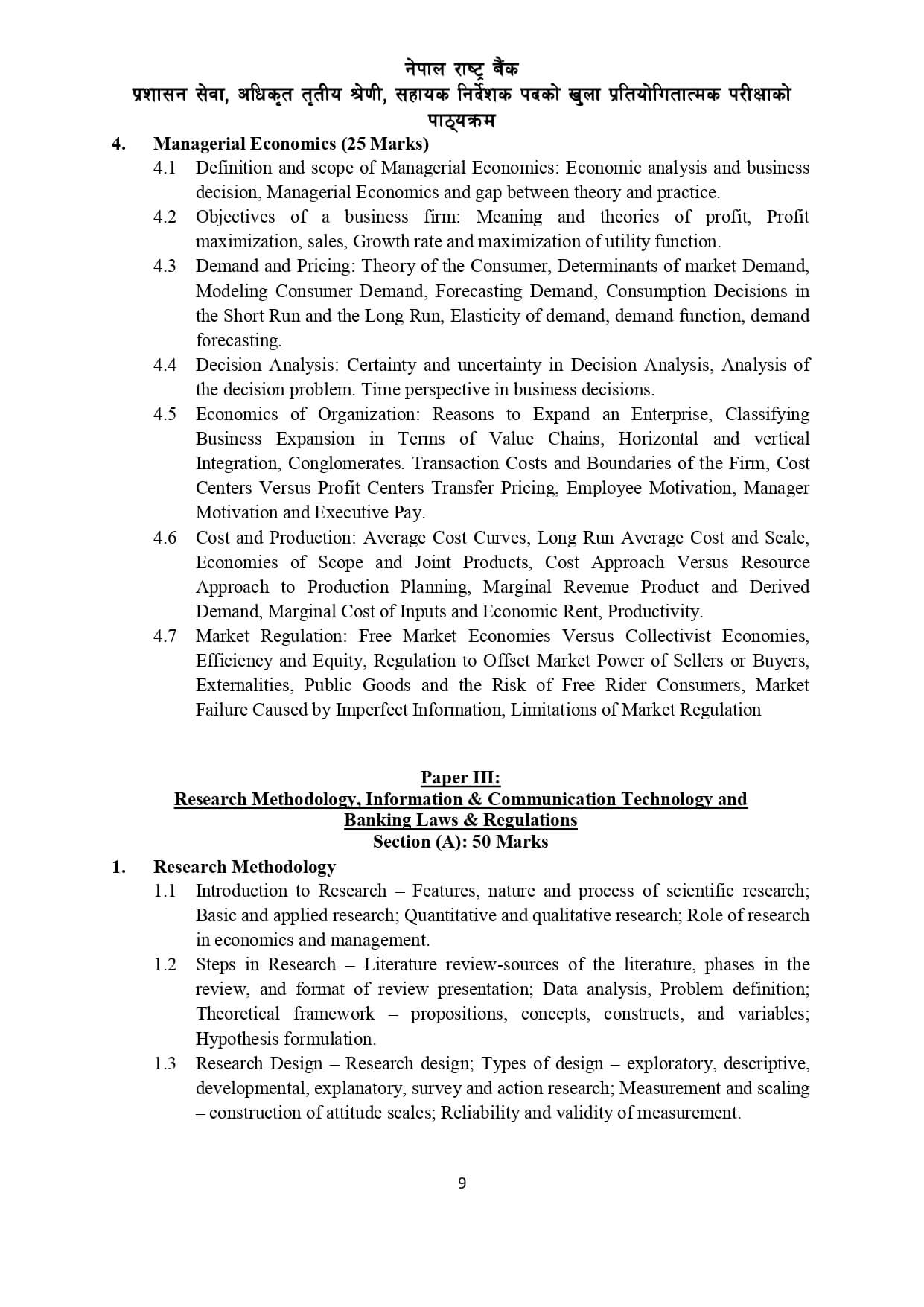
4. Managerial Economics (25 Marks)
4.1 Definition and scope of Managerial Economics; Economic analysis and business decision, Managerial Economics and the gap between theory and practice.
4.2 Objectives of a business firm: Meaning and theories of profit, Profit maximization, sales, Growth rate and maximization of utility function.
4.3 Demand and Pricing: Theory of the Consumer, Determinants of market Demand, Modeling Consumer Demand, Forecasting Demand, Consumption Decisions in the Short Run and the Long Run, Elasticity of demand, demand function, demand forecasting.
4.4 Decision Analysis: Certainty and uncertainty in Decision Analysis, Analysis of the decision problem. Time perspective in business decisions.
4.5 Economics of Organization: Reasons to Expand an Enterprise, Classifying Business Expansion in Terms of Value Chains, Horizontal and vertical Integration, Conglomerates. Transaction Costs and Boundaries of the Firm, Cost Centers Versus Profit Centers, Transfer Pricing, Employee Motivation, Manager Motivation and Executive Pay.
4.6 Cost and Production: Average Cost Curves, Long Run Average Cost, Economies of Scope and Economies of Scale, Joint Products Pricing, Cost Approach Versus Resource Approach to Production Planning, Marginal Revenue Product and Derived Demand, Marginal Cost of Inputs and Economic Rent, Productivity.
4.7 Market Regulation: Free Market Economies Versus Collectivist Economies, Efficiency and Equity, Regulation to Offset Market Power of Sellers or Buyers, Externalities, Public Goods and the Risk of Free Rider Consumers, Market Failure Caused by Imperfect Information, Limitations of Market Regulation.
Paper III
Research Methodology, Information & Communication Technology, and Banking Laws & Regulations
Section (A): 50 Marks
1. Research Methodology
1.1 Introduction to Research – Features, nature, and process of scientific research; Basic and applied research; Quantitative and qualitative research; Role of research in economics and management.
1.2 Steps in Research – Literature review – sources of the literature, phases in the review, and format of review presentation; Data analysis, Problem definition; Theoretical framework – propositions, concepts, constructs, and variables; Hypothesis formulation.
1.3 Research Design – Research design – Types of design: exploratory, descriptive, developmental, explanatory, survey, and action research; Measurement and scaling – construction of attitude scales; Reliability and validity of measurement.
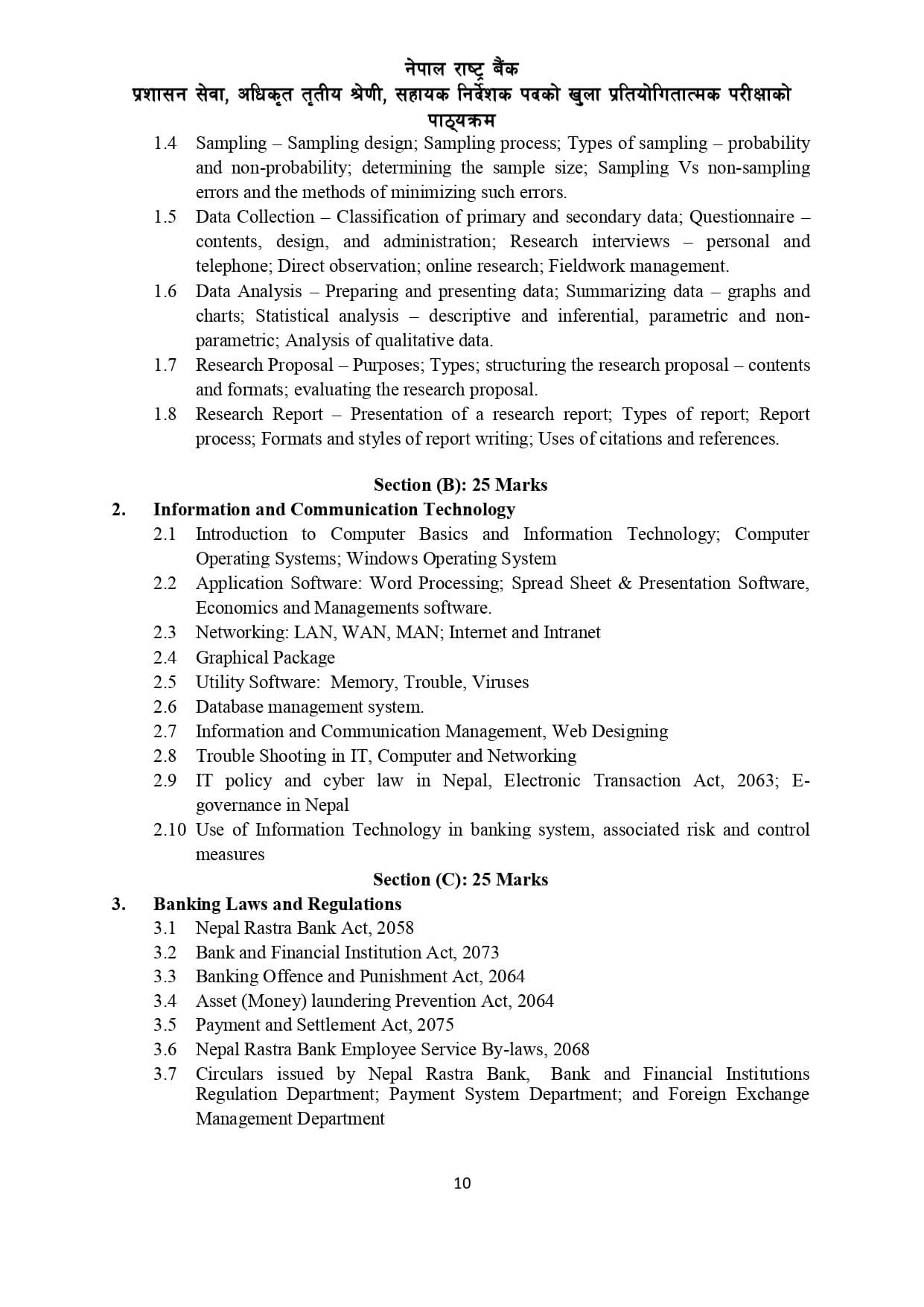
1.4 Sampling – Sampling design; Sampling process; Types of sampling – probability and non-probability; determining the sample size; Sampling Vs non-sampling errors and the methods of minimizing such errors.
1.5 Data Collection – Classification of primary and secondary data; Questionnaire – contents, design, and administration; Research interviews – personal and telephone; Direct observation; online research; Fieldwork management.
1.6 Data Analysis – Preparing and presenting data; Summarizing data – graphs and charts; Statistical analysis – descriptive and inferential, parametric and non-parametric; Analysis of qualitative data.
1.7 Research Proposal – Purposes; Types; structuring the research proposal – contents and formats; evaluating the research proposal.
1.8 Research Report – Presentation of a research report; Types of report; Report process; Formats and styles of report writing; Uses of citations and references.
Section (B): 25 Marks
2. Information and Communication Technology
2.1 Introduction to Computer Basics and Information Technology; Computer Operating Systems; Windows Operating System.
2.2 Application Software: Word Processing; Spreadsheet & Presentation Software; Economics and Management software.
2.3 Networking: LAN, WAN, MAN; Internet and Intranet.
2.4 Graphical Package.
2.5 Utility Software: Memory, Trouble, Viruses.
2.6 Database management system.
2.7 Information and Communication Management, Web Designing.
2.8 Troubleshooting in IT, Computer and Networking.
2.9 IT policy and cyber law in Nepal, Electronic Transaction Act, 2063; E-governance in Nepal.
2.10 Use of Information Technology in the banking system, associated risk and control measures.
Section (C): 25 Marks
3. Banking Laws and Regulations
3.1 Nepal Rastra Bank Act, 2058.
3.2 Bank and Financial Institution Act, 2073.
3.3 Banking Offence and Punishment Act, 2064.
3.4 Asset (Money) laundering Prevention Act, 2064.
3.5 Payment and Settlement Act, 2075.
3.6 Nepal Rastra Bank Employee Service By-laws, 2068.
3.7 Circulars issued by Nepal Rastra Bank, Bank and Financial Institutions Regulation Department, Payment System Department, and Foreign Exchange Management Department.
- Updated Date: 2080/05/18
- Type: Open competition
- Level: Officer Third
- Designation: Assistant Director
- Service: Administration
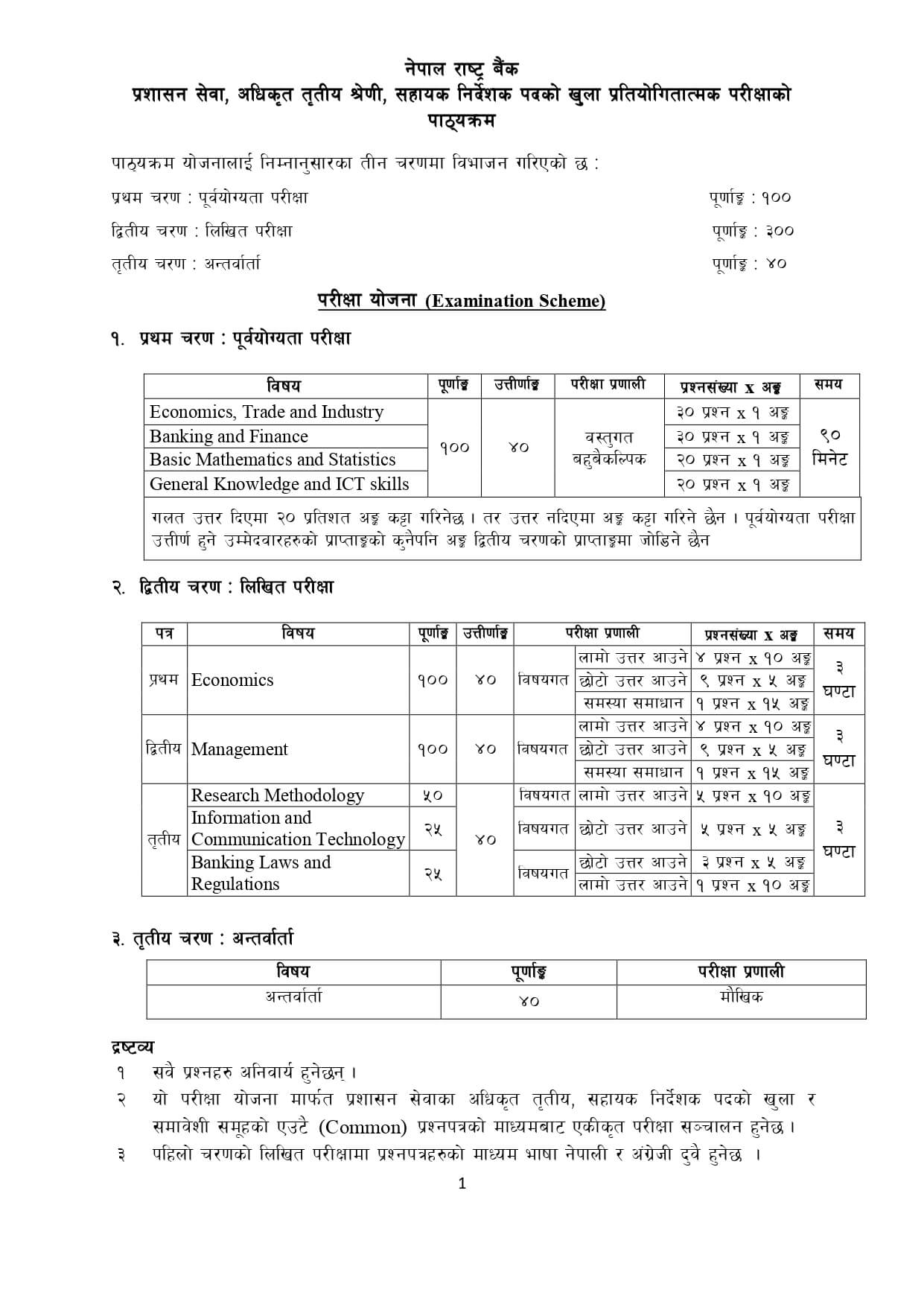
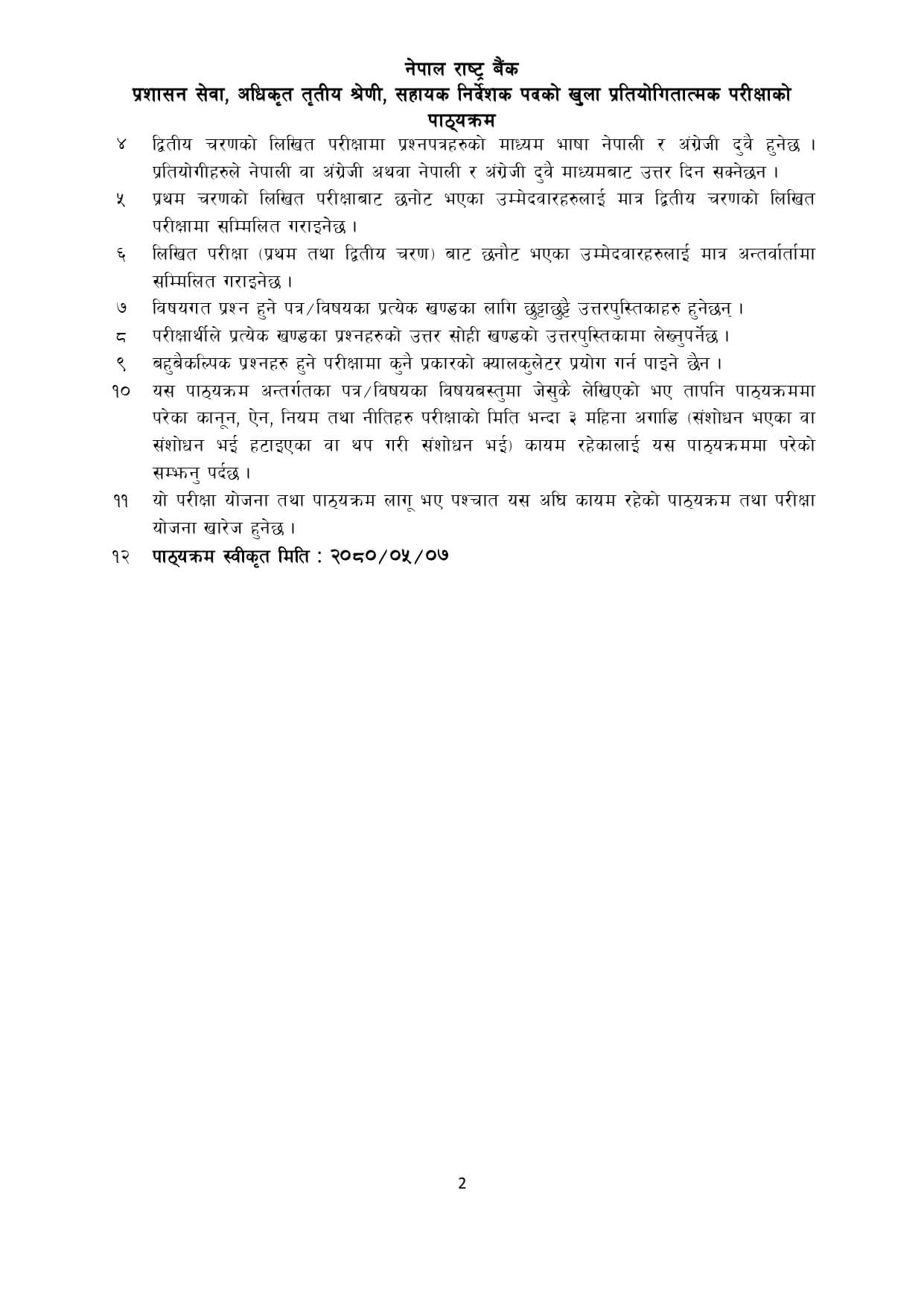
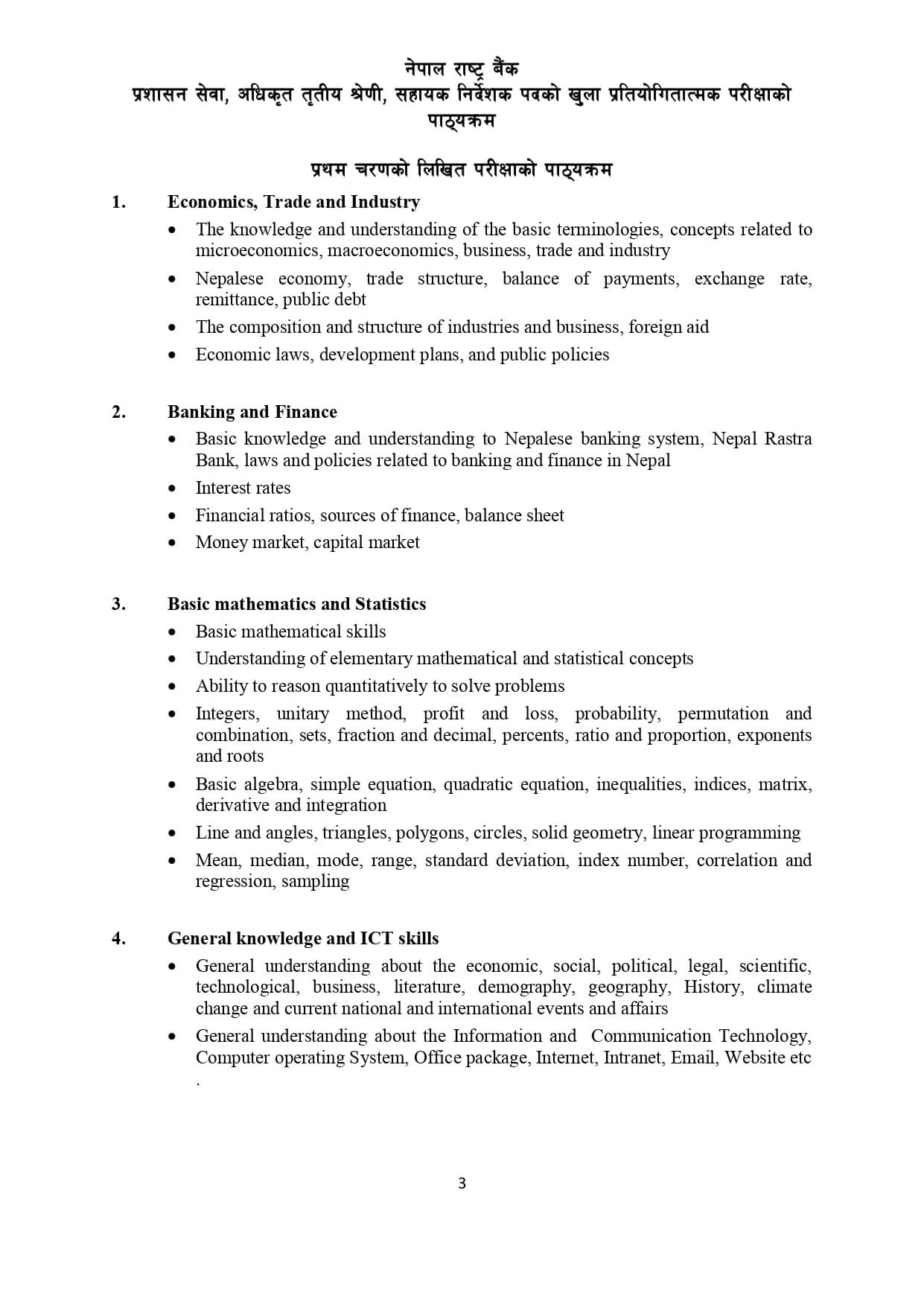
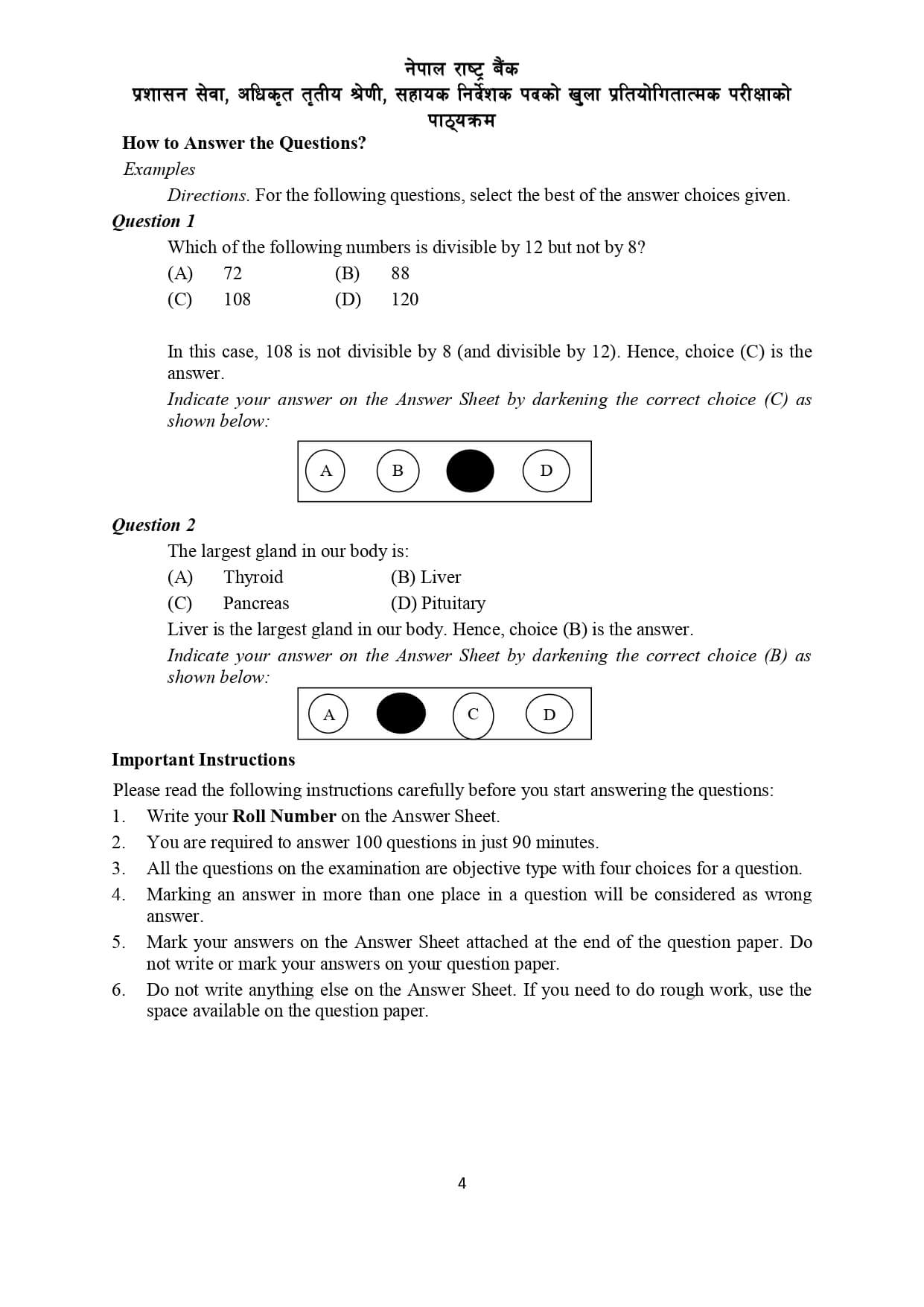
Post – Assistant Director for Admin, Officer third
Notes