It is also called the Neo-classical theory of interest Rate Determination.
- Developed by economists like Knut Wicksell and Dennis Robertson.
- Interest rate is determined by the demand and supply of loanable funds.
- The interest rate is determined at the point where demand equals the supply of loanable funds.
This theory is an extension of the classical theory of interest rate. According to this theory, the interest rate is determined by the interaction between market demand and supply of the loanable funds. Where the loanable fund is defined as the fund available for lending in the market.
The loanable fund has its demand and supply. There are various components of the market demand and supply of the loanable fund.
The major components of the market demand for the loanable fund are:
#Investment demand of the fund (I):
It is the major component of the market demand for the loanable fund, which is assumed to be an inverse function of interest rate.
i.e. I = f(r), f’ <0
#Consumption demand of the fund (C):
People demand a loan to smooth out their consumption, where people borrow less for consumption if the interest rate is higher and borrow more if the interest rate is lower. So, consumption is also assumed to be an inverse function of interest rate.
C = f(r), f'<0
#Hoarding demand of the fund (H):
For the neo-classists, money gives utility in the form of comfort and security, and so some part of the loanable fund is hoarded by the public. It means some part of the loanable fund is neither used for investment nor for consumption, which is hoarding of the fund. It is also assumed to be an inverse function os interest rate.
i.e. H = f(r), f’ < 0
This shows that the demand or use of the loanable fund consists of investment, consumption, and hoarding demand, all of which are inverse functions of the interest rate. So, the market demand for loanable funds is downward sloping.
i.e. (Demand of loanable fund (DLF ) = I + C +H which is function of interest rate ⇒ F(r), F’ < 0
The major components of the market supply for the loanable fund are:
#Saving (S): Saving is the primary source of supply of loanable fund which is assumed to be a positive function of interest rate. i.e. S = f(r), f’>0
#Disinvestment (DI): It is one of the major sources of the loanable fund in the market. If people sell out their assets or disinvest, they receive the fund, which is available for lending. It is also assumed to be a positive function of the interest rate. i.e. DI = f(r), f’ >0
#Dishoarding (DH): Interest rate is the opportunity cost of hoarding money, and so if the interest rate increases, people start to dishoard the money and make it available for lending. It means dishoarding is also a source of loanable fund which is the positive function of the interest rate. i.e. DH = f(r), f’ >0
#Bank’s reserve or Bank’s money (BR): The bank can supply loanable funds from its own reserve, which is also assumed to be a positive function of the interest rate. It means is interest rate increases, the banks do not want to hold more reserves, they prefer lending. i.e. BR = f(r), f’>0. The market supply of loanable funds is the sum of savings, disinvestment, disinvestmentm dishoarding, and banks’ reserve, which are the positive functions of the interest rate. So, the market supply of loanable funds is upward sloping.
i.e. Supply of loanable fund (SLF) = S + DI + DH + BR F(r), F’>0
- If DLF >SLF ⇒ Interest Rate (↑)
- If DLF < SLF ⇒ Interest Rate (↓)
- If DLF = SLF ⇒ Equilibrium (r*)
As the market demand for the loanable fund is downward sloping and the market supply is upward sloping, the interaction between them determines the interest rate. The interest rate is said to be in equilibrium when market demand and supply are equal.
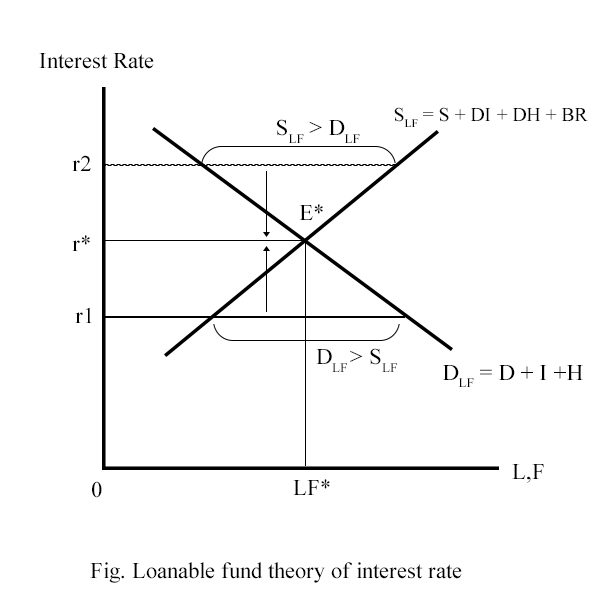
The loanable fund market is in equilibrium at E*, where both market demand and market supply of funds are equal. So, r* is the equilibrium interest rate, and this equation is stable. If the existing interest rate is below the equilibrium rate, there is excess demand for the loanable fund which increases the interest rate gradually and reaches the equilibrium point.
Similarly, if the existing interest rate is above the equilibrium rate, there is an excess supply of funds which reduces the interest rate and reaches to equlibrium sooner or later.