It was proposed by economist John B. Taylor in 1993. Taylor’s Rule is a monetary policy guideline that suggests how a central bank should set the nominal interest rate based on economic conditions—especially inflation and output.
Taylor’s Rule provides a systematic guideline for interest rate determination. It links inflation and output gap to monetary policy decisions and helps central banks maintain economic stability.
it = r* + πt + α (πt – πt*) + β (Yt – Yt*)
According to this rule, the central bank should consider some specific macro variables while setting the interest rate. The basic rule developed by Taylor is given as:
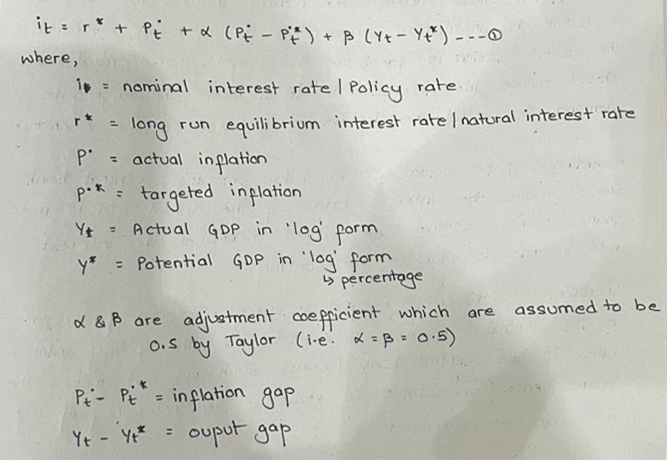
This rule shows that the central bank should consider the natural interest rate, actual inflation, the inflation gap, and the output gap when determining the nominal interest rate. Since price stability is the prime objective of monetary policy, the central bank should mainly focus on the inflationary gap while changing the interest rate. As a rule of thumb, Taylor suggests that if there is a positive inflationary gap by 1%, then the central bank should increase the nominal interest rate by more than 1% in order to cool down the economy (or control the inflation).
The Taylor rule is a basic interest-rate-setting rule for the central bank to maintain price stability as its primary objective. According to this rule, if actual inflation exceeds the target, the central bank should raise the nominal interest rate to curb inflationary pressures in the economy. Similarly, if the actual inflation is far below the target, then the central bank should reduce the interest rate to increase the aggregate demand and control the deflationary pressure in the economy.
Accordingly, if the actual GDP is below potential, the central bank should reduce the interest rate, and if the actual GDP is more than potential, the central bank should increase the interest rate in order to stabilize the economy.
Therefore, Taylor’s rule suggests a specific framework for the central bank in order to determine the policy interest rate. If the central bank follows such a rule, it makes the interest rate policy predictable and credible. The relevance of Taylor’s rule can be expressed as:
Relevancy of Taylor’s Rule
- Benchmark/reference for interest rate determination by the central bank.
- Transparency and credibility in policy making.
- Avoids the ad-hoc basis of interest rate setting by the central bank.
- Assessment of the central bank’s policy.
- Maintaining macro-economic stability through effective interest rate policy.
- Inflation targeting by the central bank.
- Provides a disciplined framework for monetary policy.
Interest rate stability ⇒ Price level stability ⇒ Macroeconomic stability
If there is interest rate stability, then it encourages investment, stabilizes the consumption, stabilizes the AD and AS, stabilizes the inflation, and stabilizes the exchange rate.