International Economics
International business theories explain why countries trade with each other and the benefits derived from such trade. These theories can be broadly categorized into classical and modern, with the former focusing on country-level advantages and the latter incorporating firm-level and dynamic factors. Key theories include Mercantilism, Absolute Advantage, Comparative Advantage, Heckscher-Ohlin, and modern theories like the Product Life Cycle and Porter’s Diamond
There are two theories in international trade, classified as follows.
- Classical Theory
- Mercantilism
- Absolute Cost Advantage (by Adam Smith)
- Comparative Cost Advantage (by David Ricardo)
- Modern theory
- Relative Factor Endowment Theory (Heckscher-Ohlin Model)
Absolute Cost Advantages Theory
- Proposed by Adam Smith in his seminal work “The Wealth of Nations” (1776)
This is one of the classical theories proposed by Adam Smith in 1776 AD. This theory argues that the trade between the countries benefit them if they trade based on the Absolute Cost Advantage. A country is said to have absolute cost advantage in the production of a commodity if the per unit cost of production is lower than that of other country.
According to this theory, the country should specialize in the products with absolute cost advantage and export them while import those products that have an absolute cost disadvantage in producing them domestically. If the trade between countries is based on this principle, it makes both of them better off.
Basic Assumptions:
- There are two countries A and B involved in trade.
- There are two products X and Y produced in the countries.
- There are no restrictions on trade between the countries (Free Trade).
- The resources are given and fully employed.
- There is no transportation and other transaction cost associated in trade.
- Products are freely mobile in between the countries but internal factors are mobile within the country only.
- There is perfect competition in both the product market and the factor market.
- There is no discrimination between domestic and foreign products in the market, and consumer preferences are evenly distributed between the domestic and foreign products.
Based on these assumptions, this theory shows that both countries benefit from free trade if it is based on the absolute cost advantage. In order to explain this, consider the following example.
| Product X | Product Y | |
|---|---|---|
| Country A | 10 | 25 |
| Country B | 20 | 15 |
Here, country A has an absolute cost advantage in producing product X while country B has an absolute cost advantage in producing product Y. So, if country A specializes in producing product X and country B specializes in producing product Y and trade to each other, it means both of them in a win-win situation.
In order to explain how the free trade between A and B based on the absolute cost advantage, benefits both of them, assume that both of the countries have equal resources of $600 billion.
Now, if a country A uses all the given resources in producing X only then it can produce 60 billion units of X and Y = 0. Similarly, if country A produces Y only, it can produce 24 billion units of Y and x=0. This gives the Production Possibility Frontier (PPF) of country A.
Production Possibility Frontier (PPF)
The Production Possibility Frontier (PPF) is a curve that shows the maximum possible combinations of two goods or services that can be produced within an economy, given fixed resources and technology.
Similarly, if country B produces X only or Y only, then it can produce 30 billion units of X and 40 billion units of Y, respectively. This is represented by the following diagram.
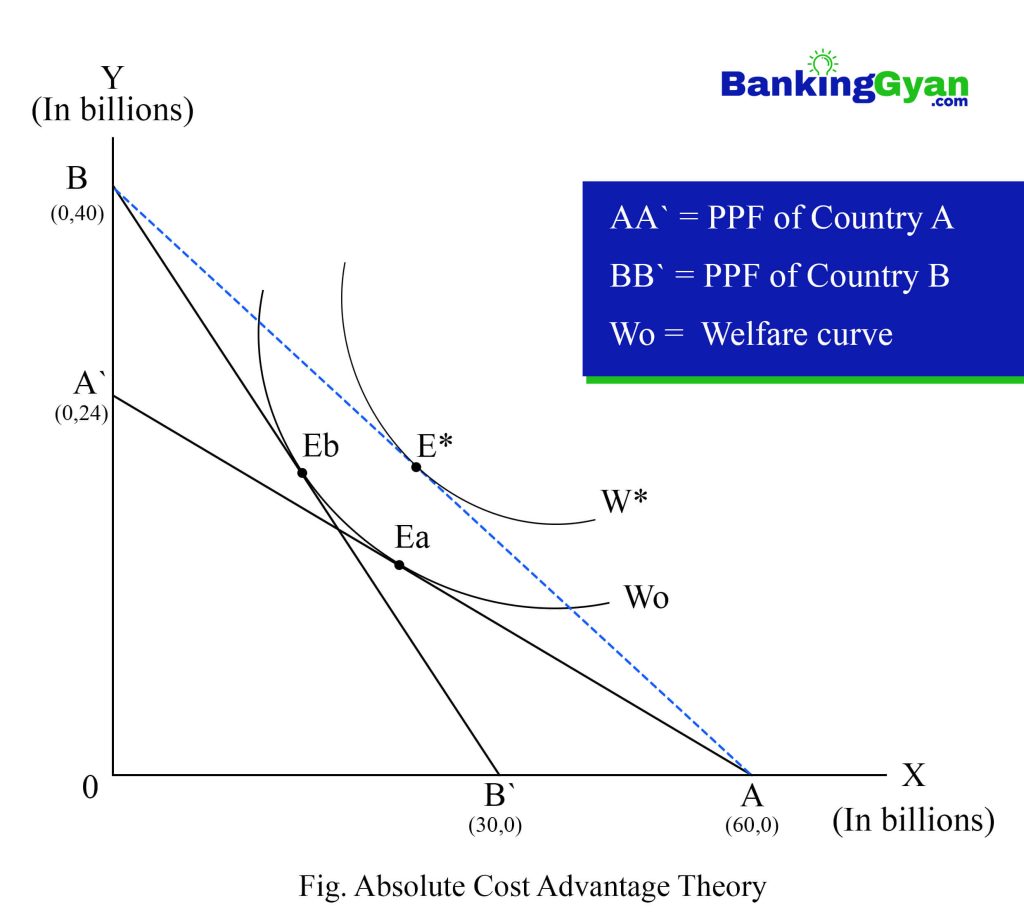
Here, AA` is the Production Possibility Frontier of country A, which shows the maximum quantity of X and Y that country A can produce from the full utilization of available resources.
Similarly, BB` is the Production Possibility Frontier of country B, which shows the maximum quantity of X and Y that country B can produce from the full utilization of available resources.
If there is no trade between the countries, then each of them have to produce both X and Y together in order to meet their domestic demand. In this case, countries A and B are in equilibrium at Ea and Eb, respectively, with W0 level of social welfare. However, if countries A and B agree to have FREE TRADE, then country A specializes in X product and country B specializes in product Y at which they achieve an absolute cost advantage. Then jointly OA units of X and OB units of Y are available, implying that AB is the new joint PPF and so both of the countries attain equilibrium at E* with a higher level of social welfare W*.
This shows that the free trade between the countries based on absolute cost advantage improves their social welfare. It means both of them benefit simultaneously. So free trade is better than no trade (Autarky).
Comparative Cost Advantages Theory
- Proposed by David Ricardo (1817)
- Concept of trade based on the opportunity cost/relative cost.
Comparative Cost Advantage Theory is another classical theory of international trade. This theory was proposed by David Ricardo in 1817. This is an alternative theory to the absolute cost advantage theory. According to this theory, the basis of the trade between two countries is not on the basis of absolute cost, but rather on the opportunity cost (comparative cost).
A country may have an absolute cost advantage in all the products, but there is also trade between the countries, which means, in this case, the absolute cost advantage theory can not explain the trade between the countries.
A country is said to have a comparative advantage in a particular product if the opportunity cost of producing it is lower than that of other countries.
So, it is better for the country to be focused on specializing in the production and export of those products if there is a lower opportunity cost of comparative cost advantage and import when there is a comparative cost disadvantage.
Basic Assumptions:
- There are two countries A and B
- There are two products X and Y
- Labor is the single factor of production and its quantity is given
- There is free trade between two countries
- Both products and the factor market are perfectly competitive
- There is no transportation and other transaction costs applicable in trade
- Products are perfectly mobile between countries, but factors are mobile within the country only
- The preferences of the consumer are equally distributed between domestic and foreign products
- The resources are fully employed/utilized
Based on these assumptions, this theory shows that the trade between two countries is beneficial to both of them if it is based on the comparative cost advantage. To explain this, consider the following example.
| Per unit cost of X (in labor) | Per unit cost of Y (in labor) | |
|---|---|---|
| Country A | 10 | 15 |
| Country B | 20 | 40 |
Here, country A has an absolute cost advantage in both X and Y products, which means trade is not possible between country A and B under the absolute cost advantage theory of Adam Smith. But in reality, they are trading with each other, which means the trade between the countries is not based on an absolute cost advantage.
Ricardo argues that the trade between two countries is based on the comparative cost advantage (opportunity cost). The comparative cost advantage is defined in terms of relative or opportunity cost, where the product with the lower opportunity cost is said to have the comparative cost advantage.
Now, for a country A:
Opportunity cost of producing X = 10/15, =0.67 units of Y
Opportunity cost of producing Y = 15/10 = 1.5 units of X
For country B,
Opportunity cost of producing X = 20/40 = 0.5 units of Y
Opportunity cost of producing Y = 40/20 = 2 units of X
This shows that, the opportunity cost of producing X is higher in country A than in country B which means country A has comparative cost disadvantage in producing X while B has such advantage in Y. So, country A should import X from country B where the country A can save (0.67-0.5) 0.17 units of Y for each unit of import of X.
Similarly, the opportunity cost of producing Y is lower in country A in comparison to country B. It means country A has a comparative cost advantage in producing Y and B has a disadvantage. SO, country B should import Y from country A, which helps country B to save (2-1.5) 0.5 units of X for each unit of import of Y.
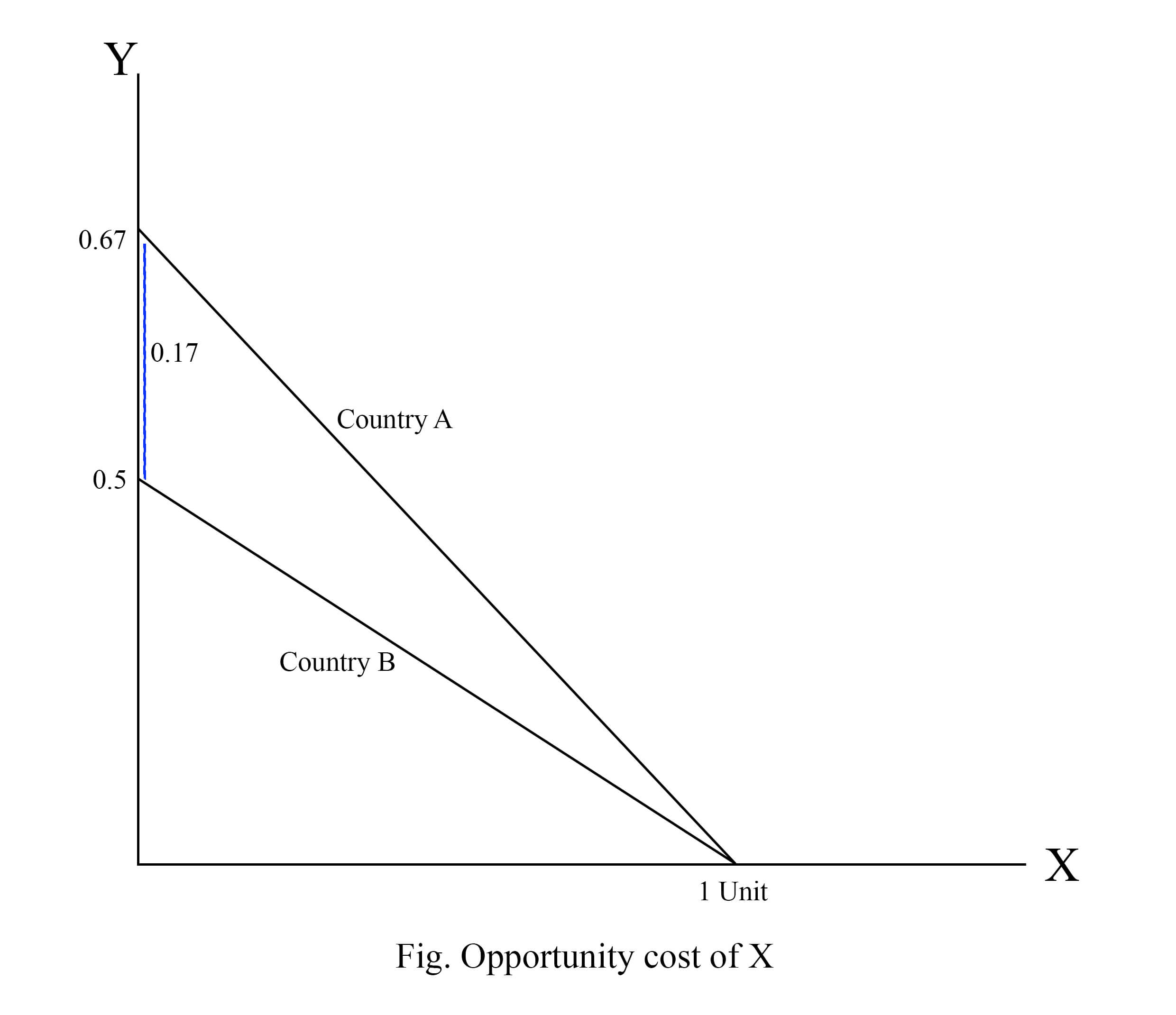
As per Figure 1, to produce each unit of X, the cost of production is lower for country B and country B can save 0.17 if they import.
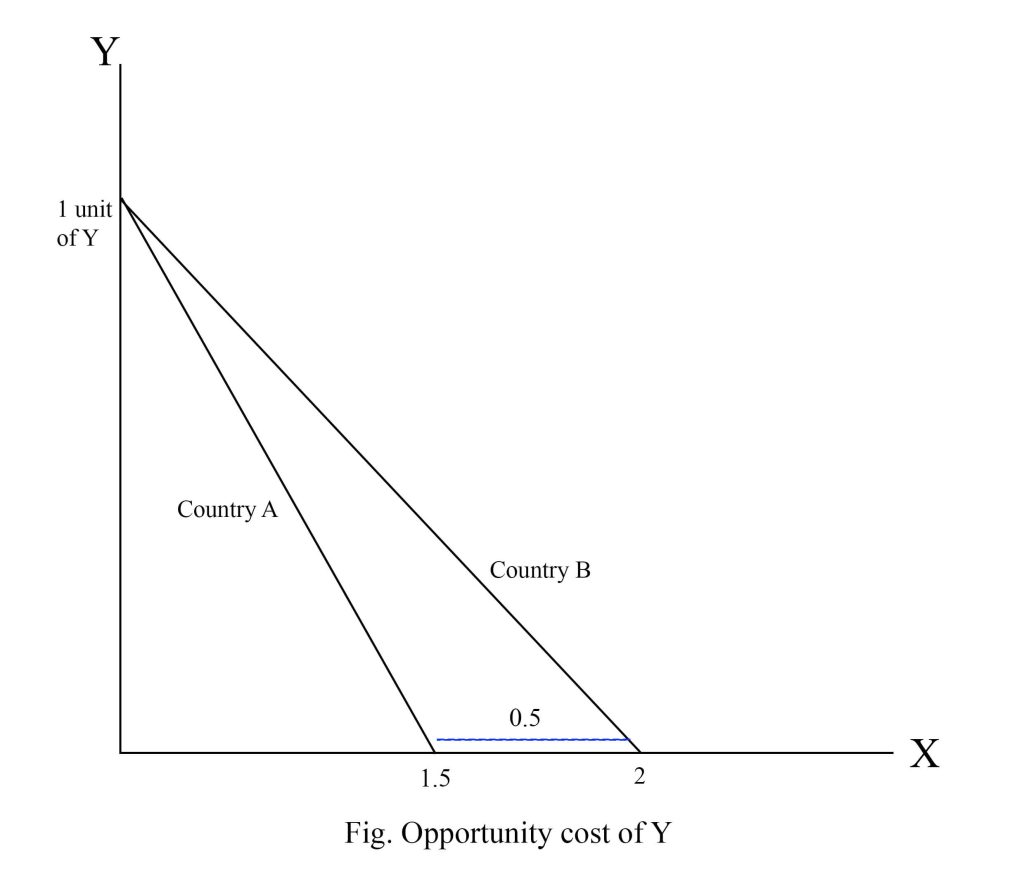
Fig. 1 shows that the opportunity cost of producing X in country A is higher than in country B, and in fig.2 shows that country B has a higher opportunity cost of producing Y than country A.
If there is no trade between them, both of them have to produce X and Y together to fulfill the domestic needs. In this case, country A is producing X at a higher cost, and country B is producing Y at a higher cost. If there is free trade, then country A imports Y from B, and that helps to save 0.17 units of Y for every unit of X imported.
Similarly, country B imports Y from A, which helps to save 0.5 units of X for each unit of import of Y. This means the free trade based on comparative cost advantage or opportunity cost helps both countries to be in a win-win position. It is due to the benefits to both consumer and producer, where the consumers benefit from imports at a lower price, and producers are also able to sell goods abroad. It means the free trade is better than no trade (Autarky).