1. Capital Output Ratio (COR) पुँजी उत्पादन अनुपात
COR shows the relationship between capital stock and the output of the economy. It is expressed as the ratio of capital stock and output.
i.e. COR = K/Y
If we consider the ratio of existing stock and the aggregate output at the given period, it is called avarage capital output ratio (ACOR).
i.e. ACOR = Kt/Yt (Time period ‘t’)
The ACOR shows/measures how much average capital is needed to produce one unit of output.
ACOR = 5:1
In 2025, on average, 5 units of capital are needed to produce 1 unit of output, showing low capital productivity.
If we consider the change in capital stock or investment and the change in output, we get the incremental or marginal capital output ratio as:
ICOR = ΔK/ΔY
The ICOR shows the additional units of capital required to produce an extra 1 unit of output. For the policy maker or development planner, ICOR is more relevant because their interest is to know the additional capital requirement for an additional unit of output.
The ICOR is calculated using the time series data of output (Real GDP) and investment for a period of at least 5 years. Such time series information is collected for each sector of the economy.
Then, we estimate the ICOR of each sector. For the national or aggregate ICOR, we calculate the weighted average of the sectoral ICOR. It shows what additional units of capital are required to produce an extra unit of output in the economy.
Uses of ICOR for the Development Planner
The ICOR is used by the development planner as a tool of planning. As a tool of development planning, the ICOR helps the planner in the following ways:
1. To estimate the economic growth rate for the planning period

Where,
- I = investment
- Y = real GDP
- ICOR = incremental capital output ratio
#Example
- Suppose, ICOR = 5:1
- Real GDP = 6000 Billion
- I =2000 Billion
Then (g) = 2000/6000 * 1/5 ⇒ 6.6%
2. Estimation of Resource requirement and planning of targeted growth
i.e., Resource requirement (I) = g*.ICOR.Y
g* = 6.6%, ICOR = 5:1
GDP (Y) = 6000 billion
I = 6.6 * 5 * 6000
Rs. 2000
3. Prioritize the development projects based on ICOR
Based on the ICOR, we prioritize and select the appropriate projects to achieve the targeted growth rate from the given resources.
For example,
- g* = 5%
- I/Y =40%
- ICOR = 8:1
- Then, g= (I/Y )/ICOR
- or, g = 40/5
- ∴ 8%
For the targeted growth rate of 8% from the investment of 40% of GDP, we have to select such a project whose average ICOR is 5:1.
2. Cost-Benefit Analysis (CBA) लागत लाभ विश्लेषण
It is a systematic approach to selecting the appropriate project funded by public money. It is a tool for assessing the economic viability, social acceptability, environmental sustainability, and political desirability of the government project.
So, CBA analyzes the social cost and benefit of the government project and helps to select the best out of the available alternatives. It promotes transparency, thereby avoiding the ad-hoc basis of the project selection.
It is a scientific framework for government project selection that makes the project selection more transparent, accountable, and acceptable.
Since it is a systematic framework, it normally follows the following sequential steps.
Major Steps of Cost-Benefit Analysis
Step I ⇒ Identification of Issues and objectives of the project intervention:
These issues and objectives of project interventions should clearly be identified. This helps to identify the alternatives and assess the costs and benefits of the projects.
Step II ⇒ Identify the possible alternatives:
Based on the objectives, resource availability, timing, and technical capacity, the alternative projects should be identified.
Step III ⇒ Collection of data on cost & benefits of each alternative:
Once the alternatives are identified, we have to collect the data on the cost and benefit of each. Since it is a social cost-benefit analysis, we have to collect both direct and indirect costs and benefits of each alternative project.
While collecting such information, we use the market price if it represents true social cost and benefits. But in most of the cases, market prices are distorted due to market imperfections and government intervention.
Similarly, the market price may not be available for indirect costs and benefits; then, we use the shadow price for estimating costs and benefits.
Step IV ⇒ Conversion of the costs and benefits into the present value:
Since the costs and benefits from the project occur over the period, we have to convert them into the present value in order to make them comparable by considering the time value of money. For this purpose, we have to select an appropriate social discount rate that considers both direct and indirect costs and the risk factor of the project.
Step V ⇒ Selection of the project:
Using the specific criteria, we select the appropriate project for intervention. The major criteria of the project selection are:
- Payback period (PBP)
- NPV criterion
- IRR criterion
- Sensitivity/risk analysis
- Benefit cost ratio (BCR)
Uses/importance of Cost-Benefit Analysis (CBA)
⇒ Cost-benefit analysis is a tool of development planning that helps to evaluate and select development projects by comparing the social costs and benefits.
⇒ It helps to make the best use of public money by selecting the best alternative projects. So, its uses in development planning are
- Rational/efficient allocation of the scarce/limited resources.
- Avoid the ad-hoc basis of project selection.
- Prioritize and select appropriate government projects.
- Inclusion of social costs and benefits of the project.
- Supports for evidence-based policy making,
- Comparison of alternative technologies and projects.
- Assessment of distributional and equity considerations in the development project.
- Justification of the program and project intervention.
- Helps to monitor and evaluate the development project.
- Makes the project selection more scientific and transparent.
3. Logical Framework (Log Frame)
Activities → Output → Outcome → Impact (Goal)
⇒ A log frame is a systematic framework used by development planners or policymakers to design, execute, and evaluate projects.
⇒ It is a framework that establishes the logical relationship between the key components of the projects, such as input, output, outcome, and impact.
⇒ There is no universally accepted specific log frame. However, every log frame has these four components.
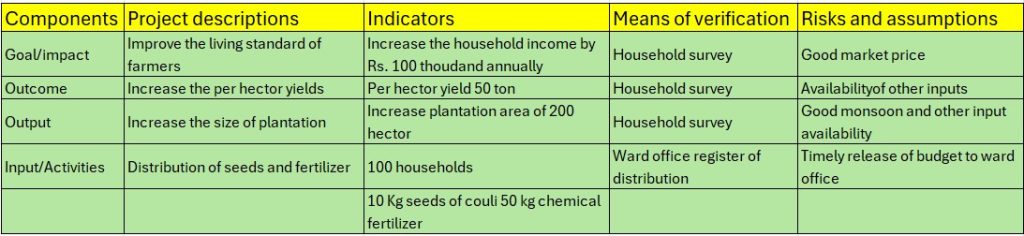
⇒ The log frame is expressed in a matrix where the rows are arranged in goal (impact), outcome, output, and activities.
⇒ Similarly, in the column, the log frame consists of the key components, their description based on the project, indicator, means of verification, risk, and assumptions.
⇒ The general framework of the log frame
Importance/Uses of Log Frame
- Provide a snapshot of the development project.
- Establishes the logical relationship between the key components of the project.
- Clarifies the development goals and the activities to achieve the goals.
- Supports for monitoring and evaluation by providing specific quantitative indicators.
- Improves the project design.
- Identifies the risk and assumption.
- Improves transparency and accountability.
- Supports for resource allocation and budgeting.
- Develop ownership among the stakeholders of the development project.
- Support for the effective execution of the project.
4. Financial and Economic Analysis
Financial analysis is basically the profitability analysis of the private sector investment. This analysis considers only the direct costs and benefits in monetary form.
Under this analysis, we compare the direct costs and benefits of the investment and select the best alternatives using the specific decision criteria (NPV, IRR, etc)
Economic Analysis is related to the welfare analysis of the government project. It considers both direct and indirect costs and benefits.
This analysis compares the social costs and benefits of the project and selects the best alternatives that maximize social welfare.
| Basis | Financial Analysis | Economic Analysis |
|---|---|---|
| Carried for | Private sector project | Govt. (Public) sector project |
| Objective | Profitability Analysis | Social welfare |
| Nature of cost & benefits | Direct cost and benefits | Both direct and indirect cost & benefits |
| Prices | Market price | Market price only if market are efficient(SMC =SMR) or perfect and shadow prices mostly. |
| Tax & Subsidy | Tax is included as cost and subsidy is benefit | Excluded both tax and subsidy as they are simply transfer income |
| Externalities | Excludes or Ignores | Positive externalities are included as benefit and negative externalities are included as cost |
| Discount Rate | Cost of capital or market interest rate | Social discount rate which considers social cost and preference |
| Decision Rule | Financial NPV Financial IRR Financial BCR | Social NPV Social IRR Social BCR |
Issues and Challenges of Economic Development in Nepal
There are multiple issues and challenges to the economic development of Nepal, such as both internal and external. Major issues are:
- Slow. volatile and narrow-based economic growth.
- Slow structural transformation of the economy. (Agri to service sector, subsistence to modern economy).
- Huge dependence on the external sector (foreign employment, aid, remittances, and imports).
- Large trade deficit (slow growth of exports, high growth of imports).
- Lower productivity and poor competitiveness (backward technology, poor infrastructure).
- Large outmigration of youths and increasing dependency on remittance (labor force scarcity).
- Poor governance and costly public service delivery.
- Poverty, inequality, and underemployment.
- Natural disasters and climate vulnerabilities.
- Expansion of transactional economic activities.
- Coordination failure among the institutions, policies, and different layers of government.
- Political instability and policy uncertainty.
- Pre-mature deindustrialization and narrow production base. (shutdown of industries before maturity)