Concept of Poverty
→ There is no unique definition of poverty, but generally, poverty is defined as a situation in which an individual, household, or community is not able to maintain a minimum standard of living defined by society due to a lack of resources. Poverty is a dynamic, multidimensional, and relative concept because the concept of poverty is changing over time and across countries or societies.
→ Poverty can broadly be analyzed in terms of three different dimensions, such as
- Income poverty – lack of sufficient income to fulfil the basic needs
- Human poverty – unable to have basic education, knowledge, and a healthy life, and a minimum standard of living
- Social inclusion – unable to have a dignified or respectable life in society and feeling of being excluded or marginalized, or voiceless.
Poverty can be classified into absolute and relative poverty from the perspective of policymakers. The absolute poverty is the situation in which the individual, household or community is unable to fulfil the basic needs due to the lack of resources. These are said to be absolutely poor if they are below the poverty line, which represents the minimum income required to fulfill the basic needs of society. So, absolute poverty is a miserable (inhuman) condition of the people where they are not able to satisfy their basic needs.
→ The estimation and analysis of absolute poverty help policymakers to design and execute the pro-poor policy to eliminate absolute poverty.
→ Relative poverty is defined by comparing the quality of life between different individuals, households or communities. These are said to be relatively poor if their quality of life is lower than other individuals, households or communities. Since it is not possible to make everyone equal in society, there is always some form of relative poverty. So, the analysis of relative poverty helps the policymaker to understand the extent of it and execute the appropriate policy to reduce such relative poverty.
- Absolute Poverty – हटाउन सकिन्छ
- Relative Poverty – घटाउन सकिन्छ
Measurement of Poverty
- Head Count Index (Po)
- Poverty Gap Index (P1)
- Square Poverty Gap Index (P2)
- Foster-Greer Thorbeck (FGT) Index (Pα)
- Sen Index (Ps)
- Human Poverty Index (HPI)
- Multidimensional Poverty Index (MDPI)
1) Head Count Indec (Po):
Head Count Index measures the proportion of the population below the poverty line, where the poverty line is defined as the minimum income or consumption required to fulfill the basic needs. It is given by Po = n/N
Where
- n = No. of poor or no. of people below the poverty line
- N = total population
2) Poverty Gap Index (P1):
This measure a poverty helps to estimate the total resources required to bring everyone below the poverty line up to the poverty line. So, it measures the minimum resource required to eliminate absolute poverty from society. It is calculated as
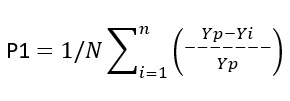 Where,
- Yp = poverty line
- Yi = income of ith poor
- N = Total population
- n = no of poor

P1 shows the proportion of the poverty line that the per capita income is required to eliminate absolute poverty.
3) Square Poverty Gap Index (P2):
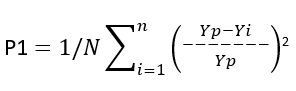
It measures the severity of poverty by providing more weight to more poor. Since all the poor are not equal, to square poverty gap (P2) measures the inequality among the poor, where the higher the P2 more serious or severe the poverty. This index is calculated as
4) Foster-Greer-Thorbeck Index (Pα):
It is a general index of measuring poverty which can be used to compute Po, P1 & P2 simultaneously. It is calculated as
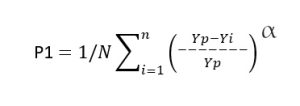
Where α measures the sensitivity of poverty.
- If α =0, it gives the head count index (Po)
- If α =1, it gives the poverty gap index (P1)
- If α =2, it gives the square gap index (P2)
5) Sen Index (Ps):
This is a composite index which combines Po, P1 and the Gini coefficient among the poor. It is the weighted average of the Po and P1, where the weight is given by G and (1-G). This index is computed as
Ps = Po.G + P1 (1-G)
Where,
- Po = head count index
- P1 = poverty gap index
- G = Gini coefficient among the poor
6) Human Poverty Index (HPI):
It is a composite index developed by UNDP differently for the developing countries. For the developing countries, HPI is computed using three different dimensions of deprivation, and for the developed countries, HPI is computed using four different dimensions of deprivation.
HPI (dev. countries) = 1/3 (P13 + P23 + P33) 1/3
Where,
- P1 = Proportion of the population with a life expectancy of less than 40 years
- P2 = Proportion of adult literacy
- P3 = Average of the proportion of the population without access to safe drinking water, proportion of population without access to basic health & proportion of malnourished children.
HPI (developed countries) = 1/4 (P14 + P24 + P34+P44) 1/4
Where,
- P1 = Proportion of the population with a life expectancy of less than 60 years
- P2 = Proportion of adult literacy with functional literacy skills
- P3 = Proportion of the proportion below the poverty line
- P4 = Rates of long-term unemployment (12 months or more)
7) Multidimensional Poverty Index (MPI):
This index was developed by UNDP/Oxford, which considers poverty as a multidimensional phenomenon. MPI is a composite index which considers three dimensions and indicators to compute the poverty index. The dimensions considered by this index are education, health and living standard.
Each of these dimensions is given equal weight of 1/3, where health & education have two indicators of each with 1/6 weight and living standard has 6 indicators with the weight of 1/18 each.
MPI Indicators
| Dimensions of Poverty | Indicator | Deprived of living in the household where… | Weight |
|---|---|---|---|
| Health | Nutrition | Any adult under 70 years of age or any child for whom there is nutritional information is undernourished. | 1/6 |
| Child mortality | Any child under the age of 18 years has died in the family in the five years preceding the survey. | 1/6 | |
| Education | Years of schooling | No household member aged ‘school entrance age + six years or older has completed at least six years of schooling. | 1/6 |
| School attendance | Any school-aged child who is not attending school up to the age at which he/she would complete class eight. | 1/6 | |
| Standard of living | Cooking fuel | The household cooks with dung, wood, charcoal or coal. | 1/18 |
| Sanitation | The household’s sanitation facility is not improved (according to SDG guidelines), or it is improved but shared with other households. | 1/18 | |
| Drinking water | The household does not have access to improved drinking water (according to SDG guidelines), or improved drinking water is at least a 30-minute walk from home, round-trip. | 1/18 | |
| Electricity | The household has no electricity. | 1/18 | |
| Housing | At least one of the three housing materials for roof, walls and floor is inadequate: the floor is of natural materials and/or the roof and/or walls are of natural or rudimentary materials. | 1/18 | |
| Assets | The household does not own more than one of these assets: radio, television, telephone, computer, animal cart, bicycle, motorbike or refrigerator, and does not own a car or truck. | 1/18 |