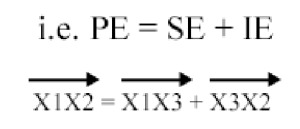
This method is used to decompose the price effect (PE) into substitution effect (SE) and income effect (IE), in which we keep the real income constant (i.e. IE = 0). Hicks defines real income as constant, as the utility constant, and so to keep the real income constant after the change in the price of a commodity, we have to impose a tax or provide a subsidy so that the consumer is able to have the initial level of satisfaction (utility).
It means if the price of a commodity declines, the real income of the consumer will increase, and in this case, we have to impose tax on the consumer in such a way that the budget line after tax is parallel to the new budget line and tangent to the initial Indifference Curve (IC).
Similarly, if the price of the commodity increases, the consumer’s real income declines, and so we have to provide a subsidy in such a way that the consumer can have the initial level of satisfaction (utility).
To explain this, assume that X and Y are two commodities for the consumer, and the price of the normal commodity X declines.
Real income refers to income in terms of purchasing power, i.e., how many goods and services can be bought with money income.
Money income refers to income measured in monetary terms (rupees, dollars, etc.), without considering changes in the price level.
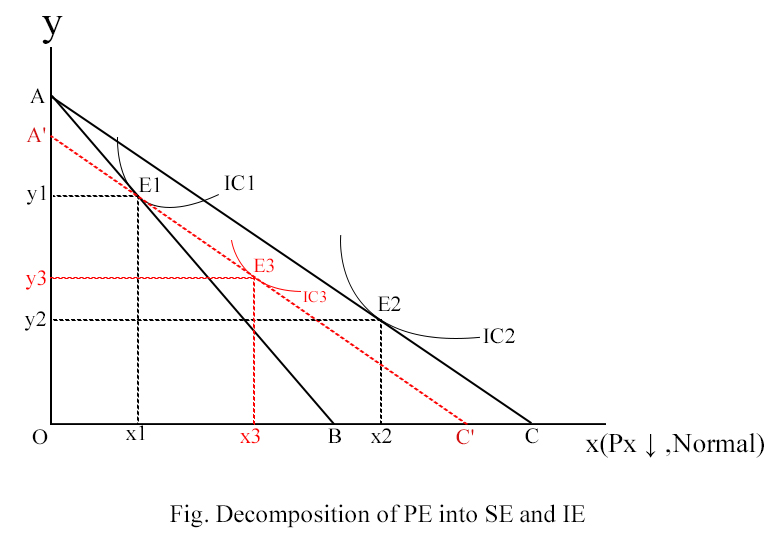
Here, the consumer is initially in equilibrium at E1 with OX1 quantity of X. Now, assume that the price of X declines, and so the budget line swings outward from AB to AC, and the consumer attains a new equilibrium E2 with E2 quantity of X.
This movement from E1 to E2 is a price effect.
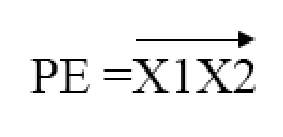
Now, since the price of X decreased, the real income of the consumer increased, so to attain the initial level of satisfaction, we have to impose a tax in such a way that the real income remains constant. To decompose PE into SE and IE. Following the Hicksian method, the new parallel line with AC after tax is A’C’. i.e. A’C’ will be tangent to IC1 and E3.
This means if real income is kept constant (i.e. IE = 0), then the consumer attains equilibrium at E3 with OX3 quantity of X. This movement from E1 to E3 is the Substitution Effect. i.e.

If we refund the tax amount from the consumer, then s/he moves from E3 to E2, which is Income Effect. i.e.
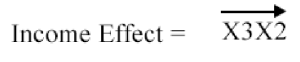
Therefore, PE = Sum of SE and IE