The Theories of Interest Rate Determination explain how the rate of interest is decided in an economy. Different economists have given different approaches. The main theories are:
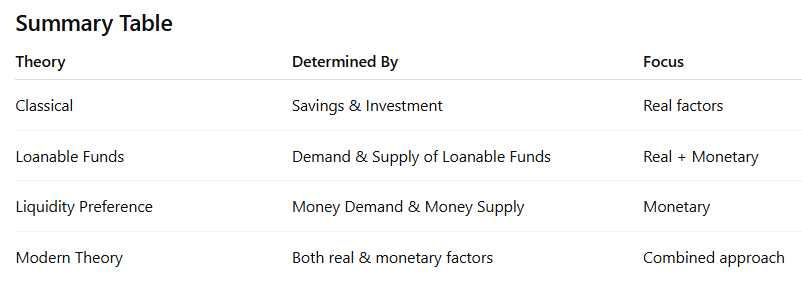
1) Classical Theory of Interest Rate Determination
- Propounded by economists like Alfred Marshall and Irving Fisher.
- According to this theory, the interest rate is determined by the demand for capital (investment) and the supply of capital (savings).
- The interest rate is determined where savings and investment are equal.
- It is a real theory because it considers real factors (saving and investment), not money.
For the classicist, the interest rate is determined by the interaction between aggregate savings and investment in the economy. According to this theory, the interest rate is the reward for saving, and so the saving increases if the interest rate rises. It means saving is the positive function of the interest rate.
i.e. Saving (S) = f(r), f’>0
Similarly, the interest rate is the cost of investment, and so, investment is an inverse function of interest rate.
i.e. I = f(r), f’ < 0
As saving is upward sloping and investment is downward sloping, they interact with each other to determine the equilibrium interest rate. The equilibrium interest rate is that at which both saving and investment demand are equal in the economy.
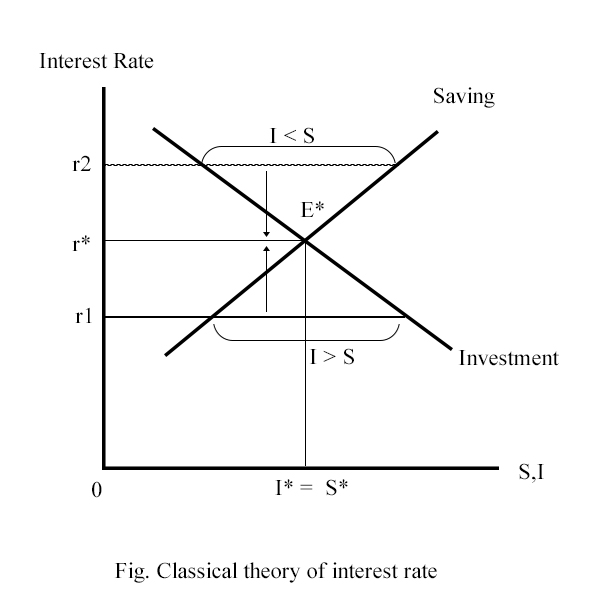
Here, both the saving and investment functions (curve) are intersected at E*, implying that r* is the equilibrium interest rate at which both investment and saving are equal (I=S). This equilibrium is stable because if the existing interest rate is below or above, the market adjusts itself by returning to the equilibrium point. For example, at the time of r1 interest rate, investment demand is higher than saving, which increases the interest rate gradually and ultimately reaches the equilibrium point.
Next Note:
- Loanable Fund Theory of Interest Rate Determination
- Liquidity Preference Theory of Interest Rate Determination
- Is-LM Theories of Interest Rate
Related Notes