The terms structure theory shows the relationship between the terms to maturity period of the bond and its yields or interest rate. It means the maturity period of the bond is different, and depending on their maturity period, their returns or interest rates may be different. So, the terms structure theory explains such a relationship.
There are 3 basic theories related to terms structure theory of interest rate.
- Expectation theory
- Liquidity premium theory
- Market segmentation theory
1) Expectation theory (Pure Expectation)
- It depends on the expectation of bond yield.
- This theory argues that the expectation on the market determines the relationship between the terms to maturity period and the interest rate.
- This theory shows that the long-term interest rate is simply the average of the short-term rate, where there is perfect substitution between short-term and long term bond.
i.e. Li = (S1 + S2 + S3 + ….. Sn)/n
This theory shows that it is the expectation of the market that determines the relationship between the term structure of the bond and interest rate.
If the market is optimistic, then the long-term interest rate is higher than the short-term rate.
It means the people are expecting a better market in the future, and so their expected short-term interest rate is increasing, which makes the long-term interest rate higher than the short-term rate.
So, in the case of an optimistic market, there is a positive relationship between terms to maturity period and interest rate.

In the optimistic market, the expected short-term interest rate is increasing, and so the average of the short-term rate, which is the long-term interest rate, is also increasing.
This upward-sloping yield curve shows a positive relationship between the interest rate and the terms to maturity period.
Similarly, if the market is pessimistic, then the expected short-term interest rate declines, which makes the long-term interest rate lower than short term rate, and so the yield curve is downward sloping.

If the market is indifferent or neutral, then the expected short-term interest rate remains constant. Which makes the yield curve perfectly flat, implying that the yield/interest rate remains the same despite the different maturity periods.

2) Liquidity Premium Theory:
This theory assumes that there is imperfect substitution between the short-term and long term bond due to the differences in risk associated with them.
This theory argues that the long-term bonds have higher risk, and to compensate for such risk market should give a premium in the form of liquidity for investing in the long-term bond.
So, the long-term interest rate is the average of the expected short-run interest rate plus some liquidity premium.

Where,
- Li = Long-term interest rate
- Si = expected short-term interest rate for the ‘t’ period
- n = no of short terms period
- LP = Liquidity premium
As the maturity period increases, it increases the risk. For higher risk, there should be a higher liquidity premium.
So, as the maturity increases, the interest rate of the bond also increases, which makes the yield curve upward sloping.
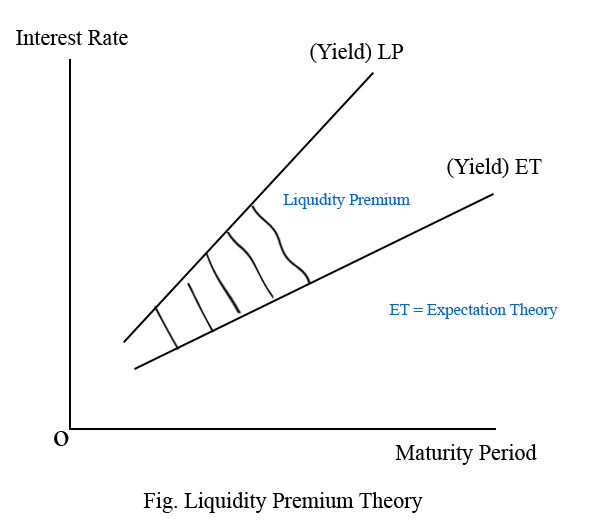
Here, the yield curve under the liquidity premium theory is above the yield curve under the expectation theory. The gap between them is the liquidity premium, and such a gap is increasing as the maturity period of the bond increases.
This implies that the longer the maturity period higher the risk and the higher the liquidity premium.
3) Market Segmentation Theory:
- Short-term and long term market are different
- No substitution between short-term and long term bond
- There is no relation between the maturity period and the interest rate
This theory argues that the short-term and long-term bond markets are completely different or segmented, and there is no substitution between the short-term and long-term bond.
There is a separate market demand and supply of short and long term bond, which determines their yield or interest rate. According to this theory, the investors have their own financial planning and goal and so, they invest in the bond according to their planning.
If the investor wants short-term return and cash flow, s/he invests in short term bond only.
Similarly, if the investor has long-term financial planning, then s/he invests in long term bond.
It means the short-term and long term bonds market are seperated and the return (yield) of the bonds depends on their market demand and supply ,but not on the maturity period.
So, we cannot establish the relationship between the interest rate andthe terms of the maturity period under this theory.
So, we can not derive yield curve.