सदर मुलुकीखानाको इतिहास
वि.सं. १९९० बैशाख ७ मा गठन भएको राणाकालीन प्रशासनमा केन्द्रिय बैङ्कको काम गर्ने निकायलाई सदर मुलुकी खाना भनिन्थ्यो । मुलुकी खानाको राजस्वको निकासी कौसी तोषाखानाबाट गरिन्थ्यो । नेपालमा पहिलो पटक वि.सं. २००२ असोज १ गते सदर मुलुकीखानाले ५, १० र १०० को कागजी नोट प्रचलनमा ल्याएको थियो। सदर मुलुकी खानाले निष्काशन गरेको नेपाली नोटलाई मोरु (मोहर रुपैयाँ) भनिन्थ्यो ।
पछि २०१३ सालमा नेपाल राष्ट्र बैङ्क स्थापना भयो र नोट तथा सिक्का छाप्ने काम गर्न थाल्यो र नेपाल राष्ट्र बैङ्क मार्फत छापिएका कागजी नोटहरू २०१६ साल फागुन ७ गतेबाट प्रचलनमा ल्याईयो ।
सदर मुलुकीखाना प्रमुखलाई खजाञ्ची भनिन्थ्यो। खजाञ्ची नियुक्ति राजगुरुको खलकबाट हुन्थ्यो ।
सदर मुलुकीखानाको कार्यहरू
१. विभिन्न सरकारी अड्डाबाट जम्मा गरिएको रकम, सुन, चादी र भारतीय मुद्रा नोटको सङ्कलन गर्नु
२. ब्रिटिस सरकारबाट वार्षिक रूपमा आउने रु. १० लाख दिल्लीमा रहने नेपाली वकिलको माध्यमबाट बुझी लिनु
३. दैनिक कामको लागि चल्ती ढुकुटीमा रु. १० लाख र रु. पाँच लाख (भारतीय मुद्रा) राख्नु र सबै जगेडा रकम तीन साँचा ढुकुटीमा राख्नु । (यो ढुकुटी मा तीन ताल्चा लगाइएको हुन्थ्यो र यसको साँचो खाजांची, तहबिल डिट्ठा र टहरीरसँग हुन्थ्यो )
४. कौशी तोषि खानाको आगी हरासंदा आदेश बमोजिम रकम निम्न कोषहरू व्यवस्था गर्नु :
* गुठि रकम
* चन्द्रबत्ति प्रकाश बिजुली रकम
* डेप्रिसियसन् बिजुली रकम
* निजामति कर्मचारी रकम
* रोपवे रकम
* महासमर सभा रकम
* त्रिचन्द्र हस्पिटल रकम
६.भारतीय तथा नेपाली मुद्राको सतही कायम गर्नु विनिमय दर १०० भारू=१२४ नेपाली रुपैया र ३% . (सटहीको लागि मुलुकीखानाको सरफखाना फाँटलाई जिम्मेवारी दिइन्थ्यो । )
– खजाञ्चीहरु
१.जनकराज पण्डित
२.भरतराज पण्डित
३.नरेन्द्रराज पण्डित
History of Sadar Mulukikhana
The central banking body in the Rana-era administration, formed on B.S. Baishakh 7, 1990 (April 19, 1933), was called the Sadar Mulukikhana. The Kausi Toshakhana handled the disbursement of Mulukikhana’s revenue. For the first time in Nepal, on B.S. Ashwin 1, 2002 (September 16, 1945), the Sadar Mulukikhana and printed paper banknotes of denominations 5, 10, and 100 were brought into circulation. The Nepali banknotes issued by the Sadar Mulukikhana were called Moru (Mohar Rupees).
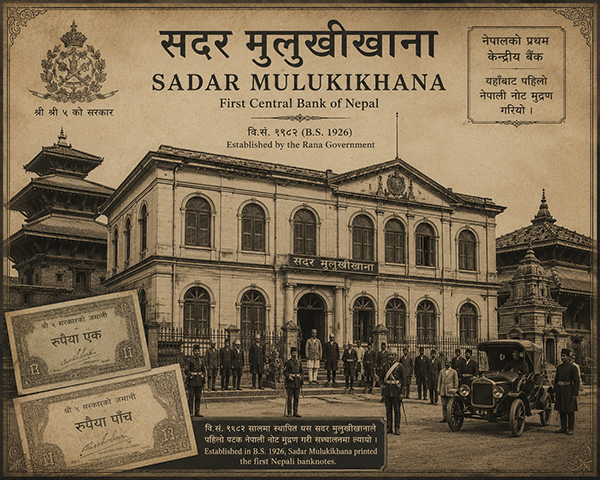
Later in the year B.S. 2013 (1956), Nepal Rastra Bank was established and took over the printing of banknotes and coins. Paper banknotes printed through Nepal Rastra Bank were brought into circulation starting from B.S. Phalgun 7, 2016 (February 19, 1960).
The head of the Sadar Mulukikhana was called the Khajanchi (Treasurer). The appointment of the Khajanchi was made from the lineage of the Rajguru (Royal Chief Priest).Functions of Sadar Mulukikhana: Collecting money, gold, silver, and Indian currency notes gathered from various government offices.
Receiving the annual sum of 1 million rupees provided by the British Government through the Nepali Vakil (envoy) stationed in Delhi.
Keeping 1 million Nepalese rupees and 500,000 Indian rupees in the current treasury for daily operations, and placing all reserve funds into the Teen Saancha Dhukuti (Three-Key Treasury). (This treasury was secured with three locks, and its keys were kept by the Khajanchi, Tahabil Dittha, and Tahrir).
Managing the following funds in order when the Kausi Toshakhana faced a deficit:
 Guthi Fund (Trust fund),Chandrabatti Prakash Bijuli Fund (Electricity fund),Depreciation Electricity Fund,Civil Servants Fund,Ropeway Fund,Mahasamar Sabha Fund (Great War Council fund),Tri-Chandra Hospital Fund.Maintaining the exchange rate between Indian and Nepali currencies at 100 INR = 124 NPR, with a 3% exchange fee.
(The Sarafkhana department of the Mulukikhana was given the responsibility for this exchange.
The Khajanchis (Treasurers):
 Janak Raj PanditBharat Raj PanditNarendra Raj Pandit