
- The structure of government revenue in Nepal shows the dominance of tax revenue, which is quite natural, implying that tax revenue is the largest share og the government revenue.
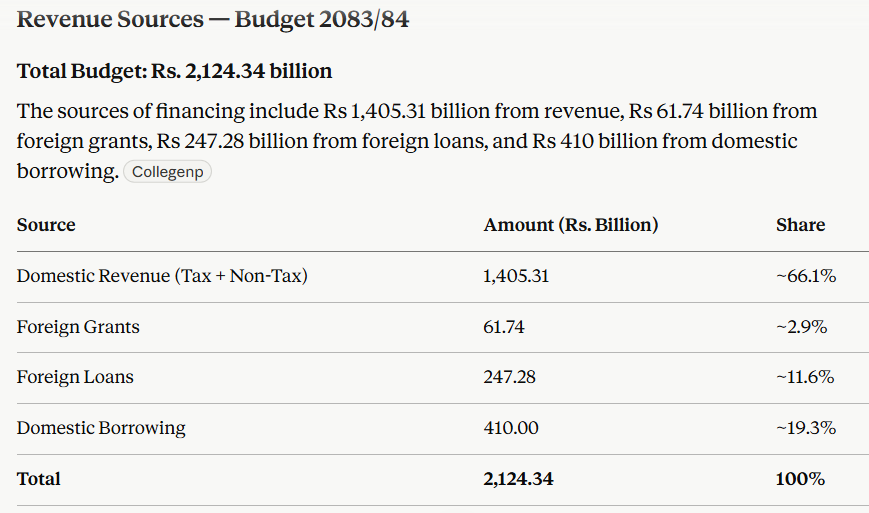
- In the total revenue, tax revenue and non-tax revenue contribute around 66%, and other sources are around 34% as per the budget 2083/84, as shown in the following table.
Revenue structure: the four pillars
Nepal’s budget is financed through four broad sources — domestic revenue, foreign grants, external loans, and domestic borrowing.
1. Domestic revenue (tax + non-tax)
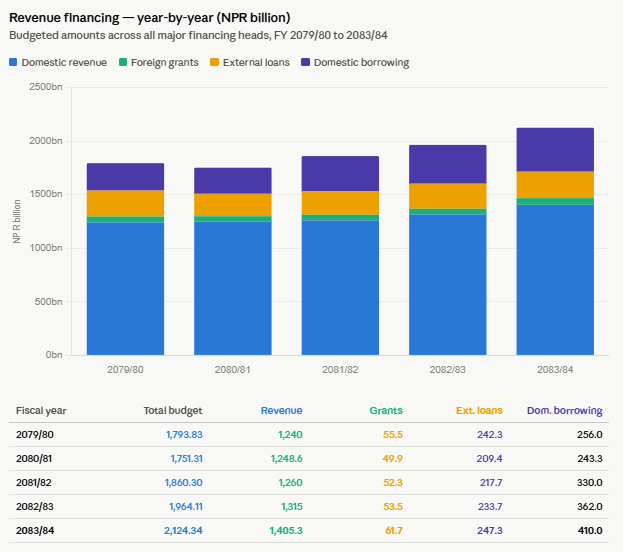
This is the backbone. Revenue collection was projected at Rs. 1,315 billion for 2082/83, and Rs. 1,405.31 billion is targeted for 2083/84 — the largest domestic revenue target in Nepal’s history. It consistently makes up 66–69% of the total budget.
Within domestic revenue, tax revenue dominates at roughly 90%+ of the pool. Key components are:
- VAT at 13% — the single largest revenue head. The VAT rate stays at 13%, but Budget 2083/84 introduced a 10% instant VAT refund for digital payments and a new 5% VAT levy on electricity consumption above 50 units and on ride-hailing services.
- Income and corporate tax — the second largest. The FY 2083/84 budget restructured personal income tax into a single unified schedule: 1% on income up to NPR 1,000,000, 10% on 1,000,001–1,500,000, 20% on 1,500,001–2,500,000, 27% on 2,500,001–4,000,000, and 29% above 4,000,000.
- Customs duty — simplified in 2083/84. The duty structure has been reduced from 11 tiers to seven, and customs duty has been cut on 273 types of industrial raw materials.
- Excise duty — excise duty on 360 goods has been abolished, though excise duty on cigarettes, liquor, and beer has been increased by up to approximately 10%.
- Non-tax revenue includes royalties (hydro, telecom), dividends from public enterprises, and service fees — accounting for roughly 10% of the domestic revenue pool.
2. Foreign grants
Only NPR 52.33 billion (2.81%) was projected from foreign grants in 2081/82 — a minimal portion that highlights the declining role of international aid in Nepal’s national financing, consistent with the government’s narrative of moving towards economic sovereignty. The figure rose to Rs. 61.74 billion, expected from foreign grant assistance in 2083/84.
3. External (foreign) loans
In 2079/80, foreign loans stood at NPR 242 billion. In 2080/81, loans and borrowing together were NPR 452.75 billion, and by 2082/83, Rs. 233.66 billion was sourced from foreign loans. The 2083/84 budget targets NPR 247.28 billion from external borrowing.
4. Domestic borrowing
This has been the fastest-growing component. In 2079/80, internal loans were NPR 256 billion, or 14.3% of the total budget. By 2083/84, domestic borrowing has climbed to NPR 410 billion — about 19.3% of the budget. However, since NPR 245.89 billion of existing domestic debt must be repaid during the same year, net new domestic borrowing is approximately NPR 164.11 billion.
Historical Revenue Actually Collected
Actual revenue collection has grown from NPR 0.405 trillion in 2071/72 to NPR 1.178 trillion in 2081/82 — an 11.33% increase that year alone, even though the initial target of NPR 1.419 trillion was revised down to NPR 1.286 trillion mid-year, of which 91.6% was achieved.
Key Structural Patterns
- Revenue targets are consistently over-ambitious. Nepal regularly revises targets downward mid-year and still achieves only 88–92% of revised targets, reflecting both optimistic planning and weak revenue administration.
- Tax reform is shifting the mix. The 2083/84 income tax cuts and customs simplification are expected to reduce direct tax collection in the short run, with the government betting on a broader, more compliant tax base to compensate.
- Borrowing fills the gap. The fiscal deficit — NPR 657 billion in 2083/84 — is financed entirely through debt. Nepal’s public debt now amounts to 44.61% of GDP, of which 20.93% is domestic debt and 23.69% is external borrowing.
- Grants are structurally declining as Nepal approaches and transitions out of Least Developed Country (LDC) status in 2026, which reduces concessional access to development finance.